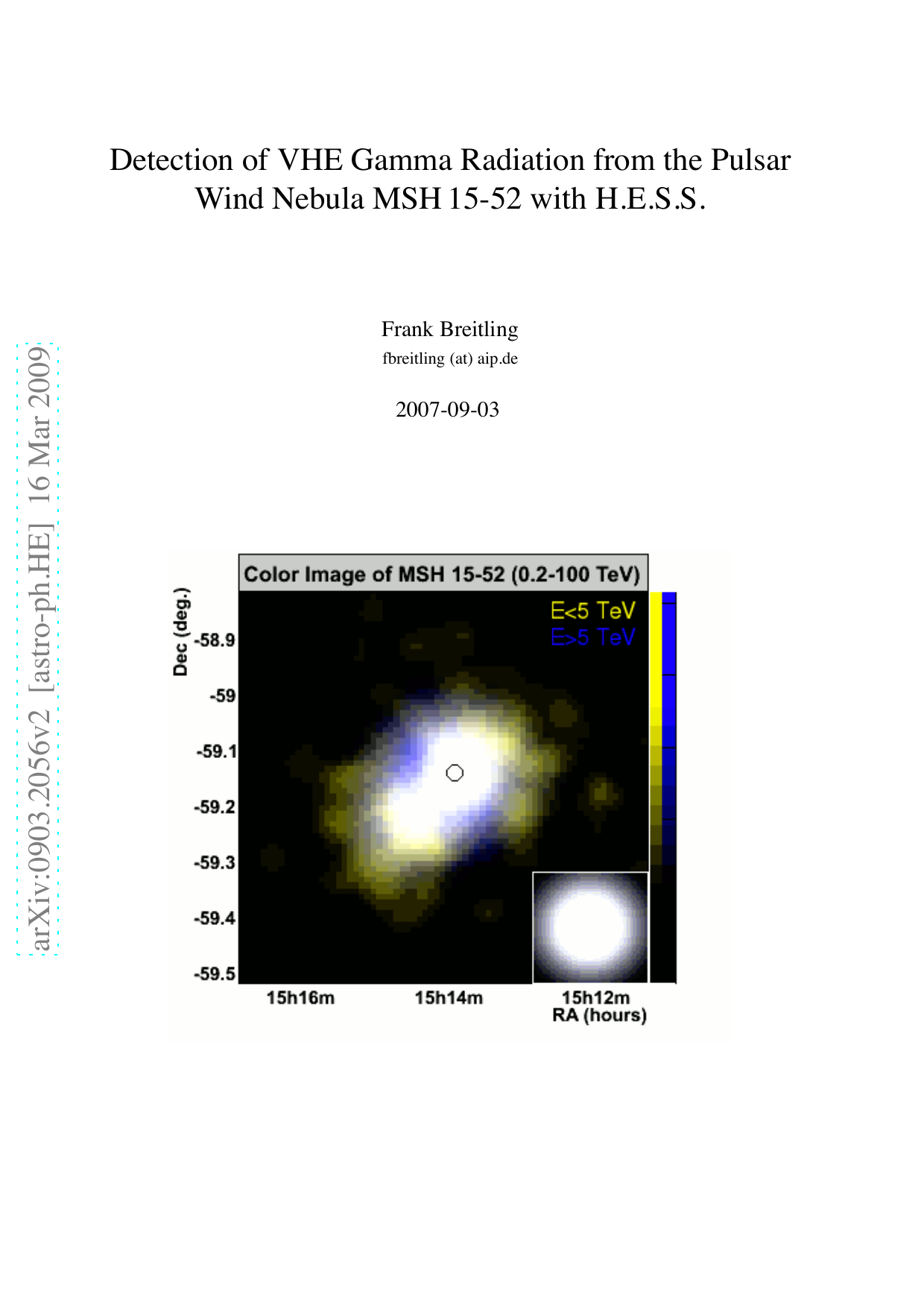
This work reports on the discovery of HESS J1514-591, a VHE gamma-ray source found at the pulsar wind nebula (PWN) MSH 15-52 and its associated pulsar PSR B1509-58. The discovery was made with the High Energy Stereoscopic System (H.E.S.S.), which currently provides the most sensitive measurement in the energy range of about 0.2-100 TeV. This analysis is the first to include all H.E.S.S. data from observations dedicated to MSH 15-52. The corresponding flux above 1 TeV is (4.4+/-0.2stat+/-1.0syst) x 10^{-12}cm^{-2}s^{-1}. The energy spectrum obeys a power-law with a differential flux at 1 TeV of (5.8+/-0.2stat+/-1.3syst) x 10^{-12}cm^{-2}s^{-1}TeV^{-1} and a photon index of 2.32+/-0.04stat+/-0.10syst. The gamma-ray emission extends along the pulsar jet, previously resolved in X-rays. This becomes more apparent after image deconvolution. The emission region along the jet axis decreases with increasing energy. An upper limit for the pulsed gamma-ray flux from PSR B1509-58 was calculated. Additional discussions include: the system of MSH 15-52 and PSR B1509-58, theory and methods of VHE gamma-ray astronomy and H.E.S.S., the first (Richardson-Lucy) deconvolution of VHE gamma-ray maps, search for pulsed emission from pulsars. The results are discussed within the framework of PWNs and are explained by inverse Compton scattering of leptons. A hadronic component is not excluded, but its gamma-ray emission would not be significant. Moreover, it is concluded that advection is the dominant transport mechanism over diffusion in the magnetized flow of the pulsar wind from PSR B1509-58. A correlation analysis with the Chandra X-ray data suggests that gamma radiation is emitted from the region of PSR B1509-58, but not from the neighboring optical nebula RCW 89.
Deep Dive into Detection of VHE Gamma Radiation from the Pulsar Wind Nebula MSH 15-52 with H.E.S.S.
This work reports on the discovery of HESS J1514-591, a VHE gamma-ray source found at the pulsar wind nebula (PWN) MSH 15-52 and its associated pulsar PSR B1509-58. The discovery was made with the High Energy Stereoscopic System (H.E.S.S.), which currently provides the most sensitive measurement in the energy range of about 0.2-100 TeV. This analysis is the first to include all H.E.S.S. data from observations dedicated to MSH 15-52. The corresponding flux above 1 TeV is (4.4+/-0.2stat+/-1.0syst) x 10^{-12}cm^{-2}s^{-1}. The energy spectrum obeys a power-law with a differential flux at 1 TeV of (5.8+/-0.2stat+/-1.3syst) x 10^{-12}cm^{-2}s^{-1}TeV^{-1} and a photon index of 2.32+/-0.04stat+/-0.10syst. The gamma-ray emission extends along the pulsar jet, previously resolved in X-rays. This becomes more apparent after image deconvolution. The emission region along the jet axis decreases with increasing energy. An upper limit for the pulsed gamma-ray flux from PSR B1509-58 was calculated. A
"We owe our existence to stars, because they make the atoms of which we are formed. So if you are romantic you can say we are literally starstuff. If you're less romantic you can say we're the nuclear waste from the fuel that makes stars shine.
We’ve made so many advances in our understanding. A few centuries ago, the pioneer navigators learnt the size and shape of our Earth, and the layout of the continents. We are now just learning the dimensions and ingredients of our entire cosmos, and can at last make some sense of our cosmic habitat." -Sir Martin Rees, British astrophysicist and president of the Royal Society Astronomy is and always has been a central discipline of natural science, driven by fundamental questions and exiting answers. The first recorded astronomical achievements date back to early cultures such as the Babylonians, Egyptians and Chinese. Further progress was made in the Renaissance, when the heliocentric model of the solar system was proposed by Nicolaus Copernicus, Galileo Galilei and Johannes Kepler. The use of the telescope for astronomic observations by Galilei marks the beginning of experimental astronomy. Since then, astronomy has evolved rapidly. For example, the introduction of spectroscopy and photography by Joseph Fraunhofer in 1814 laid the foundations for a “New Astronomy” and astrophysics by providing the means for determining the chemical composition of astronomical objects. Moreover, it paved the way for the determination of red shifts by Vesto Slipher in 1912, which allowed for such far-reaching conclusions as the expansion of the universe by Hubble in 1929. An astrophysical revolution began in the second half of the 20th century, when new types of telescopes became available, owed to technological advances, with which the full range of the electromagnetic spectrum could be explored. Radio telescopes permitted the discovery of the cosmic microwave background radiation in 1965 and pulsars in 1967, both of which were honored with the Nobel prize; infrared telescopes revealed the view through vast dust clouds to previously hidden objects; X-and γ-ray satellites provided pictures of the non-thermal universe and its most violent processes, such as γ-ray bursts first observed in 1967, active galactic nuclei or super nova remnants; also new experiments in the rising field of astroparticle physics provided fresh insights into the non-thermal universe, e.g. Kamiocande, the Irvine-Michigan-Brookhaven detector and the scintillator experiment at Baksan by the detection of neutrinos from the supernova SN 1987A. Although these examples only name some of astrophysical milestones, they CHAPTER 1 Introduction demonstrate that the exploration of new fields of astronomy can lead to outstanding discoveries with great impact on the understanding of the universe.
In this respect, imaging atmospheric Cherenkov telescopes (IACT) have been developed for the exploration of the very high energy (VHE) γ-ray sky which extends from 10 GeV to 100 TeV. Therefore, IACTs currently provide a window to the highest available γ-ray energies. Since this γ radiation is produced where highly accelerated particles interact with their environment, TeV γ radiation provides important information about the acceleration mechanisms for the primary particles. In comparison, γ-ray astronomy using IACTs is a relatively young field which achieved its breakthrough in 1989 with the discovery of TeV γ radiation from the Crab Nebula by the Whipple collaboration. Since then, IACT based γ astronomy has progressed significantly. While it took several weeks for the first detection of the Crab Nebula which is known as the strongest TeV γ-ray source, nowadays IACTs can detect the Crab Nebula within less than a minute. Moreover, while previously only a handful of TeV sources could be detected, today about 50 TeV γ-ray sources have been established and almost monthly the detection of a new source is reported. Many of these new detections are owed to the High Energy Stereoscopic System (H.E.S.S.), which is currently one of the most sensitive IACTs worldwide. During its first few years of operation, starting in 2002, H.E.S.S. has detected or confirmed more than 40 sources of TeV γ radiation (cf. Hofmann [2005] and Aharonian et al. [2005c]).
One of these sources is the pulsar wind nebula (PWN) MSH 15-52, at a distance of about 5.2 kpc from earth. PWNs, also called Plerions, are very unique but also very rare objects of which only about 50 have been identified, all within the Galaxy. The central object in a PWN is a pulsar which exposes extreme condition to its environment and generates γ radiation in its vicinity, in particular by the emission of a wind of VHE particles. The pulsar associated with MSH 15-52 is PSR B1509-58, which is one of the most energetic pulsars known. Many observations of MSH 15-52 have been conducted from radio to γ-ray energies since its discovery in 1961. They have shed light on the violent emission processes
…(Full text truncated)…
This content is AI-processed based on ArXiv data.