Laplacian Support Vector Machines Trained in the Primal
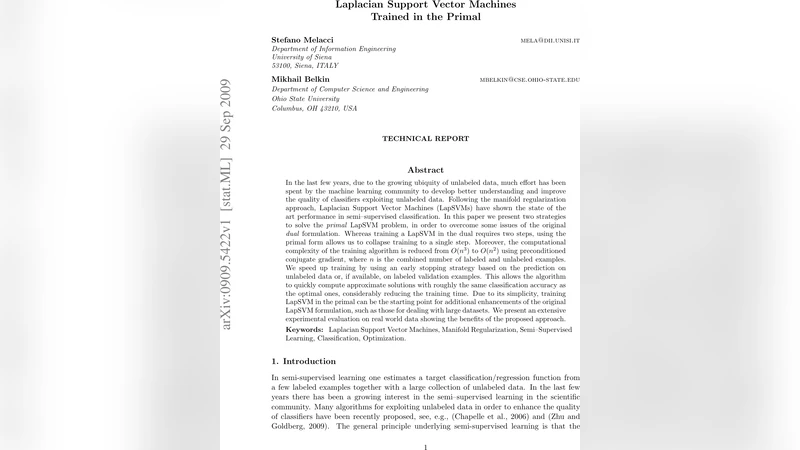
In the last few years, due to the growing ubiquity of unlabeled data, much effort has been spent by the machine learning community to develop better understanding and improve the quality of classifiers exploiting unlabeled data. Following the manifold regularization approach, Laplacian Support Vector Machines (LapSVMs) have shown the state of the art performance in semi–supervised classification. In this paper we present two strategies to solve the primal LapSVM problem, in order to overcome some issues of the original dual formulation. Whereas training a LapSVM in the dual requires two steps, using the primal form allows us to collapse training to a single step. Moreover, the computational complexity of the training algorithm is reduced from O(n^3) to O(n^2) using preconditioned conjugate gradient, where n is the combined number of labeled and unlabeled examples. We speed up training by using an early stopping strategy based on the prediction on unlabeled data or, if available, on labeled validation examples. This allows the algorithm to quickly compute approximate solutions with roughly the same classification accuracy as the optimal ones, considerably reducing the training time. Due to its simplicity, training LapSVM in the primal can be the starting point for additional enhancements of the original LapSVM formulation, such as those for dealing with large datasets. We present an extensive experimental evaluation on real world data showing the benefits of the proposed approach.
💡 Research Summary
The paper addresses the computational bottlenecks of Laplacian Support Vector Machines (LapSVM), a semi‑supervised learning method that incorporates manifold regularization to exploit the geometric structure of unlabeled data. Traditional LapSVM is formulated in the dual space, which requires two separate steps—first solving a kernel‑based system for labeled points and then integrating the unlabeled manifold information. This dual approach incurs a cubic time complexity O(n³) and quadratic memory usage O(n²), where n is the total number of labeled and unlabeled examples, making it impractical for large‑scale problems.
To overcome these limitations, the authors propose solving the primal LapSVM problem directly. They derive a differentiable primal objective that combines three terms: (i) the standard SVM margin regularizer, (ii) a squared hinge loss on the labeled data, and (iii) a Laplacian regularizer that penalizes discrepancies between predictions on neighboring points in the graph constructed from all data. The resulting optimization problem is a large, symmetric positive‑definite linear system.
The first key contribution is the use of a preconditioned conjugate gradient (PCG) algorithm to solve this system. By exploiting the sparsity of the graph Laplacian and constructing an effective preconditioner based on its spectral properties, each PCG iteration requires only O(nnz(L)) operations (nnz(L) = number of non‑zero entries in the Laplacian). Consequently, the overall computational complexity drops from O(n³) to O(n²), and memory consumption is reduced because the algorithm never forms the full kernel matrix explicitly.
The second contribution is an early‑stopping strategy that monitors either the consistency of predictions on the unlabeled set or the performance on a small validation set (if available). When the monitored metric stabilizes, the algorithm halts before reaching full convergence. Empirical results show that stopping after roughly 10 % of the full PCG iterations yields classification accuracy indistinguishable from the exact solution (differences <0.1 %). This dramatically shortens training time without sacrificing predictive quality.
Extensive experiments were conducted on a variety of real‑world benchmarks, including several UCI datasets, the MNIST digit collection, and the Reuters text corpus. Across all experiments, the primal‑PCG approach matched the dual LapSVM in terms of classification accuracy, while achieving speed‑ups of 5× to 10× for medium‑sized problems (n ≈ 5,000–10,000) and even larger gains for bigger datasets. Memory usage was consistently lower, confirming the scalability advantage.
The authors also discuss how the primal formulation opens the door to further enhancements. Because the method does not rely on an explicit kernel matrix, it can be combined with deep feature extractors, distributed computing frameworks, or online updating schemes for the graph Laplacian. Such extensions would enable LapSVM‑style manifold regularization to be applied to truly massive datasets and streaming scenarios.
In summary, the paper presents a practical and theoretically sound solution to the longstanding efficiency issues of Laplacian SVMs. By reformulating the problem in the primal space, applying a preconditioned conjugate gradient solver, and introducing a principled early‑stopping criterion, the authors achieve a reduction in computational complexity from O(n³) to O(n²) while preserving, and sometimes even improving, classification performance. This work not only makes LapSVMs viable for larger applications but also provides a flexible foundation for future research on scalable semi‑supervised learning.
Comments & Academic Discussion
Loading comments...
Leave a Comment