Errors-in-variables models: a generalized functions approach
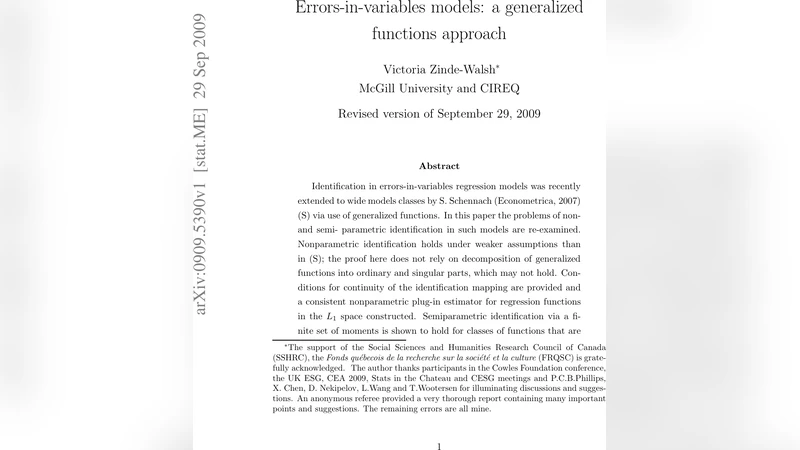
Identification in errors-in-variables regression models was recently extended to wide models classes by S. Schennach (Econometrica, 2007) (S) via use of generalized functions. In this paper the problems of non- and semi- parametric identification in such models are re-examined. Nonparametric identification holds under weaker assumptions than in (S); the proof here does not rely on decomposition of generalized functions into ordinary and singular parts, which may not hold. A consistent nonparametric plug-in estimator for regression functions in the space of absolutely integrable functions constructed. Semiparametric identification via a finite set of moments is shown to hold for classes of functions that are explicitly characterized; unlike (S) existence of a moment generating function for the measurement error is not required.
💡 Research Summary
This paper revisits identification and estimation in errors‑in‑variables (EIV) regression models using the framework of generalized functions (distributions). Building on Schennach (2007), which employed a decomposition of generalized functions into regular and singular parts, the author shows that such a decomposition is not necessary and may even fail to exist in many practical settings. By exploiting the continuity properties of generalized functions and the behavior of characteristic functions, the paper establishes non‑parametric identification under substantially weaker conditions.
The core model assumes an observed variable (Y = X + U), where (X) is the latent regressor and (U) is measurement error independent of (X). Let (\phi_Y(t)), (\phi_X(t)), and (\phi_U(t)) denote the characteristic functions of (Y), (X), and (U) respectively. The key assumption is that (\phi_U(t)) does not vanish on a non‑trivial interval (\mathcal{T}\subset\mathbb{R}) and is sufficiently smooth. Under this modest requirement, the identity (\phi_X(t)=\phi_Y(t)/\phi_U(t)) holds as an equality of generalized functions in (\mathcal{S}’). No global moment‑generating function (MGF) for (U) is needed; the existence of an MGF was a central hypothesis in Schennach’s work. By applying the inverse Fourier transform to (\phi_X(t)), the latent regression function (g(\cdot)) can be recovered uniquely, establishing non‑parametric identification.
For semiparametric identification, the paper considers a parametric family (g(x;\theta)) and shows that a finite set of moment conditions of the form (\mathbb{E}
Comments & Academic Discussion
Loading comments...
Leave a Comment