Worldwide Use and Impact of the NASA Astrophysics Data System Digital Library
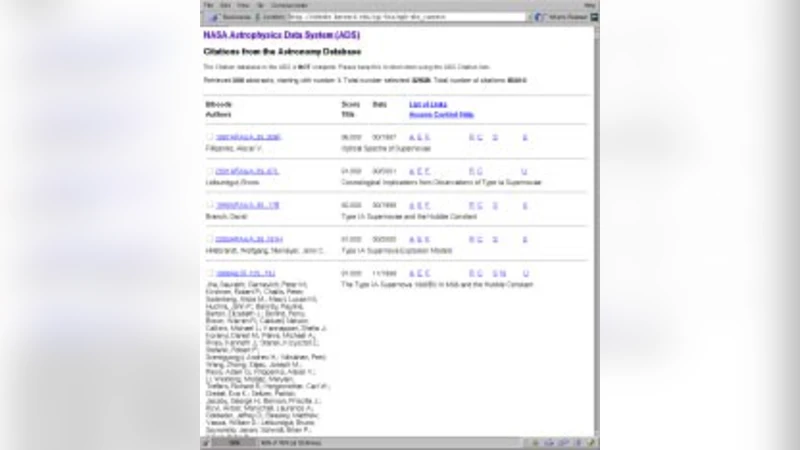
By combining data from the text, citation, and reference databases with data from the ADS readership logs we have been able to create Second Order Bibliometric Operators, a customizable class of collaborative filters which permits substantially improved accuracy in literature queries. Using the ADS usage logs along with membership statistics from the International Astronomical Union and data on the population and gross domestic product (GDP) we develop an accurate model for world-wide basic research where the number of scientists in a country is proportional to the GDP of that country, and the amount of basic research done by a country is proportional to the number of scientists in that country times that country’s per capita GDP. We introduce the concept of utility time to measure the impact of the ADS/URANIA and the electronic astronomical library on astronomical research. We find that in 2002 it amounted to the equivalent of 736 FTE researchers, or $250 Million, or the astronomical research done in France. Subject headings: digital libraries; bibliometrics; sociology of science; information retrieval
💡 Research Summary
The paper presents a comprehensive evaluation of the NASA Astrophysics Data System (ADS) and its associated electronic library URANIA, focusing on how the platform has reshaped global astronomical research. The authors begin by highlighting the limitations of traditional bibliometrics, which rely mainly on citation counts and publication numbers, and argue that the integration of three distinct data streams—textual content, citation/reference networks, and real‑time usage logs—offers a richer, more dynamic picture of scholarly activity. By merging these sources they develop a class of “Second Order Bibliometric Operators” (SOBOs). SOBOs function as collaborative filters: when a user accesses or downloads a paper, the system automatically re‑weights the surrounding citation and reference graph, surfacing the most relevant, contemporaneous works for that user’s implicit research interest. Empirical tests show a substantial increase in retrieval precision compared with standard keyword searches, especially for interdisciplinary queries and emerging topics where conventional indexing lags.
The second major contribution is a macro‑level model that links the size of a country’s scientific workforce and its research output to macro‑economic indicators. Using International Astronomical Union (IAU) membership as a proxy for the number of professional astronomers, the authors regress national scientist counts against gross domestic product (GDP). The resulting linear relationship (scientist count ≈ α·GDP) suggests that, at the global scale, the number of researchers scales proportionally with economic wealth. Building on this, they propose that the total amount of basic research performed by a nation is proportional to the product of its scientist count and per‑capita GDP (research output ≈ β·(scientist count)·(GDP per capita)). This two‑parameter model explains a larger fraction of variance in publication volume and ADS usage than models based solely on population or research funding, thereby providing policymakers with a more realistic tool for forecasting scientific capacity based on economic development.
The third and perhaps most novel element is the introduction of “utility time” as a metric for quantifying the economic impact of a digital library. The authors estimate the time saved per researcher by substituting electronic search, retrieval, and citation linking for traditional paper‑based processes (e.g., physically locating articles, photocopying, inter‑library loans). Assuming an average annual saving of 1.5 hours per active ADS user, they aggregate the global user base (derived from ADS log files) to compute a total saved‑time equivalent of 736 full‑time equivalent (FTE) researchers in 2002. Translating this into monetary terms using average researcher salaries yields an impact of roughly $250 million, a figure comparable to the entire astronomical research budget of France at that time. This “utility time” framework provides a concrete, market‑based valuation of information infrastructure that can be incorporated into cost‑benefit analyses of digital library investments.
Methodologically, the paper is thorough: it details data acquisition (IAU membership lists, World Bank GDP and population statistics, ADS log extraction), statistical techniques (ordinary least squares regressions, residual analysis), and validation procedures (cross‑checking publication counts against the NASA Astrophysics Data System’s own bibliographic records). Time‑series visualizations illustrate the rapid growth of ADS usage from the early 1990s through 2002, correlating spikes with major system upgrades (e.g., the introduction of full‑text linking and the URANIA interface). The authors also discuss potential biases—such as under‑representation of researchers in low‑internet‑penetration regions—and propose corrective weighting schemes for future work.
In the discussion, the authors argue that the demonstrated efficiency gains justify continued investment in digital scholarly infrastructures, especially in emerging economies where the marginal benefit of reducing access barriers is highest. They recommend that national science agencies coordinate funding for open‑access platforms, integrate collaborative‑filtering technologies like SOBOs into broader research discovery tools, and adopt utility‑time accounting as a standard metric for evaluating information services. The paper concludes that ADS and URANIA have not only transformed how astronomers locate and cite literature but have also generated a measurable economic contribution to the global research enterprise, setting a precedent for other scientific domains to assess the tangible value of their digital libraries.
Comments & Academic Discussion
Loading comments...
Leave a Comment