A grid of polarization models for Rayleigh scattering planetary atmospheres
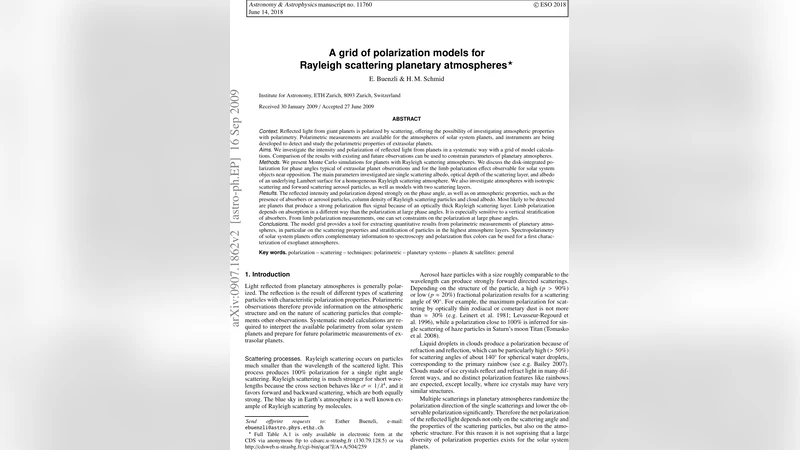
We investigate the intensity and polarization of reflected light from planetary atmospheres. We present a large grid of Monte Carlo simulations for planets with Rayleigh scattering atmospheres. We discuss the disk-integrated polarization for phase angles typical of extrasolar planet observations and for the limb polarization effect observable for solar system objects near opposition. The main parameters investigated are single scattering albedo, optical depth of the scattering layer, and albedo of an underlying Lambert surface for a homogeneous Rayleigh scattering atmosphere. We also investigate atmospheres with isotropic scattering and forward scattering aerosol particles, as well as models with two scattering layers. The model grid provides a tool for extracting quantitative results from polarimetric measurements of planetary atmospheres from solar system planets and extrasolar planets, in particular on the scattering properties and stratification of particles in the highest atmosphere layers. Spectropolarimetry of solar system planets offers complementary information to spectroscopy and polarization flux colors can be used for a first characterization of exoplanet atmospheres. From limb polarization measurements, one can set constraints on the polarization at large phase angles.
💡 Research Summary
The paper presents a comprehensive grid of Monte Carlo radiative‑transfer simulations designed to predict the intensity and linear polarization of starlight reflected by planetary atmospheres in which Rayleigh scattering dominates. The authors systematically vary three fundamental atmospheric parameters: (i) the single‑scattering albedo (ω₀) ranging from 0.1 to 1.0, (ii) the optical depth of the scattering layer (τ) from 0.1 to 10, and (iii) the albedo of an underlying Lambertian surface (A_s) from 0 to 1. By sampling phase angles (α) from 0° (full illumination) to 180° (full night) in 5° increments, they compute disk‑integrated Stokes I, Q, and U for each model, thus providing phase‑dependent polarization curves that are directly comparable to observations of both Solar‑System bodies and directly imaged exoplanets.
Key findings for the homogeneous Rayleigh‑scattering case are as follows. The polarization degree P reaches its maximum near α≈90°, where the scattering geometry is most favorable. For optically thin atmospheres (τ ≲ 1) the maximum P can exceed 30 % when ω₀≈1 and the surface is dark (A_s≈0). Increasing τ strengthens multiple scattering, which reduces P (by up to a factor of three for τ≈10) while simultaneously boosting the reflected intensity I. Raising the surface albedo adds unpolarized light, further suppressing P even if the atmospheric scattering remains strong. Thus, a clear trade‑off exists between brightness and polarization that can be exploited to infer atmospheric opacity and surface reflectivity from combined photometric‑polarimetric data.
The authors extend the grid to non‑Rayleigh scattering regimes. An isotropic scattering layer (Henyey–Greenstein asymmetry parameter g = 0) reproduces the overall shape of the Rayleigh polarization curve but with a modest reduction in peak P (≈5 % lower). In contrast, a forward‑scattering aerosol layer (g≈0.7) dramatically enhances reflected intensity at small phase angles and suppresses polarization across the entire phase range, reflecting the dominance of forward‑directed photons that retain little linear polarization. These results demonstrate that the wavelength‑dependent polarization color (i.e., the variation of P with λ) can serve as a diagnostic of particle size and composition, because larger or more absorbing particles tend to shift the scattering phase function toward the forward direction.
Two‑layer models are also investigated. By placing a thin Rayleigh‑scattering upper slab (τ₁≈0.5, ω₀₁≈1) above a thicker, more absorbing lower slab (τ₂≈5, g≈0.6), the authors show that the upper layer imprints a high‑P signature that is partially erased by the lower layer’s multiple scattering. When the upper layer is much more opaque than the lower one (τ₁≫τ₂), the polarization is essentially set by the upper slab, while the lower slab mainly modulates the total reflected flux. This layered approach mimics realistic planetary atmospheres that contain high‑altitude hazes over deeper cloud decks, and it highlights how the observed polarization phase curve can encode information about vertical stratification.
From an observational perspective, the grid provides two practical applications. First, the “limb polarization” effect—enhanced polarization near the planetary terminator observed at opposition for Solar‑System planets—is reproduced and linked to the Rayleigh optical depth of the upper atmosphere. Measurements of limb polarization can therefore constrain the same parameters that govern large‑phase‑angle polarization, offering a complementary diagnostic. Second, for directly imaged exoplanets, the phase angles accessible to current high‑contrast instruments (≈30°–150°) fall within the region where the model predicts strong sensitivity of P to ω₀, τ, and A_s. By combining broadband photometry with spectropolarimetry, one can retrieve not only the overall albedo but also the wavelength‑dependent polarization, enabling a first‑order classification of exoplanet atmospheres (e.g., clear Rayleigh‑dominated, hazy, or aerosol‑rich).
The paper acknowledges several limitations. All Rayleigh calculations assume spherical, non‑absorbing molecules; real atmospheres may contain anisotropic particles, molecular absorption bands, or non‑Lambertian surfaces, which are not captured in the present grid. Moreover, the simulations are monochromatic; extending the grid to full spectra will be necessary for detailed comparison with upcoming instruments such as VLT/SPHERE, JWST/NIRCam, and future space‑based polarimeters. The authors propose that Bayesian retrieval frameworks, seeded with this grid, could be used to fit observed Stokes parameters and extract posterior distributions for ω₀, τ, g, and A_s, thereby turning polarimetric measurements into quantitative probes of atmospheric composition and vertical structure.
In summary, the authors deliver an extensive, publicly available model library that links atmospheric scattering properties to observable intensity and polarization signatures. The grid bridges the gap between theory and observation, offering a powerful tool for interpreting both Solar‑System limb‑polarization data and exoplanet phase‑curve polarimetry, and it sets the stage for more sophisticated multi‑layer, multi‑wavelength polarimetric analyses in the era of high‑precision exoplanet characterization.
Comments & Academic Discussion
Loading comments...
Leave a Comment