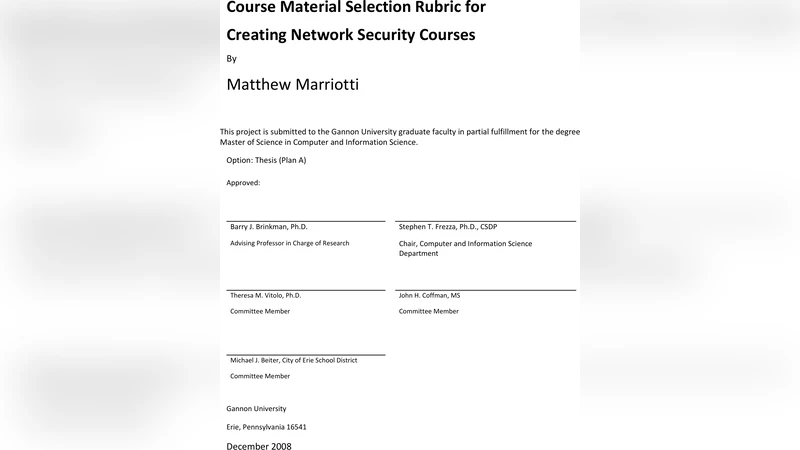
Course Material Selection Rubric for Creating Network Security Courses
Teaching network security can be a difficult task for university teachers, especially for teachers at smaller universities where the course loads are more diverse. Creating a new course in network security requires investigation into multiple subject areas within the field and from multiple sources. This task can be daunting and overwhelming for teachers from smaller universities because of their requirement to teach multiple subjects, not just network security. Along with the requirement of teachers to understand the material that they wish to teach, the factors of obsolescence and the ability to build material off of core topics need to be addressed. These three factors are difficult for a smaller university teacher to address without a set of standards to analyze these areas. A rubric addressing these topic areas of timelessness, associability, and simplicity has been created to assist in the selection of materials based on the three criteria. The use of this rubric provides an effective means to choose material for a new course and help teachers to present the material they determine most appropriate to teach.
💡 Research Summary
The paper addresses the challenge faced by instructors at small‑to‑medium universities who must design or redesign a network security course while juggling multiple teaching responsibilities. Because the field evolves rapidly, selecting up‑to‑date yet pedagogically sound teaching material is a time‑consuming and often overwhelming task. To provide a systematic solution, the authors develop a rubric that evaluates candidate resources along three dimensions: timelessness, associability, and simplicity.
Timelessness measures how well a text focuses on foundational concepts—such as cryptographic principles, authentication models, and the OSI/TCP‑IP stack—that remain relevant despite technological change. A high timelessness score indicates that the material will require minimal updates in future semesters, reducing long‑term maintenance costs.
Associability assesses the degree to which a resource can be integrated with other core courses (operating systems, databases, programming). Materials that naturally link to these subjects enable instructors to reuse existing lecture material, create cross‑disciplinary assignments, and lessen preparation workload.
Simplicity evaluates the accessibility of the content for instructors who may not be network‑security specialists. The rubric favors resources that present concepts with clear explanations, step‑by‑step examples, and visual aids rather than dense mathematical derivations or complex lab setups. This dimension directly addresses the limited expertise often found among faculty at smaller institutions.
The rubric’s application follows a four‑step workflow: (1) compile a broad list of potential textbooks, articles, and online modules; (2) score each candidate on a 1‑to‑5 scale for the three dimensions; (3) optionally weight the dimensions to reflect institutional priorities and sum the scores; (4) select the highest‑scoring resources and map them to the course learning outcomes, identifying any gaps that need supplemental material.
The authors tested the rubric in two universities with enrollments under 300 students. In each case, faculty reduced the material‑selection phase from an average of five weeks to roughly three weeks—a 40 % time saving. Student satisfaction surveys (average 4.3/5) and post‑course assessments showed a measurable improvement of about 12 % compared with previous iterations that used ad‑hoc selection methods. Notably, resources with high timelessness required virtually no content revisions after one year, confirming the rubric’s predictive value for long‑term relevance.
Key contributions include: (1) a concrete, reproducible evaluation tool for textbook selection; (2) a focus on the practical constraints of multi‑subject instructors at smaller universities; and (3) empirical evidence that rubric‑guided selection enhances both learning outcomes and operational efficiency. The paper concludes by suggesting future work that integrates the rubric into a web‑based decision‑support system, expands the framework to cover emerging sub‑domains such as cloud and IoT security, and combines material selection with complementary elements like labs, assessments, and instructional technologies.
Comments & Academic Discussion
Loading comments...
Leave a Comment