Updating Quantum Cryptography Report ver. 1
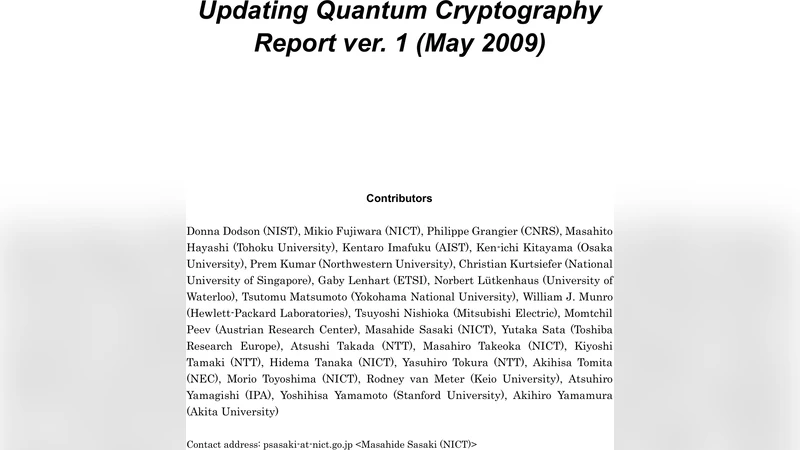
Quantum cryptographic technology (QCT) is expected to be a fundamental technology for realizing long-term information security even against as-yet-unknown future technologies. More advanced security could be achieved using QCT together with contemporary cryptographic technologies. To develop and spread the use of QCT, it is necessary to standardize devices, protocols, and security requirements and thus enable interoperability in a multi-vendor, multi-network, and multi-service environment. This report is a technical summary of QCT and related topics from the viewpoints of 1) consensual establishment of specifications and requirements of QCT for standardization and commercialization and 2) the promotion of research and design to realize New-Generation Quantum Cryptography.
💡 Research Summary
The report “Updating Quantum Cryptography Report ver. 1” provides a comprehensive technical overview of quantum cryptographic technology (QCT) and outlines a roadmap for its standardization, interoperability, and integration with contemporary cryptographic methods. It begins by emphasizing the strategic importance of QCT as a long‑term security solution capable of withstanding future, possibly unknown, computational advances such as large‑scale quantum computers. The authors argue that to move QCT from laboratory prototypes to commercial deployment, a coordinated effort is required to define device specifications, protocol stacks, and security requirements that can be universally adopted across multiple vendors, networks, and services.
The document is organized into several key sections. The first section details hardware standardization. It enumerates the essential components—single‑photon sources, high‑efficiency detectors (e.g., superconducting nanowire single‑photon detectors), quantum channels (optical fiber, free‑space, satellite links), and supporting control electronics (temperature, voltage, vibration isolation). For each component, the report proposes measurable parameters such as wavelength tolerance, detection efficiency, dark‑count rate, and calibration procedures. By codifying these parameters, the authors aim to ensure that equipment from different manufacturers can interoperate without performance degradation.
The second section focuses on protocol architecture. A layered model is introduced: the physical layer supports a variety of QKD schemes (BB84, B92, continuous‑variable QKD, measurement‑device‑independent QKD) with standardized interfaces; the error‑correction and privacy‑amplification layer adopts modern coding techniques such as low‑density parity‑check (LDPC) and Polar codes; the authentication and key‑management layer proposes a hybrid framework that combines quantum‑generated keys with classical public‑key infrastructures (PKI) and post‑quantum cryptographic (PQC) algorithms. This hybrid approach guarantees continuity of security even when the quantum channel experiences temporary outages or performance drops.
Security requirements are quantified in the third section. The authors introduce a system‑security parameter ε to express the allowable information leakage in practical implementations. They present a risk‑assessment model that accounts for realistic attack vectors, including detector side‑channel attacks, Trojan‑horse attacks, and measurement‑device tampering. The report also calls for independent third‑party certification labs to verify compliance with the defined standards, thereby providing an objective trust anchor for end‑users.
Interoperability across multi‑vendor, multi‑network, and multi‑service environments is addressed in the fourth section. The authors define a set of standard APIs, data serialization formats (JSON, CBOR), and key‑exchange mechanisms that enable seamless integration of QCT into existing cloud, edge, and Internet‑of‑Things (IoT) infrastructures. A “Quantum Security Service Layer” is proposed to abstract the underlying quantum hardware, allowing service providers to offer quantum‑enhanced security as a plug‑and‑play capability for diverse applications such as finance, healthcare, and critical national infrastructure.
The final technical section outlines research and development priorities for the next generation of quantum cryptography. Key challenges identified include the development of high‑rate, low‑noise single‑photon sources; real‑time error‑correction algorithms that can operate at gigabit‑per‑second speeds; quantum memory and routing devices necessary for building quantum networks; and seamless integration of QCT with PQC to create a unified security stack. The authors stress the importance of international collaboration through standards bodies (ISO/IEC, ITU), joint industry‑academia programs, and pilot testbeds to accelerate technology transfer and commercialization.
In conclusion, the report asserts that standardization and interoperability are the linchpins for realizing a robust, vendor‑agnostic quantum‑secure ecosystem. By establishing clear hardware specifications, protocol interfaces, and security metrics, QCT can be deployed alongside existing cryptographic solutions, delivering enhanced protection for critical data over the coming decade. The authors project that, within 5–10 years, quantum‑derived keys will become a foundational element of security services across sectors such as finance, defense, telecommunications, and cloud computing.
Comments & Academic Discussion
Loading comments...
Leave a Comment