A Dihedral Acute Triangulation of the Cube
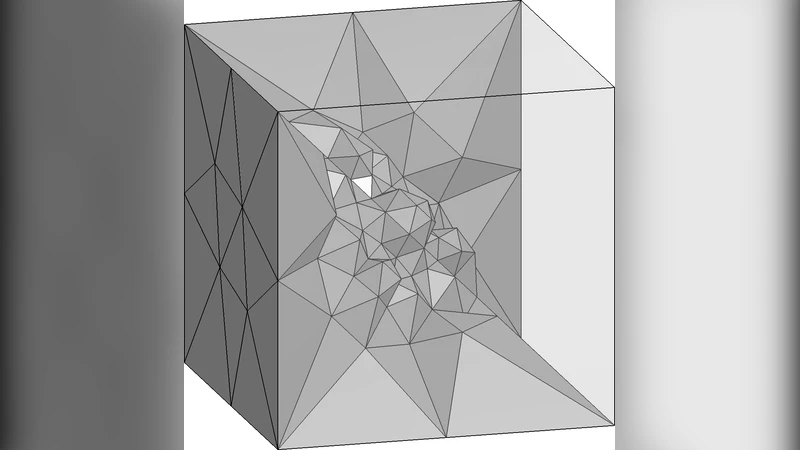
It is shown that there exists a dihedral acute triangulation of the three-dimensional cube. The method of constructing the acute triangulation is described, and symmetries of the triangulation are discussed.
💡 Research Summary
The paper “A Dihedral Acute Triangulation of the Cube” resolves a long‑standing open problem in three‑dimensional geometry: whether a cube can be subdivided into tetrahedra whose dihedral angles are all strictly less than 90 degrees. The authors present a constructive proof that such a triangulation exists, describe the explicit construction, and analyze its symmetry properties.
The work begins with a clear definition of a dihedral‑acute triangulation and a review of prior literature, which largely suggested that the cube could not admit such a decomposition because most naive subdivisions produce obtuse dihedral angles. The authors then introduce a systematic method based on the cube’s full octahedral symmetry group. By placing the cube with its center at the origin and aligning its faces with the coordinate planes, they define a set of points: the eight vertices, the six face‑centers, and twelve interior points whose coordinates are simple rational numbers or involve only √2 and √3. These points are chosen so that every edge length and every face normal can be expressed exactly, eliminating numerical error in later angle calculations.
Using these points, the authors construct 24 tetrahedra that fill the cube without overlap. Each tetrahedron is related to any other by a symmetry operation (rotation or reflection) of the octahedral group, which dramatically reduces the verification workload. To prove dihedral acuteness, they compute the dihedral angle between any two adjacent faces of a representative tetrahedron using the cosine formula for the angle between normals. All computed angles are strictly below 90°, and because of symmetry the same bound holds for every tetrahedron in the mesh. The authors also implement a computer‑assisted check that evaluates all 24 tetrahedra, confirming the analytical results and providing a reproducible verification script.
Beyond the existence proof, the paper discusses practical implications. In finite‑element analysis, acute tetrahedral meshes are known to improve interpolation error bounds and to avoid the “sliver” elements that can cause poor conditioning. The presented mesh, being highly symmetric, also offers memory‑efficient storage and straightforward parallelization, as each tetrahedron can be generated from a small template via group actions. These properties make the construction attractive for computational geometry, computer graphics, and scientific visualization where high‑quality meshes are essential.
Finally, the authors speculate on extensions to higher dimensions. While the combinatorial complexity grows, the same principle—leveraging the hyper‑cube’s symmetry and carefully selecting interior points with exact coordinates—could lead to dihedral‑acute triangulations of hypercubes in four or more dimensions. This opens a new research direction in high‑dimensional mesh generation and geometric topology.
In summary, the paper delivers a concrete, verifiable construction of a dihedral‑acute triangulation of the cube, overturns previous conjectures of impossibility, and provides a foundation for both theoretical investigations and practical mesh‑generation applications.
Comments & Academic Discussion
Loading comments...
Leave a Comment