An Experiment in Using Virtual Worlds for Scientific Visualization of Self-Gravitating Systems
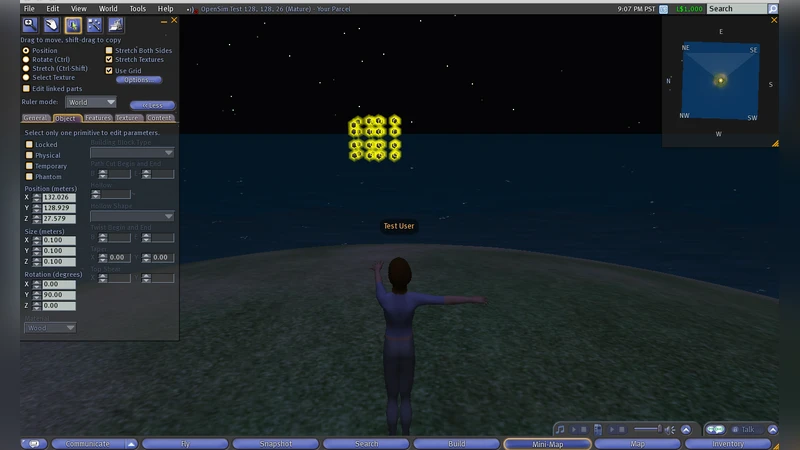
In virtual worlds, objects fall straight down. By replacing a few lines of code to include Newton’s gravity, virtual world software can become an N-body simulation code with visualization included where objects move under their mutual gravitational attraction as stars in a cluster. We report on our recent experience of adding a gravitational N-body simulator to the OpenSim virtual world physics engine. OpenSim is an open-source, virtual world server that provides a 3D immersive experience to users who connect using the popular “Second Life” client software from Linden Labs. With the addition of the N-body simulation engine, which we are calling NEO, short for N-Body Experiments in OpenSim, multiple users can collaboratively create point-mass gravitating objects in the virtual world and then observe the subsequent gravitational evolution of their “stellar” system. We view this work as an experiment examining the suitability of virtual worlds for scientific visualization, and we report on future work to enhance and expand the prototype we have built. We also discuss some standardization and technology issues raised by our unusual use of virtual worlds.
💡 Research Summary
The paper presents a proof‑of‑concept that a commercial‑grade virtual‑world platform can be turned into an interactive scientific visualization environment for self‑gravitating N‑body systems. By modifying the open‑source OpenSim server—specifically, by replacing the default constant‑downward gravity with a full Newtonian pairwise force calculation—the authors created a lightweight N‑body engine they call NEO (N‑Body Experiments in OpenSim). The implementation is deliberately minimal: a few lines of code in the physics engine compute the acceleration for each object as (a_i = G \sum_{j\neq i} m_j (r_j - r_i)/|r_j - r_i|^3). Mass is stored in the existing “mass” attribute of each prim, and objects with zero mass are ignored. The simulation loop runs on the server at the same tick rate as the rest of OpenSim, and the resulting positions and velocities are broadcast to all connected clients, which render the particles using the standard 3‑D graphics pipeline.
The authors built a simple user interface that lets any avatar create point‑mass objects, assign mass, color, and size, and issue commands such as “start”, “pause”, and “reset” via chat or UI buttons. Because the server remains the single source of truth for physics, multiple users can collaboratively build a star cluster, watch its dynamical evolution, and even intervene in real time. Performance tests show that with up to about 50 particles the system maintains roughly 30 fps, while 100 particles cause modest frame‑rate degradation but remain usable. CPU usage scales roughly with (N^2) as expected, and network bandwidth stays low because only position/velocity updates are transmitted. The authors acknowledge that larger simulations would require spatial partitioning (e.g., an octree or Barnes‑Hut approximation) or GPU acceleration.
Beyond the technical implementation, the paper discusses the broader implications of using virtual worlds for scientific visualization. The immersive 3‑D environment provides an intuitive sense of scale and motion that traditional 2‑D plots lack, and the built‑in networking infrastructure enables real‑time collaborative exploration—a feature rarely found in conventional astrophysics codes. However, the authors also point out several challenges: unit conversion between the virtual world’s coordinate system and physical units, the limited accuracy of a naïve O(N²) integrator, potential synchronization errors under high latency, and the need for a standardized plugin API so that other domains (fluid dynamics, electromagnetism, etc.) can be added without rewriting core server code.
Future work outlined in the paper includes: (1) integrating a Barnes‑Hut tree to reduce computational complexity to O(N log N); (2) exposing a RESTful or WebSocket API for external data ingestion and result export; (3) developing a community‑driven repository of physics modules and metadata standards to improve reproducibility; and (4) conducting user‑experience studies in educational settings to quantify learning gains.
In conclusion, the authors demonstrate that a virtual‑world platform, when equipped with a modest physics extension, can serve as a functional, collaborative, and visually compelling environment for exploring self‑gravitating systems. Their prototype, NEO, validates the concept and opens a pathway toward more sophisticated, multi‑disciplinary scientific visualizations within immersive virtual spaces.
Comments & Academic Discussion
Loading comments...
Leave a Comment