On Fodor on Darwin on Evolution
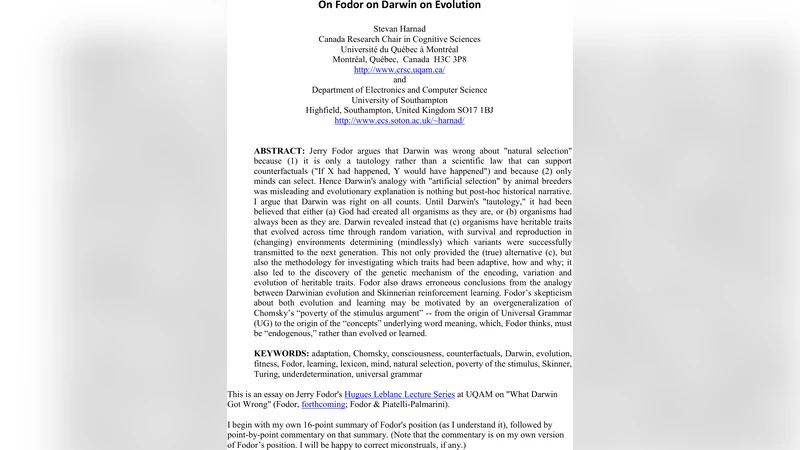
Jerry Fodor argues that Darwin was wrong about “natural selection” because (1) it is only a tautology rather than a scientific law that can support counterfactuals (“If X had happened, Y would have happened”) and because (2) only minds can select. Hence Darwin’s analogy with “artificial selection” by animal breeders was misleading and evolutionary explanation is nothing but post-hoc historical narrative. I argue that Darwin was right on all counts.
💡 Research Summary
Jerry Fodor’s critique of Darwin rests on two central claims: first, that natural selection is merely a tautological statement incapable of generating counterfactual predictions, and second, that “selection” is a process that can only be performed by minds, rendering Darwin’s analogy to artificial selection misleading. This paper systematically dismantles both arguments and re‑affirms the scientific robustness of Darwinian evolution.
Regarding the tautology charge, the paper emphasizes that modern evolutionary biology treats natural selection as a statistical and probabilistic process, not a vacuous description. Fitness functions, quantitative genetics models, and population‑dynamic equations explicitly relate environmental variables to genotype frequencies. By parameterising these relationships, researchers can simulate “what‑if” scenarios—e.g., altering temperature or resource availability—and predict allele frequency shifts. Such models are empirically testable: they generate measurable expectations that can be compared against observed data, satisfying the core requirement for a scientific law to support counterfactual reasoning.
The second claim—that only minds can select—confuses the linguistic use of “selection” with its mechanistic meaning. Artificial selection indeed involves intentional agency, but natural selection is a process of differential survival and reproduction driven by environmental constraints. It is a non‑teleological, algorithmic filter that operates without consciousness, analogous to physical forces that shape matter. The paper points out that the term “selection” in evolutionary theory denotes a statistical bias, not a purposeful decision, and therefore does not require a mind.
Fodor’s concern about evolutionary explanations being merely post‑hoc narratives is addressed through multiple lines of evidence. The fossil record, molecular phylogenetics, and especially experimental evolution provide forward‑looking, testable predictions. Laboratory evolution with bacteria, yeast, and Drosophila demonstrates that imposing a defined selective pressure (e.g., an antibiotic or a novel food source) leads to predictable phenotypic and genotypic changes. These experiments move beyond retrospective storytelling; they constitute prospective hypothesis testing that validates the causal role of natural selection.
Concrete case studies further illustrate the predictive power of Darwinian theory. The classic finch beak‑size shifts on the Galápagos Islands correlate with documented changes in seed availability, and statistical analyses have quantified the selection coefficients involved. Similarly, the rapid emergence of antibiotic‑resistant strains under drug pressure provides a real‑time demonstration of selection acting on standing genetic variation. Both examples show that natural selection can be measured, modeled, and experimentally verified.
In sum, the paper argues that Fodor’s critique overlooks the methodological advances that transform natural selection from a vague narrative into a rigorously quantified mechanism. By employing mathematical models, controlled experiments, and independent lines of historical evidence, evolutionary biology fulfills the criteria of a predictive, falsifiable science. Consequently, Darwin’s theory remains a cornerstone of biological explanation, possessing both explanatory depth and empirical testability.
Comments & Academic Discussion
Loading comments...
Leave a Comment