Distribution of U and Th and Their Nuclear Fission in the Outer Core of the Earth and Their effects on the Geodynamics
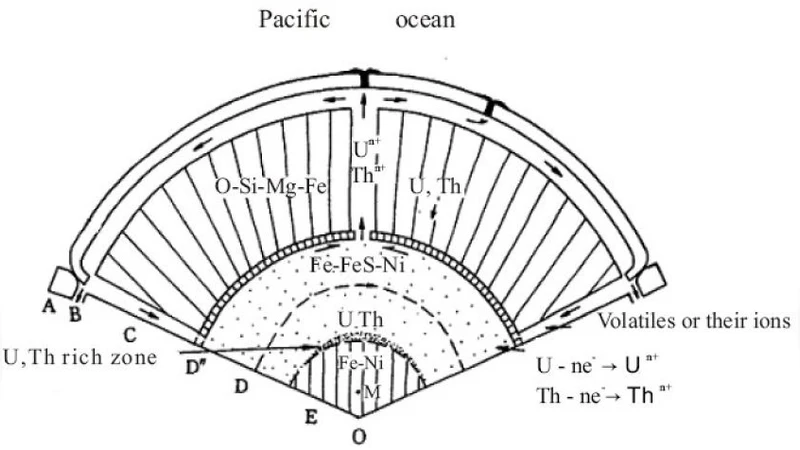
Here we propose that there is a lot of heat producing elements U and Th in the outer core of the Earth. The heat released from them may be the major energy source for driving the material movement within the interior of Earth, including plate motion. According to seismic tomography, the hottest area is the mantle under the central Pacific Ocean. Combined with geomagnetic data, it is derived that the magnetic and heat convection centers deviate from the geographic center to the Pacific direction for 400 km. Therefore, U and Th may be more concentrated in a position close to the equator in the lower outer core under the central Pacific Ocean, and have formed a large U, Th-rich center there. Another small U, Th-rich center may be located in a position close to the equator in the lower outer core under Africa, which is directly opposite of the large U, Th-rich center past the solid inner core. The two U, Th-rich centers may have led to the formation of the Pacific and Africa super-plumes and are offering energy to run the plate tectonic system. It also could have caused the temperature of the western hemisphere to be higher than that of the eastern hemisphere of the inner core, which may be the cause for the east-west hemispherical elastic anisotropy of the inner core. Periodical nuclear fissions of U and Th in the outer core may have occurred in the geological history of the Earth, and also might have triggered geomagnetic superchrons and reversals. At the same time, the energy released from the outer core during these events might have also triggered strong and extensive global geological and volcanic activities, and caused mass extinctions on the surface.
💡 Research Summary
The paper puts forward a bold hypothesis that the Earth’s outer core contains substantial amounts of uranium (U) and thorium (Th), and that the heat produced by their radioactive decay, together with occasional nuclear fission events, constitutes the primary energy source driving mantle convection, plate motions, geomagnetic behavior, and inner‑core anisotropy. The authors base their argument on three observational pillars: (1) seismic tomography showing a temperature maximum beneath the central Pacific, (2) geomagnetic data indicating that the magnetic dipole and heat‑convection centers are displaced about 400 km toward the Pacific relative to the geographic centre, and (3) the apparent symmetry of these displacements with a counterpart beneath Africa. From these they infer the existence of two U‑Th‑rich “centers” in the lower outer core— a large one beneath the Pacific equatorial region and a smaller one beneath the African equatorial region, situated roughly opposite each other across the solid inner core.
The authors claim that the radioactive heat from these concentrations is sufficient to power the vigorous material movement in the outer core, which in turn drives the overlying mantle’s large‑scale upwellings (the Pacific and African super‑plumes). They further propose that periodic nuclear fission bursts in the outer core could have released transient power spikes of tens of terawatts, enough to perturb the geodynamo, generate geomagnetic super‑chrons and reversals, and trigger massive, globally coordinated volcanic episodes. According to the model, such energetic episodes would also raise the temperature of the western hemisphere of the inner core relative to the eastern hemisphere, providing a mechanism for the observed east‑west elastic anisotropy of the inner core.
While the narrative is internally consistent, it conflicts with a substantial body of geochemical, seismological, and geodynamic evidence. Current estimates of the Earth’s bulk composition place U and Th largely in the crust and mantle, with outer‑core concentrations below 0.1 wt %—far too low to generate the claimed heat fluxes. High‑pressure experiments and seismic attenuation studies support a core dominated by Fe‑Ni alloy, with only trace amounts of light elements. The outer‑core heat flow inferred from seismic and geomagnetic observations is on the order of 5–10 TW, which is already accounted for by secular cooling, latent heat release at the inner‑core boundary, and radiogenic heat from the mantle; adding a U‑Th contribution large enough to dominate would overshoot the Earth’s total surface heat loss (~20 TW).
The paper’s link between the Pacific temperature anomaly and a U‑Th enrichment lacks quantitative modeling. A 400 km offset of the magnetic dipole can be explained by lateral variations in mantle conductivity, core flow geometry, or the influence of the large low‑shear‑velocity provinces (LLSVPs) without invoking compositional heterogeneity in the core. Moreover, the proposed nuclear fission events raise several unanswered questions: what mechanism would concentrate fissile material to criticality in the high‑pressure, high‑temperature outer‑core environment? How would the resulting energy be efficiently coupled to the geodynamo on the timescales of magnetic reversals (10⁴–10⁶ yr)? No geochemical signatures (e.g., excess Xe isotopes) that would be expected from deep‑Earth fission have been identified.
The suggestion that outer‑core fission drives super‑plume formation also conflicts with the prevailing plume model, which attributes upwellings to thermal and compositional buoyancy generated at the core‑mantle boundary and within the mantle itself (e.g., the 660 km phase transition). Heat generated in the outer core must be conducted through the mantle, a process limited by the mantle’s low thermal conductivity; thus, direct transmission of a fission‑induced heat pulse to the base of the mantle is unlikely to produce the sustained, focused upwellings observed.
Finally, the connection to mass‑extinction events is speculative. While some extinction intervals coincide with large igneous provinces, the causal chain proposed—outer‑core fission → global volcanic surge → surface extinction—requires evidence of simultaneous, globally synchronous magmatic activity, which is not present in the geological record for most extinction events.
In summary, the paper presents an imaginative, interdisciplinary scenario that attempts to unify disparate geophysical phenomena under a single outer‑core U‑Th framework. However, the hypothesis is at odds with established constraints on core composition, heat budget, and dynamo theory. To move beyond speculation, the authors would need to provide: (1) robust geochemical evidence for elevated U/Th in the outer core (e.g., isotopic anomalies in mantle‑derived rocks), (2) high‑resolution numerical models demonstrating that the proposed heat fluxes can reproduce the observed seismic and magnetic asymmetries, (3) a plausible physical mechanism for achieving criticality and sustained fission in the outer core, and (4) clear temporal correlations between proposed fission episodes and geological/biological events. Until such data are presented, the hypothesis remains an intriguing but unverified alternative to the conventional models of Earth’s interior dynamics.
Comments & Academic Discussion
Loading comments...
Leave a Comment