Configurational Effects on Alfvenic modes and Confinement in the H-1NF Heliac
The flexible Heliac coil set of helical axis stellarator H-1 (R=1m,
💡 Research Summary
The paper presents a comprehensive experimental investigation of Alfvénic activity and plasma confinement in the flexible H‑1NF heliac, a small helical‑axis stellarator (major radius ≈ 1 m, average minor radius ≈ 0.15–0.20 m). The unique feature of H‑1 is its set of independently powered helical coils, which allows the rotational transform (ι = t/2π) and magnetic shear to be varied over a wide range, giving access to many distinct magnetic configurations within a single discharge.
Plasmas are generated by radio‑frequency (RF) heating, producing electron densities of order 10¹⁸ m⁻³. Density and temperature are measured with laser and microwave interferometry, while a 48‑probe magnetic array records fluctuations from 1 kHz to 200 kHz. The authors apply modern data‑mining techniques (clustering, principal‑component analysis, and automated mode‑number extraction) to thousands of time‑frequency spectra, classifying the observed fluctuations into coherent multi‑frequency modes, broadband “turbulent‑like” spectra (Δf/f ≈ 0.02–0.5), and intermediate cases.
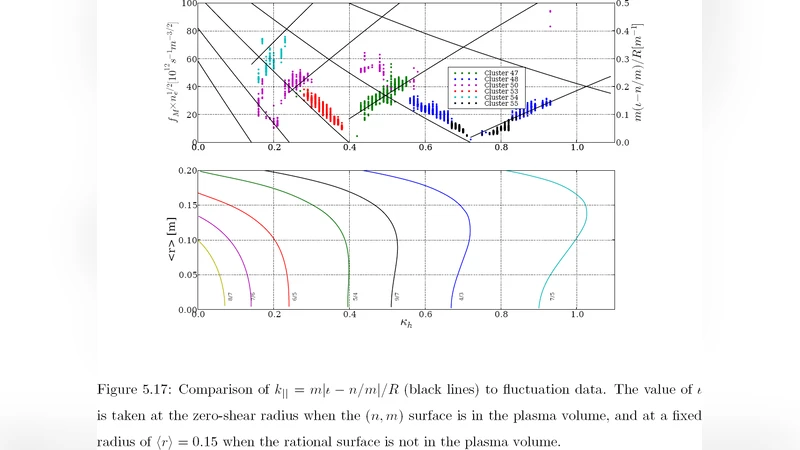
A striking result is that clear Alfvénic modes appear even though there is no obvious population of energetic particles (no neutral‑beam injection, no fusion‑born alphas). The mode frequencies scale as f ∝ √nₑ, i.e., the classic Alfvén scaling, and they also exhibit a systematic dependence on the rotational transform: as ι is swept through low‑order rational values (5/4, 4/3, 3/2, etc.) the frequencies shift abruptly and new branches appear. This demonstrates that the modes are shear Alfvén waves driven by the bulk plasma parameters rather than by fast‑particle drive.
Density profiles, obtained from interferometry and optical diagnostics, show pronounced depressions near—but not exactly at—these rational surfaces. The authors argue that the depressions are not caused by magnetic islands dominating transport; instead, the RF power deposition and electron production efficiency vary with the local magnetic geometry, leading to reduced ionisation near rational surfaces. High‑precision magnetic field mapping combined with a vacuum field model confirms that the islands are small and should not dominate confinement.
Scanning ι continuously within a single pulse reveals mode conversion phenomena: as the transform passes a rational value, a coherent mode can split into two or more branches, and broadband activity can emerge. Simultaneous optical imaging (fast cameras, visible spectroscopy) provides initial insight into the three‑dimensional structure of the modes, suggesting that the observed fluctuations are linked to localized perturbations of the magnetic field rather than global instabilities.
From the extensive dataset the authors extract quantitative scaling constants linking f, nₑ, and ι, and they propose practical strategies for controlling Alfvénic activity in heliacs: (1) tailoring the coil currents to avoid low‑order rationals that promote mode growth, (2) shaping the RF power profile to produce a more uniform electron density, and (3) implementing real‑time feedback based on magnetic probe and optical signals to suppress unwanted broadband fluctuations.
Overall, the study demonstrates that even in a low‑temperature, low‑beta heliac, Alfvénic modes can arise purely from bulk plasma parameters and magnetic geometry. The findings have implications for confinement optimization in small stellarators and provide a valuable testbed for validating theoretical models of shear Alfvén waves, mode conversion, and the interplay between magnetic topology and plasma generation.
Comments & Academic Discussion
Loading comments...
Leave a Comment