Dynamic force spectroscopy of DNA hairpins. I. Force kinetics and free energy landscapes
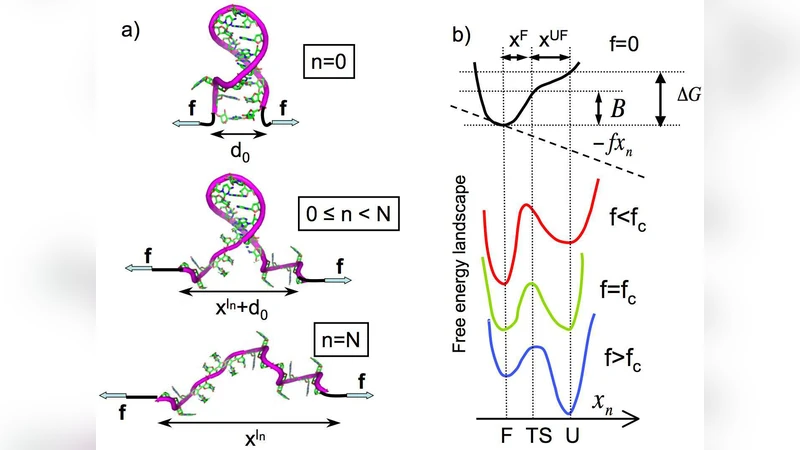
We investigate the thermodynamics and kinetics of DNA hairpins that fold/unfold under the action of applied mechanical force. We introduce the concept of the molecular free energy landscape and derive simplified expressions for the force dependent Kramers-Bell rates. To test the theory we have designed a specific DNA hairpin sequence that shows two-state cooperative folding under mechanical tension and carried out pulling experiments using optical tweezers. We show how we can determine the parameters that characterize the molecular free energy landscape of such sequence from rupture force kinetic studies. Finally we combine such kinetic studies with experimental investigations of the Crooks fluctuation relation to derive the free energy of formation of the hairpin at zero force.
💡 Research Summary
This paper presents a comprehensive study of the thermodynamics and kinetics of a DNA hairpin that undergoes force‑induced folding and unfolding. The authors first introduce the concept of a molecular free‑energy landscape, describing the system’s free energy as G(x,f)=G₀(x)−f·x, where x is the molecular extension and f is the externally applied force. By assuming a one‑dimensional landscape with two metastable minima (folded and unfolded) separated by a single barrier, they apply Kramers‑Bell theory to derive force‑dependent transition rates. Under a small‑displacement approximation and a linearized barrier, the unfolding (kᵤ) and refolding (k_f) rates take the simple exponential forms: kᵤ(f)=k₀ᵤ exp
Comments & Academic Discussion
Loading comments...
Leave a Comment