To Understand Nature - Computer Modelling between Genetics and Evolution
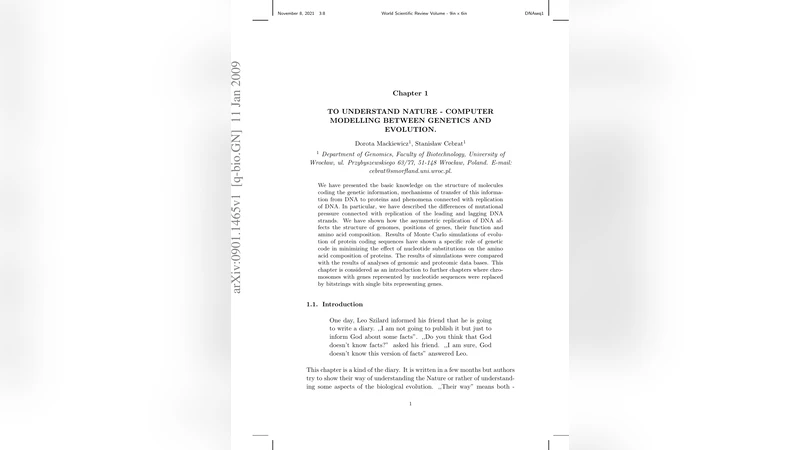
We have presented the basic knowledge on the structure of molecules coding the genetic information, mechanisms of transfer of this information from DNA to proteins and phenomena connected with replication of DNA. In particular, we have described the differences of mutational pressure connected with replication of the leading and lagging DNA strands. We have shown how the asymmetric replication of DNA affects the structure of genomes, positions of genes, their function and amino acid composition. Results of Monte Carlo simulations of evolution of protein coding sequences have shown a specific role of genetic code in minimizing the effect of nucleotide substitutions on the amino acid composition of proteins. The results of simulations were compared with the results of analyses of genomic and proteomic data bases. This chapter is considered as an introduction to further chapters where chromosomes with genes represented by nucleotide sequences were replaced by bitstrings with single bits representing genes.
💡 Research Summary
The paper provides a comprehensive overview of the molecular architecture of genetic material, the flow of information from DNA to proteins, and the replication mechanisms that shape genomic evolution. Central to the study is the asymmetry inherent in DNA replication: the leading strand is synthesized continuously, whereas the lagging strand is assembled discontinuously in short Okazaki fragments. This structural difference creates distinct mutational pressures; the lagging strand experiences a higher frequency of both transition and transversion mutations due to frequent polymerase dissociation and fragment ligation, while the leading strand accumulates fewer insertions and deletions.
To quantify how this replication asymmetry influences genome organization, gene positioning, and protein amino‑acid composition, the authors employed Monte Carlo simulations of protein‑coding sequence evolution. The simulations incorporated the standard genetic code (64 codons → 20 amino acids) and compared its performance against randomized codon‑to‑amino‑acid mappings. Results demonstrated that the canonical genetic code is highly optimized to buffer the effects of nucleotide substitutions: transitions tend to preserve amino‑acid identity more often than transversions, and the code minimizes the probability that a single‑nucleotide change will produce a radical amino‑acid replacement. Moreover, the simulations reproduced strand‑specific codon usage patterns, showing that genes located on the leading strand preferentially use codons that are more resistant to transversions, whereas lagging‑strand genes favor codons that mitigate the impact of transitions.
The authors validated these computational findings with empirical data drawn from extensive genomic and proteomic databases across bacteria, archaea, and eukaryotes. Comparative analyses revealed a non‑random distribution of genes relative to replication direction: essential, highly conserved proteins tend to be situated on the leading strand and employ codons that are less susceptible to deleterious mutations. Conversely, regions of the genome with elevated G + C content are enriched on the lagging strand, reflecting differential stability requirements during replication. The study also identified that functional domains critical for enzymatic activity display a bias toward mutation‑tolerant codons, suggesting an evolutionary strategy to preserve protein function despite the asymmetric mutational landscape.
In the concluding section, the paper outlines a roadmap for future research. Building on the insights gained, the authors propose to abstract genes into binary bit‑strings, where each bit represents the presence or absence of a functional unit. This abstraction will enable large‑scale chromosome simulations that incorporate selection pressures, variable mutation rates, and recombination events while maintaining computational tractability. By transitioning from nucleotide‑level models to bit‑string representations, the authors aim to explore genome‑wide evolutionary dynamics over extended timescales, offering a powerful platform for testing hypotheses about the interplay between replication mechanics, mutational bias, and the evolution of genetic coding.
Overall, the work convincingly demonstrates that replication‑induced asymmetry exerts a measurable influence on genome architecture and that the universal genetic code has been fine‑tuned by evolutionary forces to mitigate the detrimental effects of such asymmetry.
Comments & Academic Discussion
Loading comments...
Leave a Comment