Starting from inhomogeneous time scaling and linear decorrelation between successive price returns, Baldovin and Stella recently proposed a way to build a model describing the time evolution of a financial index. We first make it fully explicit by using Student distributions instead of power law-truncated L\'evy distributions; we also show that the analytic tractability of the model extends to the larger class of symmetric generalized hyperbolic distributions and provide a full computation of their multivariate characteristic functions; more generally, the stochastic processes arising in this framework are representable as mixtures of Wiener processes. The Baldovin and Stella model, while mimicking well volatility relaxation phenomena such as the Omori law, fails to reproduce other stylized facts such as the leverage effect or some time reversal asymmetries. We discuss how to modify the dynamics of this process in order to reproduce real data more accurately.
Deep Dive into The Ups and Downs of Modeling Financial Time Series with Wiener Process Mixtures.
Starting from inhomogeneous time scaling and linear decorrelation between successive price returns, Baldovin and Stella recently proposed a way to build a model describing the time evolution of a financial index. We first make it fully explicit by using Student distributions instead of power law-truncated L'evy distributions; we also show that the analytic tractability of the model extends to the larger class of symmetric generalized hyperbolic distributions and provide a full computation of their multivariate characteristic functions; more generally, the stochastic processes arising in this framework are representable as mixtures of Wiener processes. The Baldovin and Stella model, while mimicking well volatility relaxation phenomena such as the Omori law, fails to reproduce other stylized facts such as the leverage effect or some time reversal asymmetries. We discuss how to modify the dynamics of this process in order to reproduce real data more accurately.
arXiv:0807.4163v3 [physics.data-an] 9 Jul 2009
The
Ups
and
Do
wns
of
Mo
deling
Finan ial
Time
Series
with
Wiener
Pro
ess
Mixtures
Damien
Challet∗
Physi s
Dep
artment
F
rib
our
g
University
Pér
ol
les,
1700
F
rib
our
g,
Switzerland
Pier
P
aolo
P
eirano†
Institute
for
S ienti
Inter
hange
Viale
Settimio
Sever
o
65,
10133
T
orino,
Italy
Abstra t
Starting
from
inhomogeneous
time
s aling
and
linear
de orrelation
b
et
w
een
su essiv
e
pri e
re-
turns,
Baldo
vin
and
Stella
re en
tly
prop
osed
a
w
a
y
to
build
a
mo
del
des ribing
the
time
ev
olution
of
a
nan ial
index.
W
e
rst
mak
e
it
fully
expli it
b
y
using
Studen
t
distributions
instead
of
p
o
w
er
la
w-trun ated
Lévy
distributions;
w
e
also
sho
w
that
the
analyti
tra tabilit
y
of
the
mo
del
extends
to
the
larger
lass
of
symmetri
generalized
h
yp
erb
oli
distributions
and
pro
vide
a
full
omputation
of
their
m
ultiv
ariate
hara teristi
fun tions;
more
generally
,
the
sto
hasti
pro
esses
arising
in
this
framew
ork
are
represen
table
as
mixtures
of
Wiener
pro
esses.
The
Baldo
vin
and
Stella
mo
del,
while
mimi
king
w
ell
v
olatilit
y
relaxation
phenomena
su
h
as
the
Omori
la
w,
fails
to
repro
du e
other
st
ylized
fa ts
su
h
as
the
lev
erage
ee t
or
some
time
rev
ersal
asymmetries.
W
e
dis uss
ho
w
to
mo
dify
the
dynami s
of
this
pro
ess
in
order
to
repro
du e
real
data
more
a urately
.
∗
Ele troni
address:
damien.
hallet unifr.
h
†
Ele troni
address:
pp
eirano lib
ero.it,
orresp
onding
author
1
I.
HO
W
SCALING
AND
EFFICIENCY
CONSTRAINS
RETURN
DISTRIBUTION
Finding
a
faithful
sto
hasti
mo
del
of
pri e
time
series
is
still
an
op
en
problem.
Not
only
should
it
repli ate
in
a
unied
w
a
y
all
the
empiri al
statisti al
regularities,
often
alled
st
ylized
fa ts,
( f
e.g.
Bou
haud
and
P
otters
[15℄,
Con
t
[21℄),
but
it
should
also
b
e
easy
to
alibrate
and
analyti ally
tra table,
so
as
to
fa ilitate
its
appli ation
to
deriv
ativ
e
pri ing
and
nan ial
risk
assessmen
t.
Up
to
no
w
none
of
the
prop
osed
mo
dels
has
b
een
able
to
meet
all
these
requiremen
ts
despite
their
v
ariet
y
.
A
ttempts
in lude
AR
CH
family
(Bollerslev
et
al.
[10℄,
T
sa
y
[50℄
and
referen es
therein),
sto
hasti
v
olatilit
y
(Musiela
and
Rutk
o
wski
[41
℄
and
referen es
therein),
m
ultifra tal
mo
dels
(Ba ry
et
al.
[1℄,
Borland
et
al.
[13
℄,
Eisler
and
Kertész
[27℄,
Mandelbrot
et
al.
[39
℄
and
referen es
therein),
m
ulti-times ale
mo
dels
(Borland
and
Bou
haud
[12
℄,
Zum
ba
h
[54
℄,
Zum
ba
h
et
al.
[56℄),
Lévy
pro
esses
(Con
t
and
T
ank
o
v
[22℄
and
referen es
therein),
and
self-similar
pro
esses
(Carr
et
al.
[18℄).
Re en
tly
Baldo
vin
and
Stella
(B-S
thereafter)
prop
osed
a
new
w
a
y
of
addressing
the
question.
W
e
advise
the
reader
to
refer
to
the
original
pap
ers
Baldo
vin
and
Stella
[4,
5,
6
℄
for
a
full
des ription
of
the
mo
del
as
w
e
shall
only
giv
e
a
brief
a oun
t
of
its
main
underlying
prin iples.
Using
their
notation
let S(t)
b
e
the
v
alue
of
the
asset
under
onsideration
at
time
t,
the
logarithmi
return
o
v
er
the
in
terv
al [t, t + δt]
is
giv
en
b
y rt,δt = ln S(t + δt) −ln S(t);
the
elemen
tary
time
unit
is
a
da
y
,
i.e., t = 0, 1, . . .
and δt = 1, 2, . . .
da
ys.
In
order
to
a ommo
date
for
non-stationary
features,
the
distribution
of rt,δt
is
denoted
b
y Pt,δt(r)
whi
h
on
tains
an
expli it
dep
enden e
on t.
The
most
impressiv
e
a
hiev
emen
t
of
B-S
is
to
build
the
m
ultiv
ariate
distribution P (n)
0,1 (r0,1, . . . , rn,1)
of n
onse utiv
e
daily
returns
starting
from
the
univ
ariate
distribution
of
a
single
da
y
pro
vided
that
the
follo
wing
onditions
hold:
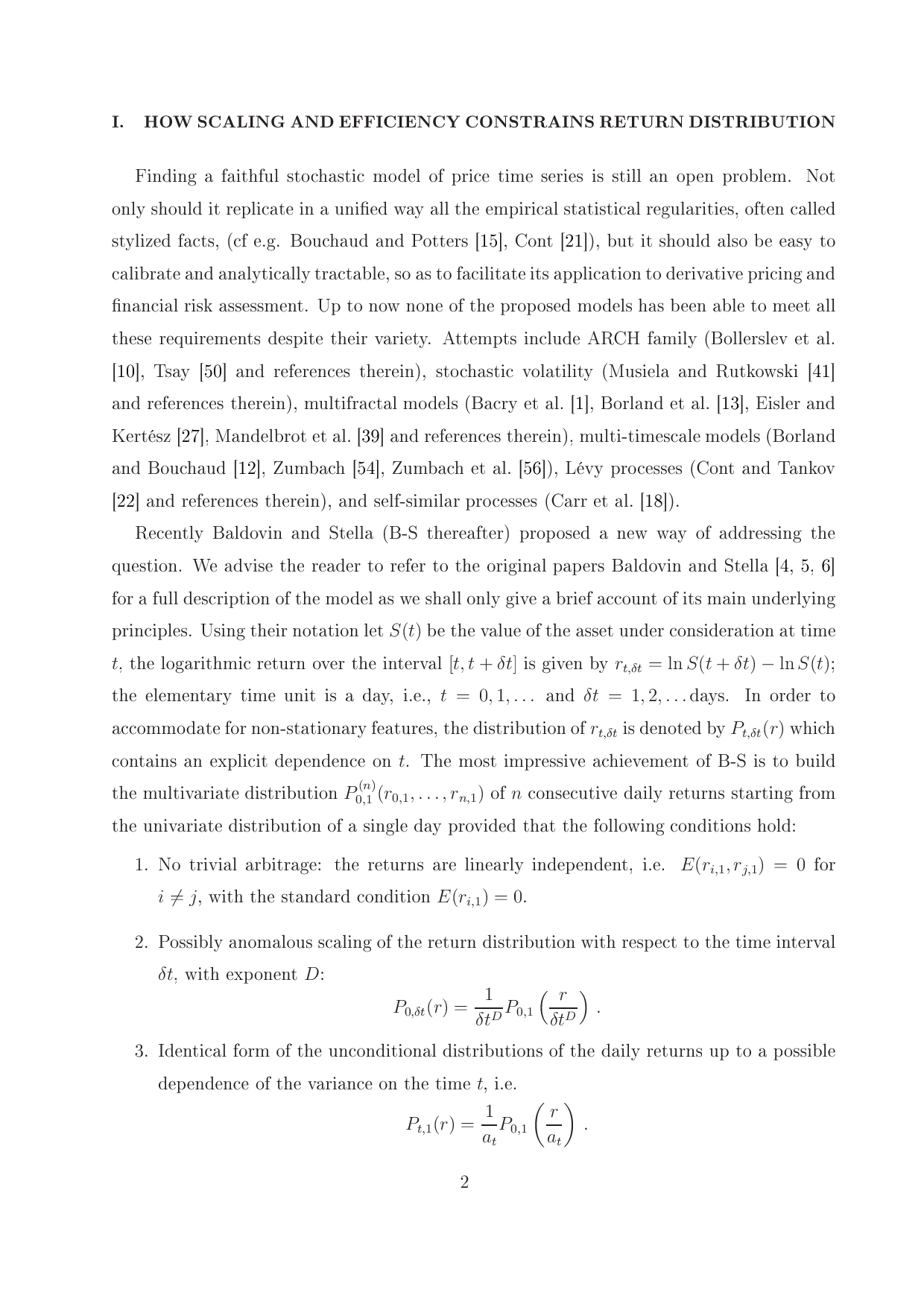
1.
No
trivial
arbitrage:
the
returns
are
linearly
indep
enden
t,
i.e. E(ri,1, rj,1) = 0
for
i ̸= j
,
with
the
standard
ondition E(ri,1) = 0 .
2.
P
ossibly
anomalous
s aling
of
the
return
distribution
with
resp
e t
to
the
time
in
terv
al
δt,
with
exp
onen
t D
:
P0,δt(r) =
1
δtD P0,1
r
δtD
.
3.
Iden
ti al
form
of
the
un onditional
distributions
of
the
daily
returns
up
to
a
p
ossible
dep
enden e
of
the
v
arian e
on
the
time t,
i.e.
Pt,1(r) = 1
at
P0,1
r
at
.
2
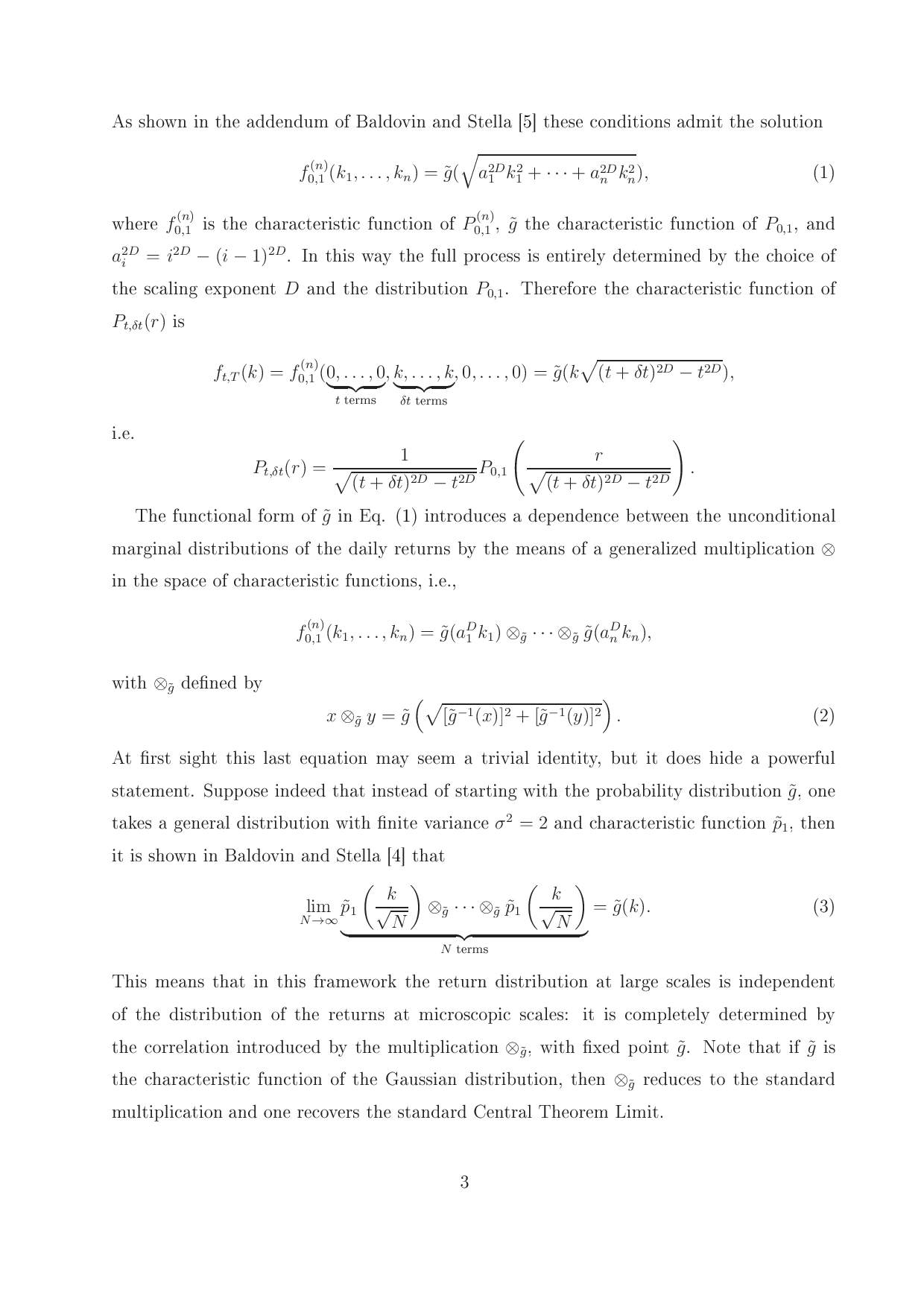
As
sho
wn
in
the
addendum
of
Baldo
vin
and
Stella
[5℄
these
onditions
admit
the
solution
f (n)
0,1 (k1, . . . , kn) = ˜g(
q
a2D
1 k2
1 + · · · + a2D
n k2
n),
(1)
where f (n)
0,1
is
the
hara teristi
fun tion
of P (n)
0,1
, ˜g
the
hara teristi
fun tion
of P0,1
,
and
a2D
i
= i2D −(i −1)2D
.
In
this
w
a
y
the
full
pro
ess
is
en
tirely
determined
b
y
the
hoi e
of
the
s aling
exp
onen
t D
and
the
distribution P0,1
.
Therefore
the
hara teristi
fun tion
of
Pt,δt(r)
is
ft,T(k) = f (n)
0,1 (0, . . . , 0
| {z }
t
terms
, k, . . . , k
| {z }
δt
terms
, 0, . . . , 0) = ˜g(k
p
(t + δt)2D −t2D),
i.e.
Pt,δt(r) =
1
p
(t + δt)2D −t2D P0,1
r
p
(t + δt)2D −t2D
!
.
The
fun tional
form
of ˜g
in
Eq.
(1)
in
tro
du es
a
dep
enden e
b
et
w
een
the
un onditional
marginal
distributions
of
the
daily
returns
b
y
the
means
of
a
generalized
m
ultipli ation ⊗
in
the
spa e
of
hara teristi
fun tions,
i.e.,
f (n)
0,1 (k1, . . . , kn) = ˜
…(Full text truncated)…
This content is AI-processed based on ArXiv data.