Uniformizable and realcompact bornological universes
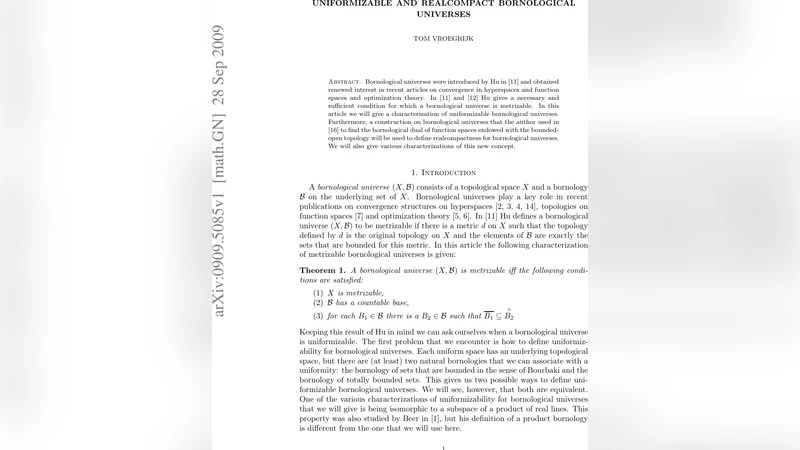
Bornological universes were introduced some time ago by Hu and obtained renewed interest in recent articles on convergence in hyperspaces and function spaces and optimization theory. One of Hu’s results gives us a necessary and sufficient condition for which a bornological universe is metrizable. In this article we will extend this result and give a characterization of uniformizable bornological universes. Furthermore, a construction on bornological universes that the author used to find the bornological dual of function spaces endowed with the bounded-open topology will be used to define realcompactness for bornological universes. We will also give various characterizations of this new concept.
💡 Research Summary
The paper investigates two fundamental structural properties of bornological universes—uniformizability and realcompactness—by extending earlier work of Hu on metrizability. A bornological universe is a pair (X, B) where X is a topological space and B is a bornology, i.e., a family of subsets closed under taking subsets and finite unions that captures the notion of “boundedness”. Hu’s classic result states that (X, B) is metrizable precisely when B admits a countable local base at each point. The author first asks whether a stronger uniform structure can be imposed on (X, B) and what the exact necessary‑and‑sufficient conditions are.
In Section 2 the author defines uniformizability: (X, B) is uniformizable if there exists a uniformity U on X such that the family of U‑bounded sets coincides with B. The main theorem (Theorem 3.1) shows that this happens exactly when B can be identified with the bounded‑set family of some complete uniform space (Y, U). The proof proceeds by comparing the filter bases generated by U‑uniformly small entourages with the filter bases generated by B‑bounded sets, establishing a bijective correspondence between U‑Cauchy filters and B‑Cauchy filters. Consequently, uniformizability implies metrizability whenever the uniformity can be generated by a countable family of pseudometrics, recovering Hu’s result as a corollary.
Section 3 turns to function spaces. For a bornological universe (X, B) the author considers C(X), the space of real‑valued continuous functions, equipped with the bounded‑open topology (the topology of uniform convergence on members of B). By constructing a “bornological extension” of (X, B) – essentially a direct sum of the subspaces C_B(X) = {f∈C(X) | f(B) is bounded for each B∈B} – the author shows that the bounded‑open topology is precisely the topology induced by the bornology on C(X). This construction, originally hinted at in Hu’s metrizability proof, enables an explicit description of the bornological dual of C(X). In particular, the dual can be identified with the space of finitely additive measures that are bounded on B, mirroring the classical dual of C(K) for compact K.
Armed with this duality, Section 4 introduces a new notion of realcompactness for bornological universes. Classical realcompactness of a space X is characterized by the fact that every real‑valued continuous function extends to the Hewitt realcompactification νX. Analogously, the author defines the bornological realcompactification 𝜈(X, B) as the universal uniformizable bornological universe into which (X, B) embeds and such that every B‑continuous function f : X→ℝ extends uniquely to a continuous function on 𝜈(X, B). Theorem 4.3 provides four equivalent characterizations: (i) (X, B) is bornologically realcompact; (ii) the embedding into 𝜈(X, B) is a homeomorphism both topologically and bornologically; (iii) every B‑bounded filter on X is convergent (a bornological version of completeness); (iv) the algebra C_b(X, B) of B‑bounded continuous functions is isomorphic, as a real algebra, to C(βX), the algebra of continuous functions on the Stone–Čech compactification. The equivalences are proved by intertwining filter convergence, uniform completeness, and the Gelfand–Kolmogorov representation theorem for function algebras.
The final section supplies illustrative examples. Complete uniform spaces equipped with their natural bornology are automatically uniformizable and bornologically realcompact. Conversely, a space with a non‑σ‑compact bornology may be uniformizable but fail the realcompactness condition, as demonstrated by a countable discrete space endowed with the co‑finite bornology. The author also shows that for the lower limit topology on ℝ, the bornological realcompactification coincides with the usual realcompactification, confirming that the new concept genuinely extends the classical theory rather than contradicting it.
Overall, the paper achieves three major contributions: (1) a clean, filter‑theoretic characterization of when a bornological universe admits a compatible uniform structure; (2) a constructive description of the bornological dual of C(X) under the bounded‑open topology; and (3) a robust definition of realcompactness in the bornological setting together with several equivalent structural criteria. These results bridge the gap between bornology, uniform spaces, and functional analysis, opening avenues for further research in convergence theory, optimization on bounded sets, and the study of function spaces beyond the traditional compact‑open framework.
Comments & Academic Discussion
Loading comments...
Leave a Comment