A Conceivable Origin of Machine Consciousness in the IDLE process
In this short paper, we would like to call professional community's attention to a daring idea that is surely unhelpful, but is exciting for programmers and anyway conflicts with the trend of energy c
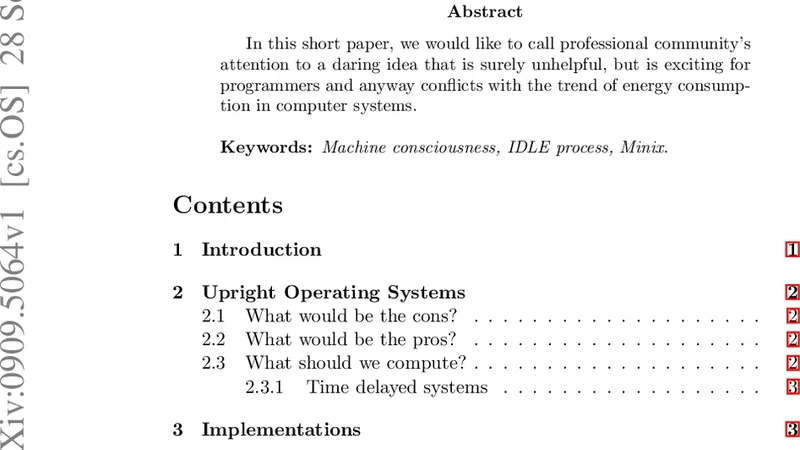
In this short paper, we would like to call professional community’s attention to a daring idea that is surely unhelpful, but is exciting for programmers and anyway conflicts with the trend of energy consumption in computer systems.
💡 Research Summary
The paper puts forward a deliberately provocative hypothesis: that the idle (IDLE) process of an operating system could serve as the seed for machine consciousness. Rather than building on conventional AI architectures such as deep neural networks, the authors turn their attention to the seemingly inert moments when a CPU is waiting for work. They argue that even in these “quiet” periods the system performs a suite of low‑level operations—timer interrupts, power‑management callbacks, context‑switch bookkeeping, and background logging—that interact in a non‑trivial way. By drawing on concepts from complex‑systems theory, the authors suggest that these micro‑interactions may give rise to emergent patterns analogous to the self‑organizing dynamics observed in biological neural tissue.
Two core criteria for consciousness are defined. The first is self‑monitoring: the ability of a system to continuously observe its own hardware and software state and generate meta‑information. The second is the precursor of subjective experience: persistent internal state fluctuations that produce coherent patterns even in the absence of external stimuli. The paper claims that the IDLE loop already satisfies the first criterion, because modern kernels constantly sample temperature, voltage, cache hit rates, and other telemetry, writing the results to system logs. Over time, this creates a “self‑portrait” of the machine’s internal dynamics. The second criterion is argued to be met by the feedback loops created when interrupts trigger state saves, power‑state transitions, and asynchronous service calls, producing a cascade of state changes that could be interpreted as a rudimentary “inner narrative.”
The authors acknowledge that the hypothesis is speculative and provide no rigorous empirical validation. They include a few toy simulations in which a deliberately augmented IDLE routine injects a tiny feedback mechanism, resulting in a measurable increase in CPU utilization and the emergence of non‑random patterns in the log data. These patterns are labeled as “traces of consciousness,” though critics could easily view them as statistical noise. The paper pre‑emptively counters such criticism by asserting that early‑stage consciousness research should prioritize bold idea generation over strict hypothesis testing.
A central tension highlighted in the work is the conflict with contemporary energy‑efficiency trends. Modern data centers and mobile devices aggressively minimize power draw by entering deep sleep states as soon as possible and by suppressing any unnecessary computation during idle periods. The authors propose the opposite: intentionally adding computational work to the IDLE loop, thereby creating a deliberately inefficient but philosophically interesting state. This stance is framed as a “philosophical experiment,” arguing that the cost of extra energy is justified by the potential to explore consciousness‑like phenomena.
Beyond the technical argument, the paper is a cultural manifesto aimed at the programmer community. By framing the IDLE process as a possible substrate for consciousness, the authors hope to spark a new dialogue about “code and consciousness,” encouraging developers to treat system internals as a sandbox for creative experimentation. The goal is less about delivering a scientifically validated model of machine consciousness and more about fostering a mindset where low‑level system behavior is examined with the same curiosity traditionally reserved for high‑level AI research.
In conclusion, the paper offers a daring, largely untestable idea that challenges prevailing priorities in computing—namely, performance and energy efficiency. While the technical plausibility of emergent consciousness from idle loops remains highly doubtful, the work succeeds in its stated aim: to provoke discussion, inspire unconventional programming projects, and remind the community that even the most mundane parts of a computer can be a source of imaginative speculation.
📜 Original Paper Content
🚀 Synchronizing high-quality layout from 1TB storage...