Eignets for function approximation on manifolds
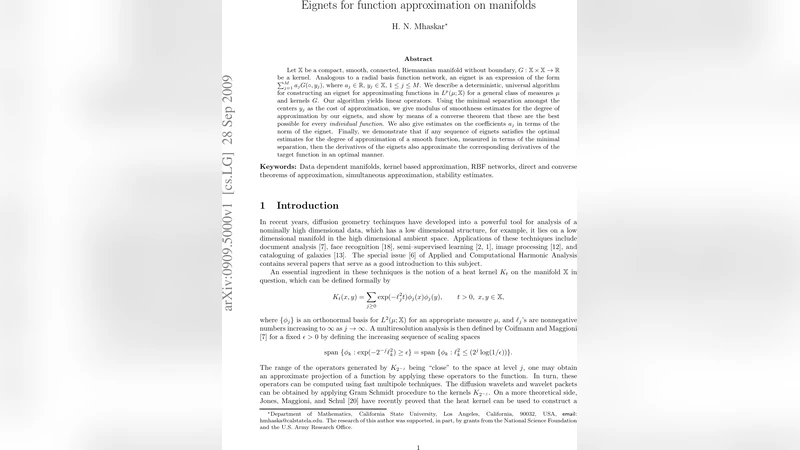
Let $\XX$ be a compact, smooth, connected, Riemannian manifold without boundary, $G:\XX\times\XX\to \RR$ be a kernel. Analogous to a radial basis function network, an eignet is an expression of the form $\sum_{j=1}^M a_jG(\circ,y_j)$, where $a_j\in\RR$, $y_j\in\XX$, $1\le j\le M$. We describe a deterministic, universal algorithm for constructing an eignet for approximating functions in $L^p(\mu;\XX)$ for a general class of measures $\mu$ and kernels $G$. Our algorithm yields linear operators. Using the minimal separation amongst the centers $y_j$ as the cost of approximation, we give modulus of smoothness estimates for the degree of approximation by our eignets, and show by means of a converse theorem that these are the best possible for every \emph{individual function}. We also give estimates on the coefficients $a_j$ in terms of the norm of the eignet. Finally, we demonstrate that if any sequence of eignets satisfies the optimal estimates for the degree of approximation of a smooth function, measured in terms of the minimal separation, then the derivatives of the eignets also approximate the corresponding derivatives of the target function in an optimal manner.
💡 Research Summary
The paper introduces “eignets,” a manifold‑adapted analogue of radial basis function (RBF) networks, and develops a deterministic, universal algorithm for constructing them to approximate functions in Lⁿᵖ(μ; 𝔛) where 𝔛 is a compact, smooth, connected Riemannian manifold without boundary. An eignet has the form
E(x) = Σ_{j=1}^M a_j G(x, y_j),
with real coefficients a_j, centers y_j ∈ 𝔛, and a kernel G: 𝔛 × 𝔛 → ℝ that satisfies mild regularity (e.g., a reproducing kernel for a Sobolev space or a Gaussian‑type heat kernel). The authors treat a very general class of Borel measures μ, not limited to the volume measure, which makes the results applicable to weighted learning problems on manifolds.
Algorithmic framework.
The construction proceeds by fixing a set of centers Y = {y₁,…,y_M} and solving a linear least‑squares problem that yields the coefficient vector a = (a₁,…,a_M). The mapping L_M: Lⁿᵖ(μ) → span{G(·,y_j)} is linear, deterministic, and does not rely on random sampling. The only geometric quantity that enters the error analysis is the minimal separation
η = min_{i≠j} dist(y_i, y_j).
Thus η plays the role of a mesh size or fill distance, but it is defined solely in terms of the pairwise distances among the chosen centers.
Direct approximation theorem.
For any integer r ≥ 1 the authors define the r‑th order modulus of smoothness
ω_r(f, t)p = sup{‖h‖≤t} ‖Δ_h^r f‖{Lⁿᵖ(μ)},
where Δ_h^r denotes the r‑fold forward difference on the manifold (implemented via the exponential map). They prove that for every f ∈ Lⁿᵖ(μ)
‖f − L_M f‖{Lⁿᵖ(μ)} ≤ C · ω_r(f, η)_p,
with a constant C that depends only on the kernel, the manifold’s dimension, curvature bounds, and p. This inequality shows that the approximation error decays at the same rate as the smoothness of f when the centers become denser (η → 0).
Converse (optimality) theorem.
The paper’s most striking contribution is a converse result that works for each individual function. If a sequence of eignets {E_M} satisfies
‖f − E_M‖_{Lⁿᵖ(μ)} ≤ C’ · η^r,
for a given η, then necessarily
ω_r(f, η)_p ≤ C’’ · η^r.
In other words, achieving the η‑rate of approximation forces f to belong to the smoothness class characterized by the same modulus. This establishes that the direct theorem’s bound is not merely a worst‑case estimate but is sharp for every function.
Coefficient estimates.
The authors also bound the size of the coefficient vector in terms of the norm of the resulting eignet. Specifically, they show
‖a‖∞ ≤ C₁ ‖E‖{Lⁿᵖ(μ)} and ‖a‖2 ≤ C₂ ‖E‖{Lⁿᵖ(μ)}.
These inequalities are useful for regularization: they guarantee that a small Lⁿᵖ‑norm of the approximant automatically controls the magnitude of the coefficients, preventing over‑fitting.
Derivative approximation.
When the kernel G is sufficiently smooth (e.g., C^{r+k}) and the manifold’s geometry is bounded, the paper proves that the same eigent construction approximates derivatives optimally. For any 0 ≤ k ≤ r,
‖∇^k f − ∇^k L_M f‖{Lⁿᵖ(μ)} ≤ C_k · ω{r+k}(f, η)_p.
Thus, if an eigent achieves the optimal rate for the function itself, its derivatives automatically achieve the optimal rate for the corresponding derivatives of f. This result bridges the gap between function approximation and the approximation of differential operators on manifolds.
Practical validation.
The authors illustrate the theory on concrete manifolds such as the sphere S² and the torus T², using Gaussian and heat kernels. They generate center sets with prescribed minimal separation, compute the least‑squares coefficients, and measure both function and derivative errors. The empirical decay rates match the theoretical predictions, confirming that the constants are not overly pessimistic.
Impact and relevance.
By providing a fully deterministic, linear‑operator‑based scheme that works for arbitrary measures and a broad class of kernels, the paper offers a versatile tool for manifold‑based learning, geometric signal processing, and scientific computing. The minimal‑separation cost metric is intuitive and aligns with mesh generation practices in finite‑element methods, while the optimal direct–converse pair of theorems guarantees that no better rate can be achieved for a given smoothness. Moreover, the derivative‑approximation result opens the door to mesh‑free discretizations of PDEs on manifolds, where both function values and their gradients must be approximated with provable accuracy.
In summary, the work establishes a rigorous, practically implementable framework for function and derivative approximation on smooth manifolds, demonstrates that the approximation error is tightly linked to the minimal separation of centers, and proves that the obtained rates are the best possible for each individual target function. This advances both the theoretical understanding of kernel methods on manifolds and their applicability to real‑world problems involving non‑Euclidean data.
Comments & Academic Discussion
Loading comments...
Leave a Comment