Quantization Errors of fGn and fBm Signals
In this Letter, we show that under the assumption of high resolution, the quantization errors of fGn and fBm signals with uniform quantizer can be treated as uncorrelated white noises.
Authors: Zhiheng Li, Li Li, Yudong Chen
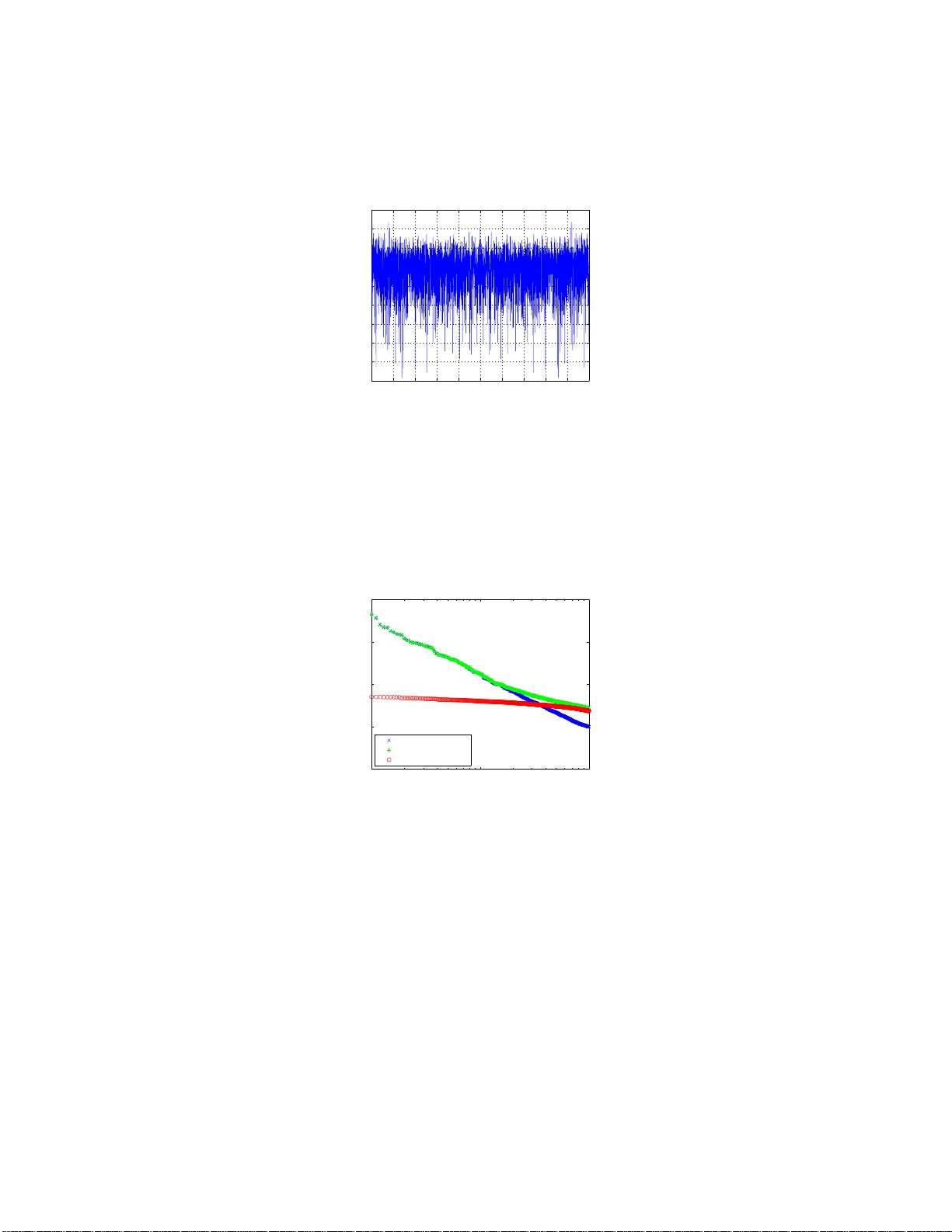
Quan tization Errors of fGn and fBm Signals Zhiheng Li, Li Li ∗ , Y udong Chen, Yi Zhang Departmen t of Automation, Tsingh ua Univ ersit y , Beijing, China 10008 4 No ve mber 3, 2018 Abstract In this Letter, w e show that under th e assumption of high resolution, the quantization errors of fGn and fBm signals with uniform quantizer can b e treated as uncorrelated white noises. 1 In tro d uction F r actional Gaussia n no ise (fGn) a nd fractional Br ownian motion (fBm) provide conv enient wa ys to describ e s to chastic pro c e sses with long-r a nge dep endencie s . Thu s, they ha ve receiv ed contin uing in teres ts in v arious fields and ha ve m a ny applications, e.g . mo deling the communication netw or ks flow a nd economic times ser ies [1]-[3]. Of particula r in ter est is the estimatio n o f the Hurst ex po nent H of a fGn or fBm pr o cess. In pr actice, such estimations ar e usua lly done on the s a mpled and quantized time series. F or exa mple, texture images ar e often viewed as 2D fBm s ignals unifor mly quan tized to the 0 − 255 scale [4], [5]. As will b e s hown later, the quantization err or might significantly affect the estimation result. T o the b est of our knowledge, no repo r ts discussed the effect of quantization error s of fGn and fBm pro cesses. In this Letter, we will sho w that under the assumption of high r esolution, the qua ntization erro r can b e v ie wed as a white noise added to the s ampled fGn or fBm sig nal. 2 The Discrete-Time fGn and fBm Signals There exist different kinds of discrete-time appr oximation for the con tinuous- time fGn and fBm pro c e sses, e.g. [6]-[8]. In this Letter, we will use the tw o- s tep discrete-time appr oximation signa ls defined in [9]: ∗ Corresp onding author: li-li@mail.tsinghua.edu.cn 1 1) First, the sta ndard discrete-time fGn pro cess W H ( n ) with Hurst exponent H ∈ (0 , 1) is defined as a weigh ted se q uence of a standa r d Gaussian white noise W ( n ) W H ( n ) = ( P n i =0 h H − 1 2 n − i W ( i ) for H 6 = 1 2 W ( n ) for H = 1 2 (1) where W ( n ) ∼ N (0 , 1) and h H − 1 2 n = Γ( n + H − 1 2 ) Γ( H − 1 2 )Γ( n +1) , n ∈ N ∪ { 0 } . 2) Second, the discrete-time fBm pro cess B H ( n ) is represented as the running sum of W H ( n ) B H ( n ) = n X i =0 W H ( i ) = n X i =0 i X j =0 h H − 1 2 i − j W ( j ) (2) As po inted out in [10], [11], Eq.(1)-(2) are indeed ARFIMA pro c e sses, which can b e r ewritten in terms of the lag op erator L : W H ( n ) = (1 − L ) 1 2 − H W ( n ) for H 6 = 1 2 W ( n ) for H = 1 2 (3) and (1 − L ) B H ( n ) = B H ( n ) − B H ( n − 1) = W H ( n ) (4) where (1 − L ) d = P ∞ k =0 Γ( k − d ) Γ( − d )Γ( k +1) L k . The truncated form ula s in (1)-(4) are equiv alent to infinite for mulas with W ( i ) = 0 for i ≤ 0; they a r e used her e since we usually consider the case with W H ( i ) = 0 for i ≤ 0 [1]-[3]. F o r clarity , we fo cus on the ab ov e standard discrete-time fBm pro c e ss but the conclusio ns can b e ea sily extended to genera l cases. 3 The High-resolution Quan tization Errors of the fGn and fBm Signals The use of high reso lution theory for err or pro cess analysis c a n date back to late 19 40s [12], [13]. In [13], Bennett demonstr ated that under the assump- tion of high resolution and smo o th density o f the sampled r a ndom pro cess, the quantization error behaves like an a dditive white noise. In other w o rds, the quantization error has small correlatio n with the signal and an appro xima tely white sp ectrum; see also the go o d surveys in [14]-[16]. In the sequel, w e will show that this conclusion als o holds for fGn and fBm signals. Our pro o f mainly uses the r esults in [17]. Suppo se the origina l discrete-time fGn or fBm sequence S H ( n ) is bo unded within [ − b , b ] in a finite time ho rizon [0 , t ] and an M -le vel uniform quantizer in [ − b, b ] is applied. W e also assume the sample r ate and the r esolution of the quantizer ar e high enough. 2 As shown in [1 7], by de fining ∆ = 2 b M − 1 , the normalized qua ntization noise e ( n ) of S H ( n ) can be represented as the normalized quant iz a tion noise of the sigma-delta mo dulator for S H ( n ): e ( n ) , 1 2 − h n X i =0 ( M − 1 ) S H ( n ) ∆ + 1 2 i (5) where h z i = x mo d 1 is the fractional part of x . In the following subs ections, we will discuss the quant iz a tion errors of the fGn and fBm signa ls, resp ectively . 3.1 fGn Signals F o r the sigma-delta mo dulator , we have the following useful lemmas. Lemma 1 [17] Defi n e an c asual st able MA pr o c ess x ( n ) x ( n ) = ψ ( L ) z ( n ) = n X i =0 ψ i z ( n − i ) (6) wher e z ( n ) is an i.i.d pr o c ess havi n g a c ertain distribution with smo oth den- sity. If the r e gr ession c o efficients ψ i of thi s MA pr o c ess satisfy that t her e ex ist η > 0 and infinitely many values of r such that | ψ 0 + ... + ψ r | > η , then the distribution of the normalize d quant ization err or e ( n ) under mo dulo sigma-delta mo dulation c onver ges to t he un iform distribution in [ − 1 2 , 1 2 ] u nder the assump- tion of high r esolut ion. 1 Lemma 2 [18] The fol lowing series 1 F 0 ( α, z ) is a sp e cial hyp er ge ometric series ∞ X i =0 Γ( α + i ) Γ( α )Γ( i + 1) z i = 1 F 0 ( α, z ) (7) wher e α, z ∈ C . If 1 ≥ Re ( α ) > 0 , the series c onver ges t hr oughout the entir e unit cir cle | z | = 1 exc ept for the p oint z = 1 . If R e ( α ) < 0 , the series c onver ges (absolutely) thr oughout the entir e unit cir cle | z | = 1 . Particularly, the sp e cial hyp er ge ometric series 1 F 0 ( α, 1) c onver ges to 0 , when R e ( α ) < 0 . Now we can pr ov e the fir st main result of this Letter using L emma 1 and L emma 2 . 1 L emma 1 is actually a slightly m odified version of Pr op erty 3 in [17], but it is not difficult to see tha t the proof in [17] can be applied to L emma 1 with li ttle modification. 3 Theorem 1 T he quantization err or of fGn pr o c ess with uniform quantizer is asymptotic al ly uniformly distribute d in [ − 1 2 , 1 2 ] un der the assu mption of high r esolution. Pro of 1 We wi l l discuss the fo l lowing thr e e c ases of 0 < H < 1 2 , H = 1 2 , and 1 2 < H < 1 , r esp e ctively. F r om Eq. ( 3 ), we know that the c o efficients of a n fGn signal ar e ψ G,i = h H − 1 2 i . i) F or H ∈ (0 , 1 2 ) , Γ( H − 1 2 ) < 0 . Be c ause 0 > H − 1 2 > − 1 2 , P ∞ i =0 ψ G,i = P ∞ i =0 Γ( i + H − 1 2 ) Γ( H − 1 2 )Γ( i +1) = 0 by L emma 2. Thus we c annot dir e ctly apply L emma 1 her e. H owever, t he c onver genc e sp e e d of this series satisfies P n i =0 Γ( i + H − 1 2 ) Γ( H − 1 2 )Γ( i +1) ≥ 1 √ n for H ∈ (0 , 1 2 ) [19]. Base d on these observations, we wil l derive the limit distribution of the quant ization err or thr ough the limit of its char acteristic func- tion. As pr oven in [1 7 ], we c an r ewrite Eq. (5 ) as e ( n ) = 1 − 1 2 h θ ( n ) i (8) wher e θ ( n ) , P n i =0 W H ( i ) ∆ + 1 2 . The c orr esp onding char acteristic function c an b e writt en as Φ h θ ( n ) i (2 π l ) = E exp 2 π l ∆ W H ( n ) + ... + W H (0) = E n exp h 2 π l ∆ P n i =0 h H − 1 2 i W ( n − i ) + ... + W (0 ) io (9) The innermost sum in Eq .(9 ) c an b e gr oup e d a s P n i =0 h H − 1 / 2 i W ( n − i ) + ... + W (0) = h H − 1 2 0 W ( n ) + ( h H − 1 2 0 + h H − 1 2 1 ) W ( n − 1) + ... + ( h H − 1 2 0 + ... + h H − 1 2 n ) W (0) (10) Henc e lim n →∞ Φ h θ n i (2 π l ) = lim n →∞ E n Y i =0 Φ W 2 π l ∆ i X j =0 h H − 1 2 j (11) Notic e that the char acteristic fu nction of a standar d Gaussian pr o c ess is Φ W ( ω ) = exp( − 1 2 ω 2 ) , ω ∈ R . We have Φ W 2 π l ∆ i X j =0 h H − 1 2 j 4 = Φ W 2 π l ∆ i X j =0 Γ( H − 1 2 + j ) Γ( H − 1 2 )Γ( j + 1) ≤ Φ W 2 π l ∆ 1 √ i (12) The harmonic series P ∞ i =1 1 i diver ges; in other wor ds, for any smal l p ositive numb er ǫ > 0 , we c an al ways find a la r ge enough i n te ger n ∗ such that n ∗ X i =1 1 i > − ln ( ǫ ) ∆ 2 π l 2 (13) or e quivalently exp " − 2 π l ∆ 2 n ∗ X i =1 1 i # < ǫ (14) F r om (11), (12) and (14), it fo l lows that for any small ǫ > 0 , ther e exist s a lar ge enough inte ger n ∗ such that for a l l n > n ∗ , Φ h θ n i (2 π l ) ≤ E ( n − 1 Y i =0 Φ W 2 π l ∆ 1 √ i ) = E ( exp " − 2 π l ∆ 2 n X i =0 1 i #) < ǫ (15) which me ans lim n →∞ Φ h θ n i (2 π l ) = 1 , l = 0 0 , l 6 = 0 (16) Ther efor e, the distribution of h θ ( n ) i c onver ges to t he uniform distribution in [0 , 1] and the li mit distribution of e ( n ) is U [ − 1 2 , 1 2 ] . ii) F or H = 1 2 , we d ir e ctly ha ve P ∞ i =0 ψ G,i = 1 6 = 0 , so L emma 1 ap plies. iii) F or H ∈ ( 1 2 , 1) , P ∞ i =0 ψ G,i = P ∞ i =0 Γ( i + H − 1 2 ) Γ( H − 1 2 )Γ( i +1) diver ges by Le m ma 2. It then fol lows fr om the definition of diver genc e that the pr emise of L emma 1 ar e satisfie d. 3.2 fBm Signals T o analyze the q uantization error of fBm pr o cesses, we need another lemma from [17]. 5 Lemma 3 [17] Defi n e an AR(1) pr o c ess x ( n ) as x ( n ) − x ( n − 1 ) = z ( n ) (17) If the input z ( n ) is a stationary indep endent incr ement s , t he normalize d quantization noise e ( n ) of the mo dulo sigma - delta mo dulation c onver ges t o the uniform distribution i n [ − 1 2 , 1 2 ] and h as a wh ite sp e ctru m under assumption of high r esolution. L emma 3 directly applies to the quant iz ation error of fBm pro cess es with H = 1 2 (indeed, the Brownian motion). F o r H 6 = 1 / 2 the techniques used for proving this lemma in [1 7] ca n also be adopted to character ize the quantization error . Theorem 2 T he quantization noise with uniform qu antizer of fBm pr o c ess is asymptotic al ly un iformly distribute d and white under the assumption of high r esolution. Pro of 2 i) F or H = 1 2 , we have B H ( n ) − B H ( n − 1) = W H ( n ) (18) which fol lows dir e ctly fr om L emma 3. ii) F or H ∈ (0 , 1 2 ) ∪ ( 1 2 , 1) , we wil l derive the limit distribution using the char acteristic function. We c an d efi ne e ( n ) = 1 − 1 2 h δ ( n ) i (19) wher e δ ( n ) , P n i =0 B H ( i ) ∆ + 1 2 . F r om Eq.(1) and Eq.(2), we know the r e gr ession c o efficients of an fBm signal ar e ψ B ,i = P i j =0 ( i − j ) h H − 1 2 j . Henc e in the c ase of H ∈ ( 1 2 , 1) , ther e exists η > 0 and infinitely many va lu es of r such t hat | ψ B , 0 + · · · + ψ B ,r | = rh H − 1 2 0 + · · · h H − 1 2 r > h H − 1 2 0 + · · · h H − 1 2 r > η (20) wher e the last ine quality fol lows fr om p art iii ) of the pr o of of Th e or em 1. N ow L emma 1 applies and the distribution of e ( n ) c onver ges to U [ − 1 2 , 1 2 ] . Similarly, we c an pr ove the c ase of H ∈ (0 , 1 2 ) . Be c ause h H − 1 2 0 > 0 , h H − 1 2 i < 0 for i > 0 , we have rh H − 1 2 0 + · · · + h H − 1 2 r > 0 (21) 6 for r ∈ N and t hus lim r − > ∞ | ψ B , 0 + ... + ψ B ,r | = lim r →∞ rh H − 1 2 0 + ( r − 1) h H − 1 2 1 + · · · + h H − 1 2 r > lim r →∞ h H − 1 2 0 + ... + h H − 1 2 r = 0 (22) A gain L emma 1 a pplies. F r om Eq.(19) , the limit c orr elation ¯ R ( ( e ( n ) , e ( n + k )) c an b e written as ¯ R (( e ( n ) , e ( n + k )) = 1 4 − ¯ E ( h δ ( n ) i ) + ¯ E {h δ ( n ) ih δ ( n + k ) i} (23) wher e the limit me an ¯ E ( x ( n )) = lim N → ∞ 1 N P N n =1 E ( x ( n )) . F or k 6 = 0 , ( h δ ( n ) i , h δ ( n + k ) i ) c onver ges in distribution t o a r andom variable which is uniformly distribute d in [0 , 1) × [0 , 1) ; t hus we have ¯ E ( h δ ( n ) i , h δ ( n + k )) = R 1 0 R 1 0 uv dudv = 1 4 . F or k = 0 , we have ¯ E h δ ( n ) i 2 = 1 3 and ¯ R ( h δ ( n ) h δ ( n )) = 1 3 . By (23), we have ¯ R (( e ( n ) , e ( n + k )) = 1 12 , k = 0 0 , k 6 = 0 (24) Thus, the normalize d quantization err or is white and is asymptotic al ly un- c orr elate d with the outpu t of the quantize d signal. Ther efor e, we pr ove t he whole c onclusion. 4 Some Sim ulation Results Fig.1 shows a t ypical Po wer Sp ectr al Density (PSD) for the quantization erro r of a 1D qua nt iz ed fBm signal, which indicates that the normalize d quantization error is indee d white. Fig.2 sho ws the PCA eigen-sp ectrum of the original fBm signal, the q ua n- tized fBm signa l and the quantization erro r. According to the results given in [20]-[21], w he n the sampling da ta length K is a sufficiently large consta nt, the P CA eigenv alue spe c trum of the auto-cor r elation of a 1 D fBm pr o cess with Hurst exp onent H decays as a power-law ˜ λ k ∼ k − (2 H +1) , k = 1 , ..., K (25) It is also proven in [20]-[21] tha t the numerical eigen-sp ectr um of a white noise should b e a str a ight line with slope α 0 ≈ 0 in the lo g-log scale (the slop e is not s trictly 0 because of the finite sampling length effect). Moreover, when the 1D fBm sig nal is co rrupted with additive white noise and the SNR is large enough, the eigenv a lue spectrum of the co rrupted signal cro ssov er s fro m 7 −0.8 −0.6 −0.4 −0.2 0 0.2 0.4 0.6 0.8 −50 −45 −40 −35 −30 −25 −20 −15 −10 −5 Normalized Frequency ( × π rad/sample) Power/frequency (dB/rad/sample) Figure 1: The P SD estimate for the qua ntization error of a 1 D quantized fBm signal, where H = 0 . 2, the quan tization sc a le is ∆ = 1. The PSD is estimated via p erio do gram metho d. α 1 = − (2 H + 1) to α 0 . Compar ing Fig .2 to the simulation results provided in [20]-[21], we can se e that under high re s olution, the quantization e r ror b ehaves exactly like a certain a dditive white noise. 10 1 10 2 10 3 10 −4 10 −2 10 0 10 2 10 4 Index Eigenvalues Single fBm (H=0.5) Quantized fBm Quantized error Figure 2: PCA eigen-sp ectr um of the auto-cor relation of a standar d fBm signal, its cor resp onding quantized signal, and the quantization er ror, where H = 0 . 8, and the qua ntization sc a le is ∆ = 1. References [1] B. Ma ndelbrot and J. W. v an Ness, “F ractiona l Brownian motio ns, fractiona l noises and a pplications,” SIAM R eview , vol. 10, no . 4, pp. 422-4 37, 1 968. [2] F. Biagini, Y. Hu, B. Okse nda l, and T. Zhang, Sto chastic Calculus for F r ac- tional Br ownian Motion and Applic ations , Springer , L ondon, UK, 2008 . 8 [3] Y. S. Mishura, Sto chastic Calculus for F r actional Br ownian Motion and R e- late d Pr o c esses , Spring e r-V erlag , New Y ork , USA, 2 008. [4] S. S. Chen, J. M. Keller, and R. M. Crowno ver, “O n the ca lculation of fractal features fr om images,” IE EE T r ansactions on Pa t tern A nalysis and Machine Intel ligenc e , vol. 15, no . 10, pp. 1087 -109 0, Oct. 19 93. [5] B. Pesquet-Popescu and J. L. V ehel, “Sto chastic fractal mo dels for image pro cessing ,” IEEE Signal Pr o c essing Magazine , v o l. 19, no. 5, pp. 48 -62, 2002. [6] B. B. Mandelbr ot a nd J. R. W allis, “Computer Exp eriments with F ra ctional Gaussian Noise s,” Water R esour c es Rese ar ch , vol. 5, pp. 228-2 67, 196 9. [7] M. Deriche a nd A . H. T ewfik, “Signa l modeling with filtered discrete frac- tional noise pro cesses,” IEEE T r ansactions on Signal Pr o c essing , vol. 41, no . 9, pp. 2 839-2 849, 1 993. [8] S. Lee, W. Z hao, R. Narasimha , and R. M. Rao, “Discr ete-Time mo dels for statistically self-simila r sig nals,” IEEE T r ansactions on Signal Pr o c essing , vol. 5 1, no. 5, pp. 122 1-12 3 0, 200 3. [9] M. L. Meade, “Nois e in physical systems and 1 /f fluctuations,” AIP Con- fer enc e Pr o c e e dings , vol. 285, pp. 629- 632, 19 93. [10] C. W. Gra ng er and R. J oyeaux, “An introduction to long-memory time series mo dels and fr actional differencing,” The Journal of Time Series Anal- ysis , vol. 1, no. 1, pp. 1 5-29, 1980 . [11] J. R. Hosking, “F r actional differencing ,” Bio m et rika , v o l. 68 , no. 1, pp. 165-1 76, 19 8 1. [12] A. G. Clavier, P . F. Pan ter, a nd D. D. Gr ieg, “P C M, distortion analysis,” Ele ctric al Engine ering , pp. 11 10-1 1 22, Nov. 1947. [13] W. R. Bennett, “ Spe c tr a of quantized signals,” Bel l System T e chnic al Jour- nal , vol. 27, no. 4 , pp. 44 6-47 2, 19 48. [14] R. M. Gray , “Quantization noise spectra ,” IEEE T r ansactions on Informa- tion The ory , vol. 36, no . 6, pp. 1220- 1244 , 1 990. [15] R. M. Gray and D. L. Neuhoff, “Quantization,” IEEE T r ansactions on Information The ory , vol. 44, no. 6, pp. 2325 - 2383 , 1998. [16] B. Widrow and I. Ko ll´ ar, Quant ization Noise: R oundoff Err or in D igital Computation, Signal Pr o c essing, Contr ol, and Communic ations , Cambridge Univ ersity P ress, Cambridge, UK, 200 8. [17] W. Chou and R. M. Gra y , “Mo dulo sig ma-delta mo dula tion,” IEEE T r ans- actions on Communic ations , vol. 4 0 , no. 8, pp. 1 388-1 395, 199 2. 9 [18] I. S. Gradshteyn and I. M. Ryz hik , T able of Int e gra ls, Series, and Pr o ducts , 7th edition, Aca demic Pr ess, New Y or k , 2007 . [19] E. T. Whittaker and G. N. W atson, A Course of Mo dern A nalysis , 4th edition, Cambridge Universit y Pr ess, 1996 . [20] S. Baykut, T. Akg ¨ u l, S. Erginta v , “Estimation o f spectra l exp o nent param- eter of 1 /f pro ces s in additive white ba ckground noise,” Eur asip J ournal on A dvanc es in Signal Pr o c essing , vol. 2007, id. 6 3129 , 200 7. [21] L. Li, J. Hu, Y. Chen, a nd Y. Zhang , “PCA based Hurst expo nent estimator for fBm signals under disturbances,” IEEE T r ansactions on Signal Pr o c essing , in press. (an online pre- print ca n b e download fro m ht tp:/ / ieeexplore .ie ee.org/ xpl/to cprepr int .jsp?isn um b er =4359509 &pun umber =78) 10
Original Paper
Loading high-quality paper...
Comments & Academic Discussion
Loading comments...
Leave a Comment