How Homophily Affects Diffusion and Learning in Networks
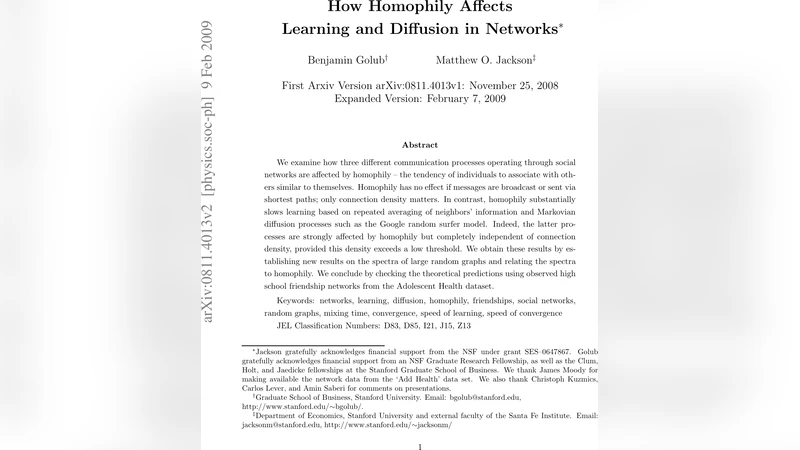
We examine how three different communication processes operating through social networks are affected by homophily – the tendency of individuals to associate with others similar to themselves. Homophily has no effect if messages are broadcast or sent via shortest paths; only connection density matters. In contrast, homophily substantially slows learning based on repeated averaging of neighbors’ information and Markovian diffusion processes such as the Google random surfer model. Indeed, the latter processes are strongly affected by homophily but completely independent of connection density, provided this density exceeds a low threshold. We obtain these results by establishing new results on the spectra of large random graphs and relating the spectra to homophily. We conclude by checking the theoretical predictions using observed high school friendship networks from the Adolescent Health dataset.
💡 Research Summary
The paper investigates how homophily—the tendency of individuals to associate with similar others—affects three canonical communication and learning processes that operate on social networks. The authors introduce a flexible “multi‑type random network” model in which nodes belong to a finite set of types and the probability of a link between two nodes depends only on their types, captured by a symmetric matrix P. When all entries of P are equal the model reduces to an Erdős‑Rényi graph; other special cases include Chung‑Lu degree‑heterogeneous graphs and spatial models. Homophily is represented by larger diagonal entries (within‑type link probabilities) relative to off‑diagonal entries (between‑type link probabilities).
Three processes are examined:
-
Shortest‑path communication – the time for a message to travel between two nodes is proportional to the length of the shortest path. This class includes broadcast protocols and any routing that follows optimal paths.
-
Linear updating (averaging) learning – each agent repeatedly replaces his belief with a weighted average of his neighbors’ beliefs. This is the classic DeGroot model and can be written as x(t+1)=W x(t) where W is a row‑stochastic matrix derived from the adjacency structure.
-
Random walk (Markovian diffusion) – a particle moves each step to a uniformly chosen neighbor; the Google “random surfer” model adds a teleportation component but the core dynamics are governed by the same transition matrix.
The key technical contribution is a new spectral theorem for large multi‑type random graphs. The authors prove that, as the number of nodes n grows, the second eigenvalue λ₂ of the normalized adjacency (or Laplacian) matrix converges to the second eigenvalue of the much smaller m × m matrix that contains only the expected linking probabilities between types. Consequently, the mixing time (or convergence speed) of any process that depends on λ₂ is determined almost entirely by the pattern of inter‑type link probabilities, not by the full‑size network.
From this result, the authors derive the following comparative statics:
-
For shortest‑path communication, the expected distance between two random nodes grows logarithmically with n and is essentially independent of homophily. Even when same‑type links are far more likely than cross‑type links, the number of nodes reachable in t steps still expands exponentially, so the average shortest‑path length remains unchanged. Only the overall link density (average degree) matters; increasing density shortens paths, but homophily does not.
-
For linear updating and random walks, the convergence speed is proportional to 1/(1‑λ₂). As homophily rises, within‑type connections dominate, cross‑type connections become scarce, and λ₂ approaches 1. This dramatically inflates the mixing time, slowing consensus formation or diffusion. Moreover, once the average degree exceeds a modest threshold (e.g., logarithmic in n), further increases in density have negligible impact on λ₂; the process is then governed solely by homophily.
To validate the theory, the authors analyze 50 high‑school friendship networks from the Add Health dataset. They define types by observable attributes (race, gender, grade) and compute a homophily index for each school. Simulations of the three processes on each network reveal:
- Broadcast/shortest‑path times are virtually identical across schools, confirming the theoretical independence from homophily.
- Both the DeGroot averaging dynamics and random‑walk mixing times increase sharply with the homophily index, matching the predicted relationship between λ₂ and the type‑level link matrix.
The empirical findings align closely with the analytical predictions, demonstrating that the spectral reduction captures the essential effect of homophily in realistic social structures.
The paper’s contributions are threefold:
- It provides a tractable, type‑based random‑graph framework that isolates the role of homophily while preserving the ability to model realistic degree heterogeneity.
- It establishes a novel spectral approximation that reduces the analysis of large networks to a low‑dimensional problem, linking homophily directly to the second eigenvalue that governs convergence and mixing.
- It shows, both theoretically and empirically, that homophily matters dramatically for processes that rely on repeated averaging or random walks, but not for those that depend on shortest‑path distances.
Policy implications follow naturally. In organizations or online platforms, simply adding more links (increasing density) will speed up broadcast‑style communication but will not accelerate consensus or information diffusion if the network remains highly homophilous. Conversely, fostering cross‑type connections—reducing homophily—can dramatically improve the speed of learning, opinion formation, and diffusion, even without changing the total number of links. This insight is valuable for designers of social media algorithms, managers of collaborative teams, and policymakers aiming to enhance social integration.
Comments & Academic Discussion
Loading comments...
Leave a Comment