Editorial: Statistics and forensic science
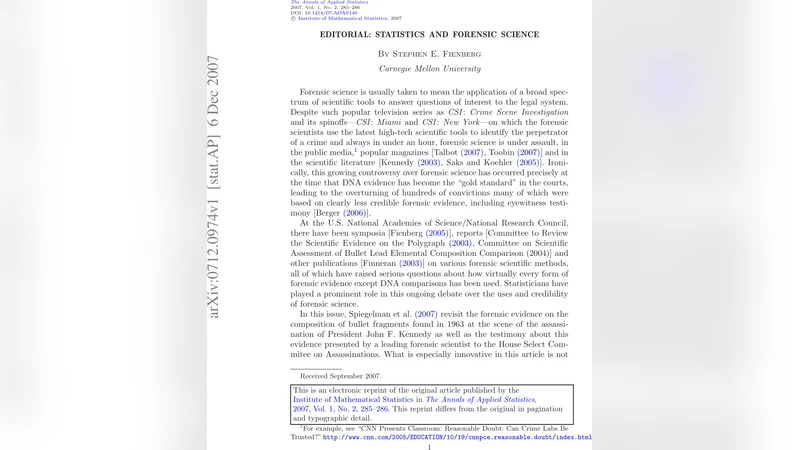
Forensic science is usually taken to mean the application of a broad spectrum of scientific tools to answer questions of interest to the legal system. Despite such popular television series as CSI: Crime Scene Investigation and its spinoffs–CSI: Miami and CSI: New York–on which the forensic scientists use the latest high-tech scientific tools to identify the perpetrator of a crime and always in under an hour, forensic science is under assault, in the public media, popular magazines [Talbot (2007), Toobin (2007)] and in the scientific literature [Kennedy (2003), Saks and Koehler (2005)]. Ironically, this growing controversy over forensic science has occurred precisely at the time that DNA evidence has become the ``gold standard’’ in the courts, leading to the overturning of hundreds of convictions many of which were based on clearly less credible forensic evidence, including eyewitness testimony [Berger (2006)].
💡 Research Summary
The paper “Statistics and Forensic Science” offers a comprehensive critique of contemporary forensic practice and argues that rigorous statistical validation is essential for restoring credibility to the field. It begins by contrasting the glamorous, rapid‑turnaround image of forensic work portrayed in popular television series such as CSI with the reality of most forensic disciplines, which rely on techniques that have rarely undergone systematic validation. The authors cite a wave of media criticism (e.g., Talbot 2007, Toobin 2007) and scholarly commentary (Kennedy 2003; Saks & Koehler 2005) that highlight the lack of scientific rigor, the absence of published error rates, and the consequent risk of wrongful convictions.
A central theme is the statistical misinterpretation of forensic evidence. Using Bayesian reasoning and the well‑known “prosecutor’s fallacy,” the authors demonstrate how forensic conclusions can be dramatically overstated when prior probabilities, sensitivity, and specificity are not properly accounted for. They point out that many traditional methods—fingerprint comparison, shoe‑print analysis, ballistics, and blood‑pattern interpretation—depend heavily on expert judgment, which introduces subjective bias and makes it difficult to quantify uncertainty. This lack of quantification has contributed to numerous cases where convictions were later overturned after DNA testing revealed errors in the original forensic assessment.
DNA analysis is presented as a benchmark of what a scientifically robust forensic technique should look like. The paper details how DNA laboratories follow standardized protocols, participate in external quality‑assessment schemes, and routinely publish error rates that are often on the order of one in a million. Because these statistical safeguards are in place, DNA evidence has become the “gold standard” and has been instrumental in exonerating hundreds of individuals whose convictions were based on less reliable evidence, including eyewitness testimony. Nevertheless, the authors caution that DNA is not infallible; contamination, mixed samples, and laboratory mistakes still pose statistical challenges that must be acknowledged in court.
In response to these findings, the authors propose a set of policy recommendations aimed at embedding statistical rigor throughout forensic science. First, they call for the development and mandatory adoption of standardized validation protocols for every forensic method, with results made publicly available. Second, they advocate for the routine reporting of method‑specific error rates, confidence intervals, and likelihood ratios, thereby giving judges and juries a clear quantitative basis for evaluating evidence. Third, they suggest that expert testimony should explicitly include statistical foundations and limitations, and that courts should require disclosure of the underlying data whenever possible. Fourth, they recommend integrating formal training in probability theory and statistical inference into forensic science curricula and continuing‑education programs for practicing analysts and legal professionals.
The paper concludes that without a systematic, statistically grounded framework, forensic science will continue to be vulnerable to both media sensationalism and judicial misuse. By aligning forensic practice with the standards of modern statistical science, the field can achieve greater transparency, reduce the incidence of wrongful convictions, and fulfill its ultimate mission of serving justice with reliable, scientifically validated evidence.
Comments & Academic Discussion
Loading comments...
Leave a Comment