Comment: Struggles with Survey Weighting and Regression Modeling
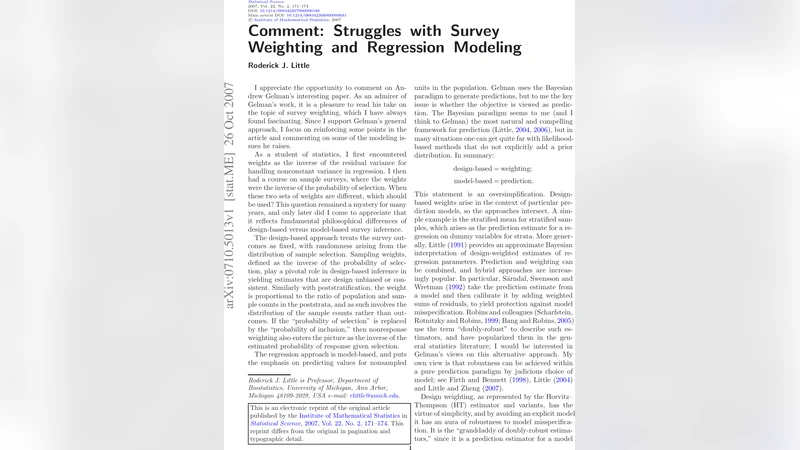
Comment: Struggles with Survey Weighting and Regression Modeling [arXiv:0710.5005]
💡 Research Summary
The paper addresses a long‑standing tension in survey analysis between the traditional design‑based approach, which relies on sampling weights to produce unbiased estimates, and the model‑based approach, which uses regression modeling to incorporate auxiliary information. The author begins by outlining the theoretical appeal of weighting: if the sampling design is correctly specified, weighting yields estimates that are unbiased for population quantities. However, in practice, surveys suffer from non‑response, selection bias, and measurement error, and the weights themselves are estimated rather than known. These imperfections introduce additional variance and can even lead to biased results when the weights are poorly calibrated, especially for small subpopulations.
The paper then turns to model‑based inference, emphasizing that regression models can “learn” the appropriate weighting from the data when key design variables are included as predictors. Hierarchical Bayesian models are highlighted as particularly powerful because they naturally accommodate multi‑level structure, borrow strength across groups, and produce posterior distributions for all parameters. By coupling such models with post‑stratification—adjusting model‑based predictions to known population margins—the analyst can correct for any residual discrepancies between the sample and the target population. This two‑step procedure effectively reduces the variance inflation caused by large or unstable weights while still controlling bias.
Through a series of simulations and a real‑world example, the author compares three strategies: (1) pure design‑based weighting, (2) pure regression without weights, and (3) a hybrid that incorporates weights into a hierarchical model followed by post‑stratification. The results show that pure weighting yields near‑zero bias but often suffers from high mean‑squared error due to inflated variance. Pure regression reduces variance but can be biased if important design variables are omitted. The hybrid approach consistently achieves the best trade‑off, delivering low bias and substantially lower variance than pure weighting.
A further contribution of the paper is a discussion of how to quantify the uncertainty associated with the weights themselves. The author proposes bootstrapping the weight construction process and propagating this uncertainty into the Bayesian model via informative priors. This yields credible intervals that more accurately reflect total uncertainty, including both sampling variability and weight estimation error.
In the concluding remarks, the author argues that survey practitioners should view weighting and modeling not as mutually exclusive alternatives but as complementary tools. The recommended workflow is to obtain the best possible design weights during the sampling phase, then employ hierarchical modeling with post‑stratification during analysis, explicitly accounting for weight uncertainty. This integrated strategy leverages the strengths of both paradigms, providing more reliable and efficient estimates for complex survey data.
Comments & Academic Discussion
Loading comments...
Leave a Comment