Causality and Association: The Statistical and Legal Approaches
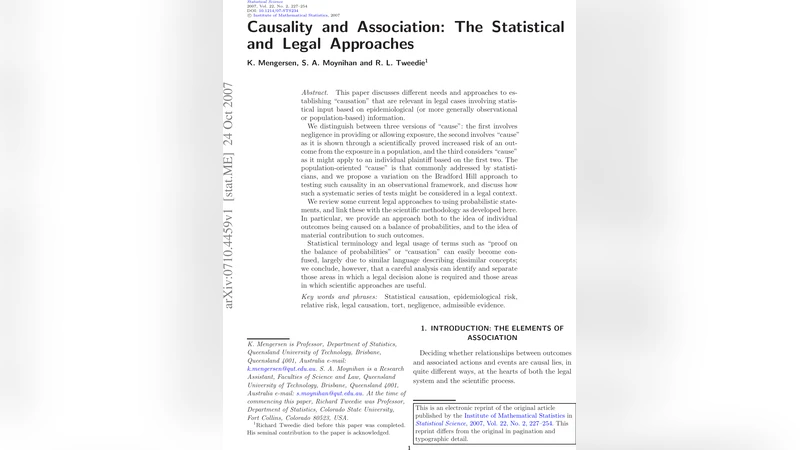
This paper discusses different needs and approaches to establishing causation'' that are relevant in legal cases involving statistical input based on epidemiological (or more generally observational or population-based) information. We distinguish between three versions of cause’’: the first involves negligence in providing or allowing exposure, the second involves cause'' as it is shown through a scientifically proved increased risk of an outcome from the exposure in a population, and the third considers cause’’ as it might apply to an individual plaintiff based on the first two. The population-oriented cause'' is that commonly addressed by statisticians, and we propose a variation on the Bradford Hill approach to testing such causality in an observational framework, and discuss how such a systematic series of tests might be considered in a legal context. We review some current legal approaches to using probabilistic statements, and link these with the scientific methodology as developed here. In particular, we provide an approach both to the idea of individual outcomes being caused on a balance of probabilities, and to the idea of material contribution to such outcomes. Statistical terminology and legal usage of terms such as proof on the balance of probabilities’’ or ``causation’’ can easily become confused, largely due to similar language describing dissimilar concepts; we conclude, however, that a careful analysis can identify and separate those areas in which a legal decision alone is required and those areas in which scientific approaches are useful.
💡 Research Summary
The paper addresses the persistent confusion surrounding the concept of “causation” when epidemiological or other observational data are introduced into legal proceedings. It begins by distinguishing three distinct notions of cause that operate at different levels of analysis. The first is the legal notion of negligence‑based causation, which asks whether a defendant’s act or omission created the exposure that led to the plaintiff’s injury. The second is the scientific, population‑level notion of causation, which asks whether the exposure is associated with a statistically significant increase in risk for the outcome in a defined group. The third bridges the first two and concerns the individual plaintiff: does the population‑level association, together with the defendant’s negligence, make it more likely than not that the plaintiff’s injury was caused by the exposure?
To evaluate the second, population‑level notion, the authors propose a modernized version of the Bradford Hill criteria. While retaining the classic nine criteria (strength, consistency, specificity, temporality, biological gradient, experimental evidence, plausibility, coherence, and analogy), they add explicit checks for confounding control and reverse causation, and they recommend quantitative synthesis methods such as meta‑analysis, hierarchical Bayesian models, and heterogeneity statistics to assess effect‑size variability. They also stress the need for dose‑response modeling, precise latency periods, and sensitivity analyses that test the robustness of the association to different model specifications. This systematic framework is presented as a “weight of evidence” approach that can be communicated to a court to demonstrate that the scientific evidence meets a high standard of reliability.
The third notion, causation at the individual level, is linked to the legal standard of “balance of probabilities.” The authors introduce the concept of “probability balance” to translate a population risk ratio into an individual‑level probability that the exposure caused the plaintiff’s injury. For example, a relative risk of 1.5 for a particular cancer implies that, absent other information, the probability that the exposure contributed to a given case exceeds 50 %. However, they caution that this translation must incorporate confidence intervals, adjustment for individual exposure intensity, and the presence of alternative causes. In addition, they differentiate this from “material contribution,” which quantifies the proportion of total risk attributable to the exposure (e.g., a 20 % attributable fraction) and can be used to apportion damages in a more granular way.
The paper then surveys current judicial practices concerning probabilistic statements. Many courts have adopted a simplistic rule that “more likely than not” (i.e., > 51 % probability) suffices for causation, often without regard for statistical uncertainty. The authors argue that such a rule conflates the legal threshold with statistical significance and can lead to erroneous conclusions. They recommend that judges separate the “weight of evidence” (the aggregate of scientific studies) from the “strength of causation” (the degree to which the evidence satisfies the Hill‑type criteria). By doing so, courts can better assess whether the scientific foundation is robust enough to support a finding of causation, and they can also decide when a purely legal judgment—such as the allocation of fault or the determination of reasonable doubt—is required.
In conclusion, the article provides a comprehensive roadmap for integrating rigorous epidemiological assessment with legal standards. It clarifies the distinct roles of negligence, population‑level risk, and individual‑level probability, offers a refined set of criteria for testing causality in observational data, and proposes practical ways to translate statistical findings into the legal concepts of balance of probabilities and material contribution. This interdisciplinary framework aims to improve the consistency and fairness of judgments that rely on complex scientific evidence, reducing the risk of both wrongful liability and unjust denial of compensation.
Comments & Academic Discussion
Loading comments...
Leave a Comment