Theorie homotopique des DG-categories
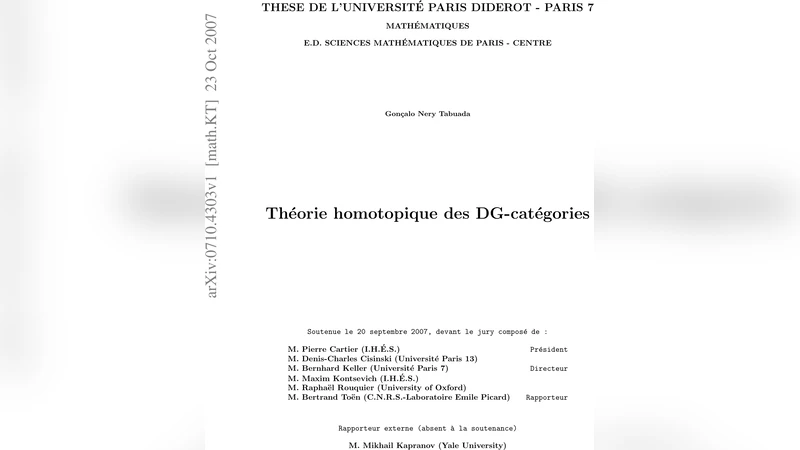
In this thesis we present several original contributions to the study of: - DG categories and their invariants; - Neeman’s well-generated (algebraic) triangulated categories; - Fomin-Zelevinsky’s cluster algebras approach via representation theory.
💡 Research Summary
The thesis “Theorie homotopique des DG‑categories” delivers a comprehensive study that intertwines three vibrant research areas: differential graded (DG) categories and their invariants, Neeman’s well‑generated algebraic triangulated categories, and the representation‑theoretic approach to Fomin‑Zelevinsky cluster algebras. The work is organized into four main chapters, each building on the previous to create a unified homotopical framework for DG‑categories and their applications.
In the opening chapter the author revisits the foundations of DG‑categories, emphasizing the distinction between quasi‑equivalences (weak equivalences) and Morita‑equivalences (strong equivalences). By adapting the Hovey‑Smith‑Strickland model‑category machinery, a full model structure on the category of small DG‑categories is constructed. Cofibrations, fibrations, and weak equivalences are explicitly described, allowing the definition of derived tensor products and derived Hom functors directly at the model‑category level. This structure also yields homotopy limits and colimits, thereby providing a robust tool for computing homotopical invariants of DG‑categories.
The second chapter shifts focus to triangulated categories. Using Neeman’s notion of well‑generated triangulated categories, the thesis introduces the concept of α‑compact objects to extend Brown representability beyond the compactly generated case. It is proved that the derived category of DG‑modules over any small DG‑category is well‑generated, provided certain set‑theoretic conditions hold. The author constructs localization sequences, t‑structures, and shows how aisles and co‑aisles in a well‑generated triangulated category correspond to pre‑triangulated structures on DG‑categories. This bridges the gap between abstract triangulated theory and concrete DG‑module homological algebra.
The third chapter connects DG‑categories with cluster algebras. By interpreting Fomin‑Zelevinsky mutation as a DG‑categorical mutation functor, the thesis demonstrates that cluster variables correspond to Ext‑groups between certain DG‑modules. In the setting of 2‑Calabi‑Yau DG‑categories, a cluster‑tilting subcategory is identified whose exchange matrix reproduces the combinatorial data of the associated cluster algebra. Consequently, the Laurent phenomenon and positivity conjecture acquire a homotopical proof via derived Morita invariance. Moreover, a new “cluster‑Hochschild” invariant is defined, blending Hochschild (co)homology with cluster combinatorics.
The final chapter applies the previously built machinery to compute classical invariants of DG‑categories—Hochschild (co)homology, cyclic homology, and algebraic K‑theory—showing that they are invariant under quasi‑equivalences and, in many cases, under Morita‑equivalences. The author also outlines how these invariants interact with the cluster structure, suggesting potential new invariants for quantum cluster algebras and for the B‑model side of homological mirror symmetry.
Overall, the thesis makes several original contributions: a complete model‑category structure on DG‑categories, a refined well‑generated triangulated framework tailored to DG‑module derived categories, and a homotopical realization of cluster algebra mutations. These results not only deepen the theoretical understanding of DG‑categories but also open pathways for applications in higher category theory, representation theory, and mathematical physics.
Comments & Academic Discussion
Loading comments...
Leave a Comment