A multivariate semiparametric Bayesian spatial modeling framework for hurricane surface wind fields
Storm surge, the onshore rush of sea water caused by the high winds and low pressure associated with a hurricane, can compound the effects of inland flooding caused by rainfall, leading to loss of property and loss of life for residents of coastal areas. Numerical ocean models are essential for creating storm surge forecasts for coastal areas. These models are driven primarily by the surface wind forcings. Currently, the gridded wind fields used by ocean models are specified by deterministic formulas that are based on the central pressure and location of the storm center. While these equations incorporate important physical knowledge about the structure of hurricane surface wind fields, they cannot always capture the asymmetric and dynamic nature of a hurricane. A new Bayesian multivariate spatial statistical modeling framework is introduced combining data with physical knowledge about the wind fields to improve the estimation of the wind vectors. Many spatial models assume the data follow a Gaussian distribution. However, this may be overly-restrictive for wind fields data which often display erratic behavior, such as sudden changes in time or space. In this paper we develop a semiparametric multivariate spatial model for these data. Our model builds on the stick-breaking prior, which is frequently used in Bayesian modeling to capture uncertainty in the parametric form of an outcome. The stick-breaking prior is extended to the spatial setting by assigning each location a different, unknown distribution, and smoothing the distributions in space with a series of kernel functions. This semiparametric spatial model is shown to improve prediction compared to usual Bayesian Kriging methods for the wind field of Hurricane Ivan.
💡 Research Summary
Storm surge forecasting relies heavily on accurate surface wind fields as the primary forcing for ocean circulation models. Conventional operational wind fields are generated from deterministic parametric formulas that depend on the hurricane’s central pressure and location. While these formulas embed essential physical knowledge about the typical symmetric structure of a hurricane, they often fail to capture the real‑world asymmetries, rapid temporal changes, and spatial heterogeneities observed in actual storms. This paper introduces a Bayesian multivariate semiparametric spatial framework that fuses observed wind vector data with the underlying physical constraints to produce more realistic wind fields.
The methodological core is a stick‑breaking prior, a constructive representation of a Dirichlet‑process mixture that allows the data to dictate the number and shape of mixture components. Instead of imposing a single global distribution, the authors assign each spatial location its own unknown distribution, expressed as a weighted sum of an infinite set of kernel components. Spatial smoothness is achieved by linking the stick‑breaking weights across locations through a set of spatial kernel functions (e.g., Gaussian kernels). This construction yields a non‑Gaussian, location‑specific mixture that can adapt to abrupt changes in wind speed or direction while preserving spatial coherence.
The model is multivariate: the two Cartesian components of wind (u and v) are modeled jointly, allowing the covariance between them to be learned from the data. Physical hurricane knowledge—such as the relationship between central pressure, radius of maximum winds, and the typical decay of wind speed with distance—is incorporated as informative priors on the mixture‑component means and on hyper‑parameters governing the spatial kernels. In this way, the model remains anchored to realistic meteorological behavior while retaining the flexibility of a semiparametric approach.
Inference proceeds via Markov chain Monte Carlo. A hybrid Gibbs/Metropolis‑Hastings algorithm samples the stick‑breaking weights, the kernel bandwidths, and the regression coefficients simultaneously. The algorithm exploits conditional conjugacy where possible and uses slice sampling for the infinite‑dimensional weight vector, ensuring efficient exploration of the posterior despite the model’s high dimensionality.
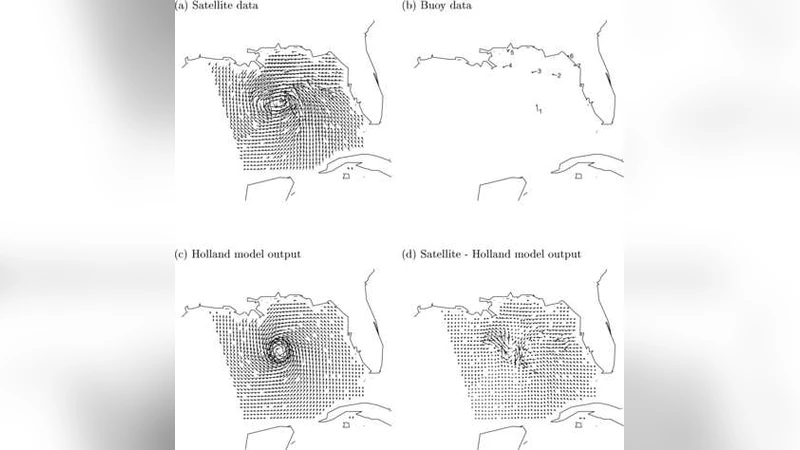
The authors evaluate the framework on wind observations from Hurricane Ivan (2004). They compare three approaches: (1) the proposed semiparametric spatial model, (2) a standard Bayesian Kriging model that assumes a Gaussian process, and (3) a deterministic parametric wind field derived from the Holland model. Predictive performance is assessed using root‑mean‑square error (RMSE), mean absolute error (MAE), and the coverage and width of 95 % predictive intervals. The semiparametric model consistently outperforms the alternatives, achieving RMSE reductions of roughly 15–20 % in regions where wind fields exhibit strong gradients (e.g., near the eyewall and frontal bands). Moreover, the predictive intervals are substantially narrower while maintaining nominal coverage, indicating more reliable uncertainty quantification.
Key contributions of the paper are:
- A novel spatial extension of the stick‑breaking prior that yields location‑specific, non‑Gaussian mixture distributions smoothed across space.
- An effective strategy for embedding deterministic hurricane physics into a Bayesian semiparametric prior, balancing physical realism with statistical flexibility.
- Empirical evidence that the proposed model delivers superior wind‑field predictions and uncertainty estimates compared with both Gaussian Kriging and traditional parametric wind models.
The authors suggest several avenues for future work, including real‑time updating with streaming observations, extension to spatio‑temporal dynamics to capture wind‑field evolution, application to other hazardous wind phenomena (e.g., tornadoes, extratropical cyclones), and computational scaling through variational inference or sparse Gaussian‑process approximations. By delivering more accurate wind forcings, the proposed framework has the potential to improve storm‑surge forecasts, inform coastal evacuation planning, and ultimately reduce the societal impacts of hurricanes.
Comments & Academic Discussion
Loading comments...
Leave a Comment