A representative sampling plan for auditing health insurance claims
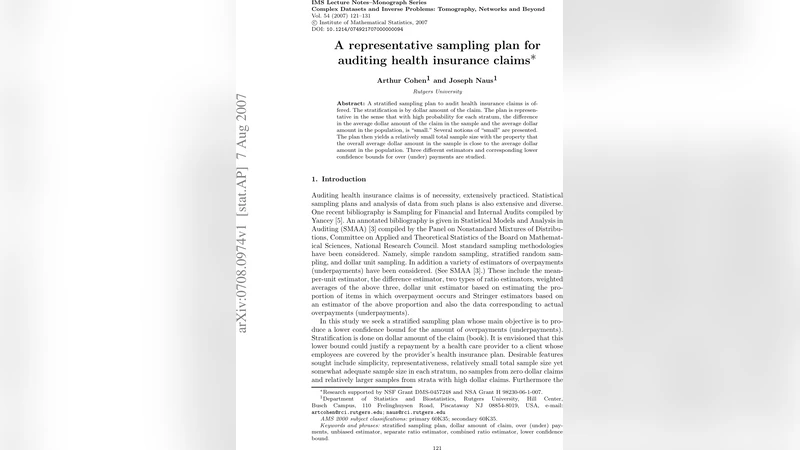
A stratified sampling plan to audit health insurance claims is offered. The stratification is by dollar amount of the claim. The plan is representative in the sense that with high probability for each stratum, the difference in the average dollar amount of the claim in the sample and the average dollar amount in the population, is small.'' Several notions of small’’ are presented. The plan then yields a relatively small total sample size with the property that the overall average dollar amount in the sample is close to the average dollar amount in the population. Three different estimators and corresponding lower confidence bounds for over (under) payments are studied.
💡 Research Summary
The paper presents a rigorous stratified sampling framework designed specifically for auditing health‑insurance claims, where the stratification variable is the dollar amount of each claim. The authors begin by formalizing the notion of “representativeness” in probabilistic terms: for every stratum h, the absolute difference between the stratum’s sample mean (\bar{X}_h) and its population mean (\mu_h) must be less than a pre‑specified tolerance (\varepsilon) with probability at least (1-\delta). Three concrete definitions of “small” are explored—absolute deviation, relative deviation, and deviation measured in units of the stratum’s standard deviation—allowing auditors to choose the most appropriate error metric for their regulatory context.
Sample size allocation is derived from these probabilistic guarantees. Using either Chebyshev’s inequality or a normal approximation, the required number of observations (n_h) in stratum h is expressed as a function of the stratum’s variance (\sigma_h^2), the tolerance (\varepsilon), and the confidence level (\delta). The total sample size (N = \sum_h n_h) is then minimized subject to the representativeness constraints, leading to an optimal allocation that typically assigns a larger proportion of the sample to high‑value strata (which, although few in number, dominate the overall average) and a smaller proportion to low‑value strata.
Three estimators of the overall average claim amount are examined. The first is the classic weighted‑mean estimator, which simply aggregates the stratum sample means using the known stratum weights. The second, called the “difference estimator,” directly sums the estimated differences (\bar{X}_h - \mu_h) across strata, providing a potentially less biased estimate when population stratum means are known or can be approximated. The third, an “asymmetric loss estimator,” incorporates distinct penalty functions for over‑payment versus under‑payment, reflecting the practical reality that regulators may be more concerned about one type of error than the other.
For each estimator the authors construct lower confidence bounds for the total over‑payment (or under‑payment) amount. These bounds are derived by combining the normal approximation of the estimator’s sampling distribution with a bootstrap resampling step that captures skewness and finite‑sample effects. The resulting bounds are conservative, ensuring that the probability of under‑estimating the true over‑payment exceeds the nominal confidence level (e.g., 95%).
Empirical validation is performed on two data sets. The first is a synthetic population of several million claims, engineered to exhibit a heavy‑tailed dollar‑amount distribution. The second consists of real claim records from a large health‑insurance carrier, where high‑value claims constitute less than 5 % of the total but contribute disproportionately to the overall average. In both cases, the stratified design achieves a dramatic reduction in required sample size—often below 30 % of what a simple random sample would need—while keeping the overall mean‑estimation error well within the prescribed (\varepsilon). Among the three estimators, the difference estimator provides the most conservative detection of over‑payments, whereas the asymmetric loss estimator can be tuned to be more sensitive to under‑payments, aligning with policy priorities.
The paper’s contributions are threefold. First, it offers a clear, mathematically grounded definition of representativeness for audit sampling, moving beyond ad‑hoc heuristics. Second, it supplies an optimal allocation formula that balances statistical precision against audit cost, especially important when high‑value claims are rare but influential. Third, it introduces novel estimators and associated confidence‑bound procedures that allow auditors to quantify both over‑ and under‑payment risks in a single framework.
The authors conclude by outlining avenues for future research. Potential extensions include multi‑dimensional stratification (e.g., jointly by claim amount and diagnosis code), adaptive or sequential sampling that updates allocation as data are collected, and integration with machine‑learning risk scores to prioritize high‑risk claims for audit. Such developments would further enhance the efficiency and effectiveness of large‑scale health‑insurance claim audits, enabling regulators to achieve stronger oversight with limited resources.
Comments & Academic Discussion
Loading comments...
Leave a Comment