Comment: Monitoring Networked Applications With Incremental Quantile Estimation
Our comments are in two parts. First, we make some observations regarding the methodology in Chambers et al. [arXiv:0708.0302]. Second, we briefly describe another interesting network monitoring probl
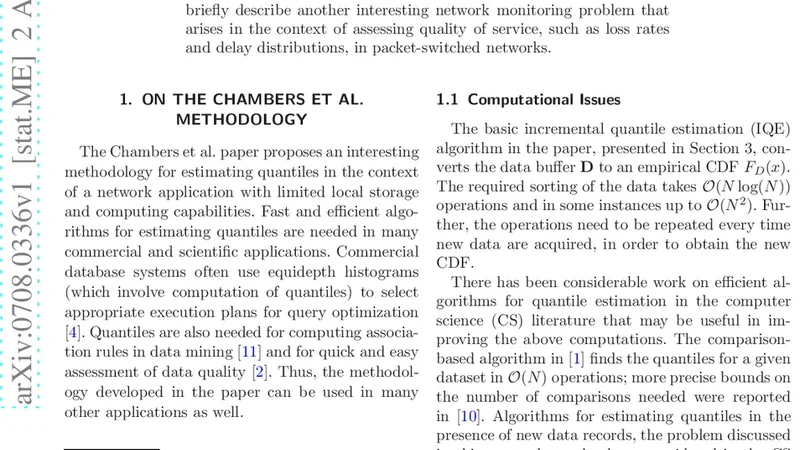
Our comments are in two parts. First, we make some observations regarding the methodology in Chambers et al. [arXiv:0708.0302]. Second, we briefly describe another interesting network monitoring problem that arises in the context of assessing quality of service, such as loss rates and delay distributions, in packet-switched networks.
💡 Research Summary
The paper is organized into two distinct sections. The first part offers a critical appraisal of the methodology presented by Chambers et al. in their work “Monitoring Networked Applications With Incremental Quantile Estimation.” Chambers and colleagues introduced an incremental quantile (IQ) algorithm designed to estimate distributional quantiles on high‑volume data streams while keeping memory consumption and computational overhead low. The authors of the present commentary argue that, despite its elegance, the IQ approach suffers from several practical and statistical shortcomings that limit its applicability to real‑world network monitoring.
First, the rank‑based nature of IQ makes it vulnerable to bias when the underlying data exhibit abrupt bursts—a common characteristic of network traffic. Historical observations continue to exert undue influence on current quantile estimates, causing the algorithm to lag behind rapid changes in the distribution. Second, the algorithm assumes a fixed update interval, which conflicts with the need for adaptive sampling rates in network devices that must throttle or accelerate data collection based on current load. Third, IQ provides only point estimates; it lacks a built‑in mechanism for quantifying uncertainty or constructing confidence intervals, a critical requirement for operational decision‑making. Fourth, the internal data structures required to maintain incremental ranks are relatively complex and can consume significant CPU cycles and memory, making deployment on high‑performance routers or embedded monitoring agents problematic.
To address these issues, the authors discuss alternative streaming quantile techniques. Traditional histogram‑based methods, while more memory‑intensive, can be tuned to capture distributional shifts more responsively and can be extended to provide variance estimates. Kernel density estimators (KDE) offer smooth approximations and natural bandwidth selection, albeit at higher computational cost. More recent algorithms such as t‑digest and Q‑digest achieve a favorable trade‑off between accuracy, memory footprint, and the ability to merge summaries from distributed sources. These alternatives also lend themselves to straightforward derivation of error bounds, which can be communicated to operators.
The second part of the paper shifts focus to a related but distinct monitoring problem that arises in quality‑of‑service (QoS) assessment for packet‑switched networks: the real‑time estimation of packet loss rates and delay distributions. Loss rates can be modeled as Bernoulli processes, while delays typically follow heavy‑tailed, asymmetric distributions that are well characterized by their quantiles (e.g., median, 95th percentile). The authors argue that the same limitations identified for IQ apply to naïve streaming quantile estimators of delay metrics. Consequently, they propose a hybrid approach that combines adaptive sampling, weighted updates, and Bayesian posterior updating. In this framework, recent observations receive higher weight, and the posterior distribution over quantiles is updated incrementally, yielding both a point estimate and a credible interval. This method can react quickly to sudden congestion events, provide statistically sound uncertainty measures, and be efficiently merged across multiple monitoring points.
In conclusion, the commentary acknowledges that incremental quantile estimation is an intellectually appealing solution for low‑resource environments, but it stresses that robust network monitoring demands algorithms that mitigate bias, support dynamic update schedules, quantify estimation uncertainty, and remain computationally lightweight for deployment on constrained hardware. The authors advocate for the adoption of more adaptive streaming statistics—such as t‑digest, Q‑digest, or Bayesian‑enhanced quantile trackers—especially when monitoring QoS‑critical metrics like loss and delay, where accurate, timely, and trustworthy quantile information directly influences network management decisions.
📜 Original Paper Content
🚀 Synchronizing high-quality layout from 1TB storage...