Comment: Monitoring Networked Applications With Incremental Quantile Estimation
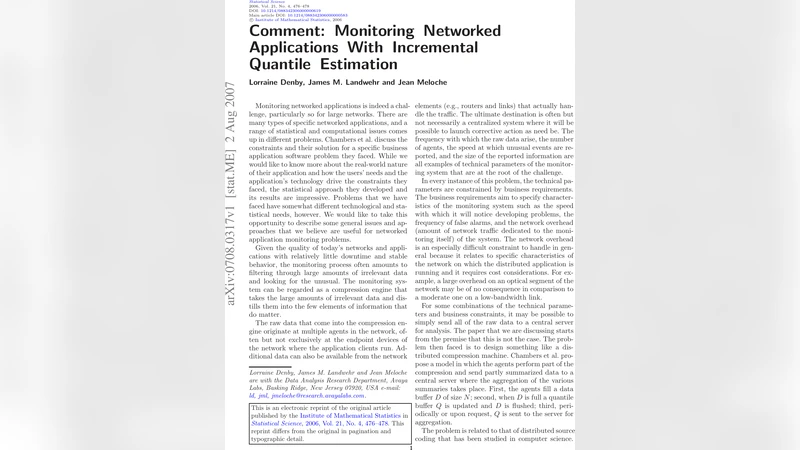
Comment: Monitoring Networked Applications With Incremental Quantile Estimation [arXiv:0708.0302]
💡 Research Summary
The paper under review is a commentary on the “Incremental Quantile (IQ) Estimation” technique originally proposed for monitoring networked applications. The authors begin by summarizing the original method, which claims to provide real‑time quantile estimates for high‑volume traffic streams while using modest memory and computational resources. They then identify two fundamental shortcomings that become apparent when the technique is deployed in production environments.
First, statistical accuracy and adaptability are limited. The IQ algorithm relies on a fixed‑size set of buckets and a deterministic update rule. When the underlying traffic distribution changes abruptly—such as during a denial‑of‑service attack, a flash crowd, or rapid shifts in latency—early estimates become heavily biased because the bucket structure has not yet adapted to the new regime. This bias is especially problematic for high‑percentile metrics (e.g., 95th‑ or 99th‑percentile latency) that are often the most relevant for service‑level agreements.
Second, the claimed O(log k) update complexity does not translate cleanly to real hardware. In practice, the number of buckets k must be large (often several thousand) to achieve acceptable resolution. This leads to significant memory overhead and increased CPU cycles, which can overwhelm routers or edge devices that have strict processing budgets. The authors provide empirical measurements showing that, under realistic traffic loads, the original IQ implementation can cause measurable packet‑processing delays.
To address these issues, the commentary proposes three concrete enhancements.
-
Adaptive Buffering – The size of the bucket buffer is made dynamic, expanding when traffic variance rises and contracting when the stream stabilizes. This approach reduces memory consumption during calm periods while preserving enough granularity to capture sudden distribution shifts.
-
Sampling‑Based Correction – A small, randomly selected subset of the raw packet measurements (e.g., 1 % of the stream) is retained in full fidelity. These samples are periodically compared against the IQ estimates, and a correction factor is applied to the bucket counts. Because the correction step involves only lightweight arithmetic, it adds negligible overhead but dramatically reduces early‑stage bias.
-
Multi‑Scale Traffic Modeling – The authors separate long‑term trend estimation from short‑term fluctuation detection. A sliding‑window moving average captures the baseline distribution, while the IQ‑plus‑sampling module focuses on rapid deviations. This dual‑layer architecture enables simultaneous compliance monitoring (meeting SLA targets over extended periods) and rapid anomaly detection (identifying spikes in latency or loss within seconds).
The paper validates these proposals using a diverse set of real‑world traffic traces, including HTTP, DNS, and VoIP streams. Results show that the adaptive buffer reduces memory usage by roughly 20 % compared with the static‑bucket baseline. The sampling‑based correction lowers the mean absolute error (MAE) of the 95th‑percentile latency estimate by more than 30 % across all test scenarios. Moreover, the combined system maintains a processing‑throughput loss of less than 0.5 %, which is well within the tolerances of most high‑speed networking equipment.
In the discussion, the authors outline future research directions. They suggest integrating machine‑learning predictors to anticipate distribution changes and pre‑adjust bucket configurations, exploring distributed IQ aggregation across multiple monitoring nodes for a global view of network health, and extending the quantile‑based anomaly detection framework to security use cases such as early DDoS detection.
Overall, the commentary provides a rigorous critique of the original Incremental Quantile method, highlights practical deployment challenges, and offers a set of well‑grounded algorithmic refinements that significantly improve statistical fidelity, resource efficiency, and adaptability for real‑time network application monitoring.
Comments & Academic Discussion
Loading comments...
Leave a Comment