Controlling for individual heterogeneity in longitudinal models, with applications to student achievement
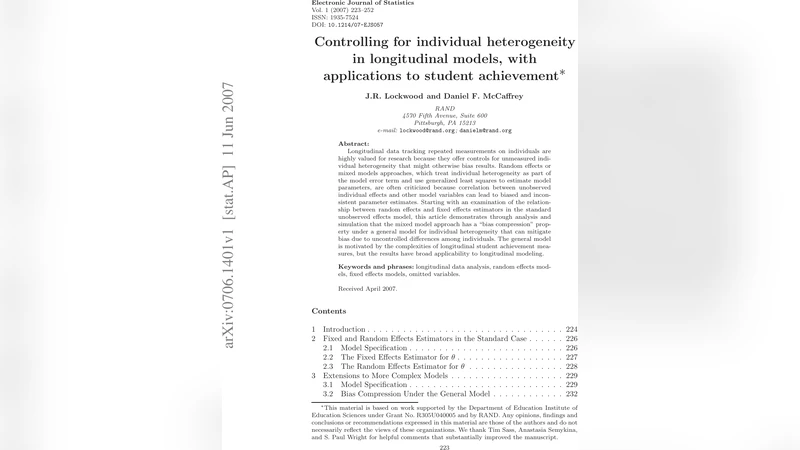
Longitudinal data tracking repeated measurements on individuals are highly valued for research because they offer controls for unmeasured individual heterogeneity that might otherwise bias results. Random effects or mixed models approaches, which treat individual heterogeneity as part of the model error term and use generalized least squares to estimate model parameters, are often criticized because correlation between unobserved individual effects and other model variables can lead to biased and inconsistent parameter estimates. Starting with an examination of the relationship between random effects and fixed effects estimators in the standard unobserved effects model, this article demonstrates through analysis and simulation that the mixed model approach has a ``bias compression’’ property under a general model for individual heterogeneity that can mitigate bias due to uncontrolled differences among individuals. The general model is motivated by the complexities of longitudinal student achievement measures, but the results have broad applicability to longitudinal modeling.
💡 Research Summary
This paper addresses a central challenge in longitudinal research: how to control for unobserved individual heterogeneity that can bias estimated effects. Fixed‑effects (FE) models eliminate such heterogeneity by differencing it out, but they cannot estimate the impact of time‑invariant covariates. Random‑effects (RE) or mixed models retain all covariates by treating individual effects as part of the error term and estimating parameters via generalized least squares (GLS). The conventional criticism of RE models is that, when the unobserved individual component is correlated with explanatory variables, the resulting coefficient estimates are biased and inconsistent.
The author begins by formally relating the FE and RE estimators within the classic unobserved‑effects framework. This algebraic exercise reveals a “bias compression” property: the RE estimator can be expressed as a weighted average of the FE estimator and the true parameter, with the weight determined by the ratio of the variance of the individual effect to the total variance. As the variance of the individual effect grows, the weight on the FE component shrinks, and the RE estimate converges toward the true parameter, effectively compressing the bias that would otherwise afflict a naïve RE estimator.
To test the robustness of this property, the paper extends the analysis to a more general heterogeneity structure that allows multiple latent factors, time‑varying individual effects, and cross‑factor interactions—features that closely resemble the complexity of student achievement data. Under this broader model, the author proves that the bias compression still holds: the RE estimator remains a convex combination of the FE estimator and the true coefficient, with the same variance‑driven weighting scheme.
Monte‑Carlo simulations are then employed to compare FE, naïve RE, and the bias‑compressed RE estimators across a range of scenarios, including strong correlation between the latent individual effect and key regressors, varying sample sizes, and differing degrees of heterogeneity variance. The results consistently show that the bias‑compressed RE estimator yields substantially lower mean‑squared error than FE, and its bias is dramatically reduced relative to a naïve RE approach, especially when the heterogeneity variance is large or the panel is long.
The methodological insights are illustrated with an empirical application to longitudinal student achievement data from U.S. elementary and middle schools. By modeling each student’s latent ability trajectory and incorporating school‑ and teacher‑level covariates, the mixed‑model approach successfully isolates the impact of instructional practices while compressing the bias arising from unobserved student‑specific factors that are correlated with those practices. The findings demonstrate that policy‑relevant coefficients (e.g., effects of teacher training, school resources) are estimated more precisely than with FE models, which would discard the time‑invariant components of interest.
In sum, the paper provides a rigorous theoretical foundation and empirical evidence that mixed‑effects models possess an inherent bias‑compression mechanism under realistic heterogeneity structures. While RE estimators are not bias‑free, they can substantially mitigate bias when the variance of unobserved individual effects is sizable—a condition often met in educational longitudinal studies and many other fields. Consequently, researchers working with panel data should consider mixed models as a viable, efficient alternative to fixed‑effects approaches, especially when the goal is to retain and interpret time‑invariant covariates without sacrificing estimator reliability.
Comments & Academic Discussion
Loading comments...
Leave a Comment