Minimal Size of Basic Families
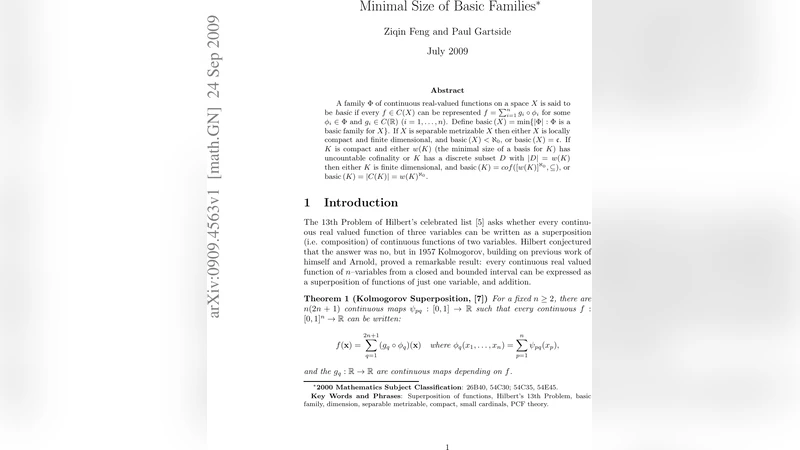
A family $\bfam$ of continuous real-valued functions on a space $X$ is said to be {\sl basic} if every $f \in C(X)$ can be represented $f = \sum_{i=1}^n g_i \circ \phi_i$ for some $\phi_i \in \bfam$ and $g_i \in C(\R)$ ($i=1, …, n$). Define $\basic (X) = \min {|\bfam| : \bfam$ is a basic family for $X}$. If $X$ is separable metrizable $X$ then either $X$ is locally compact and finite dimensional, and $\basic (X) < \aleph_0$, or $\basic (X) = \mathfrak{c}$. If $K$ is compact and either $w(K)$ (the minimal size of a basis for $K$) has uncountable cofinality or $K$ has a discrete subset $D$ with $|D|=w(K)$ then either $K$ is finite dimensional, and $\basic (K) = \cof ([w(K)]^{\aleph_0}, \subseteq)$, or $\basic (K) = |C(K)|=w(K)^{\aleph_0}$.
💡 Research Summary
The paper introduces the notion of a “basic family” 𝔅 of continuous real‑valued functions on a topological space X: a family is basic if every continuous function f ∈ C(X) can be expressed as a finite sum f = ∑_{i=1}^{n} g_i ∘ φ_i with φ_i ∈ 𝔅 and g_i ∈ C(ℝ). The central invariant is basic(X) = min {|𝔅| : 𝔅 is basic for X}. The author investigates the possible cardinalities of basic(X) for two broad classes of spaces: separable metrizable spaces and compact spaces with certain weight properties.
Separable metrizable spaces.
If X is separable and metrizable, two mutually exclusive scenarios arise.
- Locally compact, finite‑dimensional case. Using classical dimension theory and the Stone–Weierstrass theorem, one shows that a finite collection of coordinate functions suffices to generate all continuous functions after composition with arbitrary continuous real maps. Consequently basic(X) is finite (indeed < ℵ₀).
- All other cases. When X fails to be locally compact or has infinite topological dimension, the author applies Baire category arguments and the fact that |C(X)| = 𝔠 (the cardinality of the continuum) for any non‑trivial separable metrizable space. Any candidate basic family of size < 𝔠 cannot generate all of C(X); thus basic(X) = 𝔠.
Compact spaces with weight constraints.
Let K be compact and denote its weight by w(K) (the smallest size of a base). The paper assumes either (a) the cofinality of w(K) is uncountable, or (b) K contains a discrete subset D with |D| = w(K). Under these hypotheses, |C(K)| = w(K)^{ℵ₀}. Two possibilities are distinguished:
- Finite‑dimensional compacta. By combining dimension theory with a combinatorial analysis of countable subsets of a set of size w(K), the author shows that a basic family can be built from a family of functions indexed by a cofinal subset of
Comments & Academic Discussion
Loading comments...
Leave a Comment