On Hilberts 13th Problem
Every continuous function of two or more real variables can be written as the superposition of continuous functions of one real variable along with addition.
Authors: Ziqin Feng, Paul Gartside
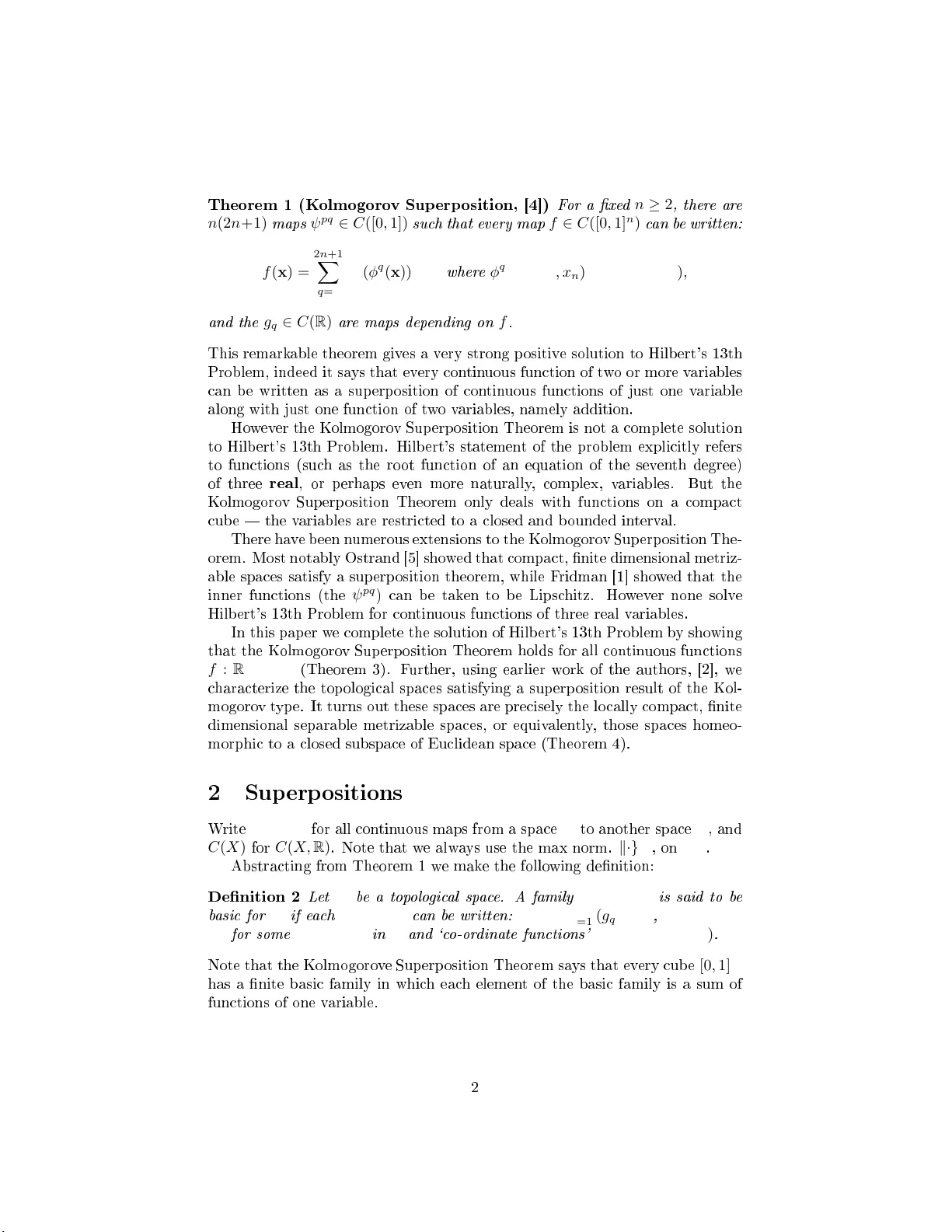
On Hilb ert's 13th Problem ∗ Ziqin F eng † and P aul Gartside ‡ July 2009 Abstrat Ev ery on tin uous funtion of t w o or more real v ariables an b e written as the sup erp osition of on tin uous funtions of one real v ariable along with addition. 1 In tro dution The 13th Problem from Hilb ert's famous list [3℄ asks whether ev ery on tin uous funtion of three v ariables an b e written as a sup erp osition (in other w ords, omp osition) of on tin uous funtions of t w o v ariables. Hilb ert an tiipated a negativ e answ er sa ying, it is probable that the ro ot of the equation of the sev en th degree is a funtion of its o eien ts whi h [...℄ annot b e onstruted b y a nite n um b er of insertions of funtions of t w o argumen ts. In order to pro v e this, the pro of w ould b e neessary that the equation of the sev en th degree f 7 + xf 3 + y f 2 + z f + 1 = 0 is not solv able with the help of an y on tin uous funtions of only t w o argumen ts. It to ok o v er 50 y ears for signian t progress to b e made on Hilb ert's 13th Prob- lem. Then in 1954 Vitushkin [ 6℄ found a result in the diretion Hilb ert exp eted: if n/q > n ′ /q ′ then there are funtions of n v ariables with all q th order deriv a- tiv es on tin uous whi h an not b e written as a sup erp osition of funtions of n ′ v ariables and all q ′ th order deriv ativ es on tin uous. In partiular, there are on tin uously dieren tiable funtions of three v ariables whi h an not b e written as a sup erp osition of on tin uously dieren tiable funtions of t w o v ariables. Ho w ev er K olmogoro v and Arnold subsequen tly pro v ed a series of results ulminating with K olmogoro v's 1957 Sup erp osition Theorem. ∗ 2000 Mathematis Sub jet Classiation : 26B40, 54C30; 54C35, 54E45. Key W ords and Phrases : Sup erp osition of funtions, nite dimension, lo ally ompat, basi family , Hilb ert's 13th Problem. † Departmen t of Mathematis, Univ ersit y of Pittsburgh, P A 15260, USA ‡ Corr esp onding author Departmen t of Mathematis, Univ ersit y of Pittsburgh, Pittsburgh, P A 15260, USA, email: gartsidemath.pitt.edu. 1 Theorem 1 (K olmogoro v Sup erp osition, [ 4 ℄) F or a xe d n ≥ 2 , ther e ar e n (2 n + 1) maps ψ pq ∈ C ([0 , 1]) suh that every map f ∈ C ([0 , 1] n ) an b e written: f ( x ) = 2 n +1 X q =1 g q ( φ q ( x )) wher e φ q ( x 1 , . . . , x n ) = n X p =1 ψ pq ( x p ) , and the g q ∈ C ( R ) ar e maps dep ending on f . This remark able theorem giv es a v ery strong p ositiv e solution to Hilb ert's 13th Problem, indeed it sa ys that ev ery on tin uous funtion of t w o or more v ariables an b e written as a sup erp osition of on tin uous funtions of just one v ariable along with just one funtion of t w o v ariables, namely addition. Ho w ev er the K olmogoro v Sup erp osition Theorem is not a omplete solution to Hilb ert's 13th Problem. Hilb ert's statemen t of the problem expliitly refers to funtions (su h as the ro ot funtion of an equation of the sev en th degree) of three real , or p erhaps ev en more naturally , omplex, v ariables. But the K olmogoro v Sup erp osition Theorem only deals with funtions on a ompat ub e the v ariables are restrited to a losed and b ounded in terv al. There ha v e b een n umerous extensions to the K olmogoro v Sup erp osition The- orem. Most notably Ostrand [5 ℄ sho w ed that ompat, nite dimensional metriz- able spaes satisfy a sup erp osition theorem, while F ridman [1℄ sho w ed that the inner funtions (the ψ pq ) an b e tak en to b e Lips hitz. Ho w ev er none solv e Hilb ert's 13th Problem for on tin uous funtions of three real v ariables. In this pap er w e omplete the solution of Hilb ert's 13th Problem b y sho wing that the K olmogoro v Sup erp osition Theorem holds for all on tin uous funtions f : R m → R (Theorem 3). F urther, using earlier w ork of the authors, [2℄, w e haraterize the top ologial spaes satisfying a sup erp osition result of the K ol- mogoro v t yp e. It turns out these spaes are preisely the lo ally ompat, nite dimensional separable metrizable spaes, or equiv alen tly , those spaes homeo- morphi to a losed subspae of Eulidean spae (Theorem 4). 2 Sup erp ositions W rite C ( X , Y ) for all on tin uous maps from a spae X to another spae Y , and C ( X ) for C ( X , R ) . Note that w e alw a ys use the max norm. k·} ∞ , on R m . Abstrating from Theorem 1 w e mak e the follo wing denition: Denition 2 L et X b e a top olo gi al sp a e. A family Φ ⊆ C ( X ) is said to b e b asi for X if e ah f ∈ C ( X ) an b e written: f = P n q =1 ( g q ◦ φ q ) , for some φ 1 , · · · , φ n in Φ and ` o-or dinate funtions' g 1 , . . . , g n ∈ C ( R ) . Note that the K olmogoro v e Sup erp osition Theorem sa ys that ev ery ub e [0 , 1] m has a nite basi family in whi h ea h elemen t of the basi family is a sum of funtions of one v ariable. 2 Theorem 3 Fix m in N . Ther e exist ψ pq ∈ C ( R ) , for q = 1 , 2 , . . . , 2 m + 1 and p = 1 , 2 , . . . , m , suh that for any funtion f ∈ C ( R m ) , ther e an b e found funtions g 1 , . . . , g 2 m +1 in C ( R ) suh that: f ( x ) = 2 m +1 X q =1 g q ( φ q ( x )) , wher e φ q ( x 1 , . . . , x m ) = ψ 1 q ( x 1 ) + · · · + ψ mq ( x m ) . Pro of. W e break the pro of in to four parts. In the rst step w e dene a family of `grids', and appro ximations to the funtions ψ pq . Next w e dene the ψ pq and φ q , and establish ertain useful prop erties of the grids and funtions. In the nal t w o steps w e sho w that the funtions φ q are basi for R m , rst for ompatly supp orted funtions, and then in general. 1. Constrution of the Grids and Appro ximations W e establish b y in- dution on k , the existene for ea h k ∈ N , p = 1 , 2 , . . . , m , and q = 1 , 2 , . . . , 2 m + 1 , of p ositiv e ǫ k , γ k < 1 / 10 , distint p ositiv e prime n um b ers P pq k > m + 10 , disrete families (`grids') S q k of op en in terv als of R and on tin uous funtions f pq k : R → R su h that: (1) the sequenes of ǫ k 's and γ k 's b oth stritly derease to zero (in fat, for all k , 0 < ǫ k +1 < ǫ k / 6 and 0 < γ k < 1 /k ), (2) ea h mem b er of S q k has diameter ≤ γ k , for ea h xed k an y t w o of the families {S q k : q = 1 , . . . , 2 m + 1 } o v er [ − k , k ] , and all o v er {− k , 0 , k } ; (3) mǫ k < 1 / Q m p =1 P pq k for ea h q = 1 , 2 , . . . , 2 m + 1 ; (4) f pq k is nondereasing on R + , noninreasing on R − and onstan t outside [ − k , k ] ; (5) f pq k is onstan t on ea h mem b er of S q k with v alue a p ositiv e in tegral m ulti- ple of 1 /P pq k , and ( f pq k ( J 1 ) − f pq k ( J 2 )) P pq k mo d P pq k 6 = 0 giv en J 1 , J 2 ∈ S pq k ; additionally , if J is an in terv al on taining 0 , then f pq k maps J to 0 ; (6) | f pq k ( k ) − k | < 1 / ( m + 1) and | f pq k ( − k ) − k | < 1 / ( m + 1) ; (7) for ea h ℓ ≤ j < k and x ∈ [ − ℓ, ℓ ] , f pq j ( x ) ≤ f pq k ( x ) ≤ f pq j ( x ) + ǫ j − ǫ k . Base Step: It is straigh tforw ard to nd disrete olletions of op en in terv als S pq 1 for p = 1 , . . . , m and q = 1 , . . . , 2 m + 1 su h that an y t w o of the families {S pq 1 : q = 1 , 2 , · · · , 2 m + 1 } o v er [ − 1 , 1] , ea h of the families o v ers { 1 , 0 , − 1 } , and ea h in terv al in the olletion has length ≤ γ 1 = 1 / 10 . Let n 1 b e the n um b er of all the op en in terv al in all the olletions S pq 1 ( 1 ≤ p ≤ m , 1 ≤ q ≤ 2 m + 1 ). F or p = 1 , . . . , m and q = 1 , . . . , 2 m + 1 pi k distint primes P pq 1 larger than n 1 . 3 No w w e dene f pq 1 on [ − 1 , 1] . Then for x > 1 dene f pq 1 ( x ) = f pq 1 (1) , and for x < − 1 dene f pq 1 ( x ) = f pq 1 ( − 1) . If J ∈ S pq 1 , then dene f pq 1 su h that f pq 1 restrited to J is a p ositiv e in tegral m ultiple of 1 /P pq 1 . More sp eially , if 0 ∈ J then f pq 1 ( J ) = 0 ; if 1 ∈ J then f pq 1 ( J ) = 1 − 1 /P pq 1 ; and if 1 ∈ J then f pq 1 ( J ) = 1 − 2 /P pq 1 . This an easily b e done so that f pq 1 (as dened so far) is nondereasing on [0 , 1] and noninreasing on [ − 1 , 0] . F or x in [ − 1 , 1] \ S S pq 1 , in terp olate f pq 1 linearly . Cho ose ǫ 1 > 0 su h that mǫ 1 < 1 / Q m p =1 P pq 1 for ea h q = 1 , 2 , · · · , 2 m + 1 . All (appliable) onditions (1)(7) hold. Indutiv e Step: Supp ose P pq k − 1 , ǫ k − 1 , γ k − 1 , S q k − 1 and f pq k − 1 are all giv en and satisfy the requiremen ts (1)(7). By uniform on tin uit y of f pq k − 1 on [ − ( k − 1 ) , k − 1] , there exists γ k < min { 1 / k, γ k − 1 } su h that | f pq k − 1 ( x 1 ) − f pq k − 1 ( x 2 ) | < ǫ k − 1 / 6 if | x 1 − x 2 | < γ k for ea h p = 1 , . . . , m and q = 1 , . . . , 2 m + 1 . Then it is straigh tforw ard to nd disrete olletions of op en in terv als, S pq k for 1 ≤ p ≤ m and 1 ≤ q ≤ 2 m + 1 , su h that an y t w o of the families {S pq k : q = 1 , 2 , · · · , 2 m + 1 } o v er [ − k , k ] , ea h of the families o v ers { k , 0 , − k } , ea h in terv al in the olletion has length ≤ γ k and the distane b et w een ea h pair of adjaen t in terv als is also ≤ γ k . Let n k b e the total n um b er of op en in terv als in all the olletions S pq k for p = 1 , 2 , . . . , m and q = 1 , 2 , . . . , 2 m + 1 . F or ea h p, q selet distint primes P pq k so that 2 n k /P pq k < ǫ k − 1 / 6 . Next, w e giv e the onstrution of f pq k on [ − k , k ] . Outside of [ − k , k ] extend onstan tly (as in the Base Step). • If J ∈ S pq k , then f pq k ( J ) is a p ositiv e in tegral m ultiple of 1 /P pq k . F or an y J ∈ S pq k with J ∩ [ − ( k − 1) , k − 1] 6 = ∅ , w e an ensure that f pq k − 1 ( x ) < f pq k ( x ) < f pq k − 1 ( x ) + ǫ k − 1 / 3 . [i℄ Sine 2 n k /P pq k < ǫ k − 1 / 6 and | f pq k − 1 ( x 1 ) − f pq k − 1 ( x 2 ) | < ǫ k − 1 / 6 when | x 1 − x 2 | < γ k , there are 2 n k p ossible hoies for the v alue of f pq k ( J ) ( J ∈ S pq k ) whi h mak es f pq k − 1 ( x ) < f pq k ( x ) < f pq k − 1 ( x ) + ǫ k − 1 / 3 for x ∈ J ∩ [ − ( k − 1) , k − 1] . As there are man y few er than 2 n k elemen ts in S pq k , w e an selet the f pq k ( J ) 's su h that ( f pq k ( J 1 ) − f pq k ( J 2 )) P pq k mo d P pq k 6 = 0 for an y J 1 , J 2 ∈ S pq k . [ii℄ More sp eially , if 0 ∈ J then f pq k ( J ) = 0 , if k ∈ J then f pq k ( J ) = 1 − 1 /P pq k , and if − k ∈ J then f pq k ( J ) = 1 − 2 /P pq k . This an easily b e done to mak e f pq k (as dened so far) nondereasing on [0 , k ] and non-inreasing on [ − k , 0] . • If x / ∈ S S pq k , let J L and J R b e the adjaen t in terv als in S pq k su h that x lies b et w een them. Let x L b e the righ t endp oin t of J L and x R b e the left end p oin t of J R Then f pq k maps [ x L , x R ] linearly to 4 [ f pq k − 1 ( J L ) , f pq k − 1 ( J R )] . Sine | x L − x R | < γ k , | f pq k − 1 ( x L ) − f pq k − 1 ( x R ) | < ǫ k − 1 / 6 , therefore, f pq k ( x ) − f pq k − 1 ( x ) < ǫ k − 1 / 3 + ǫ k − 1 / 6 = ǫ k − 1 / 2 . Cho ose ǫ k su h that mǫ k < min { 1 / Q m p =1 P pq k , ǫ k − 1 / 6 } for all 1 ≤ q ≤ 2 m + 1 . All requiremen ts (1)(7) are satised. 2. Denition and Useful Prop erties of the F untions, ψ pq and φ q F or x ∈ R , let ψ pq ( x ) = lim k →∞ f pq k ( x ) . No w for a xed n ∈ N , and an y x ∈ [ − n, n ] , f pq k ( x ) ≤ ψ pq ( x ) ≤ f pq k ( x ) + ǫ k for k > n + 1 . So ψ pq restrited to [ − n, n ] , b eing the uniform limit of the f pq k for k > n + 1 , is on tin uous on [ − n, n ] . Therefore, ψ pq is on tin uous on R . Also, b y onstrution, the image of [ n, n + 1] under ψ pq is a subset of [ | n | − 1 / ( m + 1) , | n | + 1 + 1 / ( m + 1 )] for ea h n ∈ Z . Let φ q ( x 1 , . . . , x m ) = ψ 1 q ( x 1 ) + · · · + ψ mq ( x m ) for ( x 1 , x 2 , . . . , x m ) ∈ R m . Our ev en tual goal is to sho w { φ q : q = 1 , 2 , . . . , 2 m + 1 } is a basi family of R m , ho w ev er rst, w e establish some useful prop erties of the grids and funtions. F or ea h q and k , let J q k = { C 1 × C 2 × · · · × C m : C p ∈ S q k for ea h p = 1 , 2 , . . . , m } . Then w e an sa y the follo wing ab out J q k . • F or a zed q and k , J q k is a disrete olletion. • F or a xed k , an y elemen t in R m b elongs to at least m + 1 retangles of J q k , i.e. an y m + 1 of {J q k : q = 1 , . . . , 2 m + 1 } form an op en o v er of R m . Let U q k = { φ q ( C ) : C ∈ J q k } . T ak e C = C 1 × C 2 × · · · × C m ∈ J q k , then φ q ( C ) is on tained in the in terv al [ P m p =1 f pq k ( C p ) , P m p =1 f pq k ( C p ) + mǫ k ] . By ondition (3) in the onstrution of the f pq k , these losed in terv als are disjoin t for ea h q and k . Therefore, Claim U q k is a disrete olletion of subsets of R for ea h q and k . 3. The φ q are Basi for Compatly Supp orted F untions W e no w pro v e: Claim F or an y ompatly supp orted h ∈ C ( R m ) , there are g 1 , . . . , g 2 m +1 in C ( R ) su h that h = P 2 m +1 q =1 g q ◦ φ q . Fix a ompatly supp orted h ∈ C ( R m ) . Cho ose ℓ in N so that h ( x ) = 0 for an y x outside K = [ − ℓ − 1 , ℓ + 1] m . F or ea h in teger r ≥ 0 and q = 1 , · · · , 2 m + 1 , nd p ositiv e k r and on tin uous funtions χ q r : R → R ( k 0 = ℓ and χ q 1 = 0 for ea h q ) su h that if h r ( x ) = P 2 m +1 q =1 P r s =0 χ q s ( φ q ( x )) and M r = sup x ∈ R m | ( h i − h r i )( x ) | , then: (1) k r +1 > k r ; (2) if k a − b k ∞ < m/ 10 k r +1 , then | ( h − h r )( a ) − ( h − h r )( b ) | < (2 m + 2) − 1 M r for a , b ∈ R m ; 5 (3) χ q r +1 is onstan t on ea h mem b er of U q k r +1 ; (4) if C ∩ ( R m \ K ) 6 = ∅ for C ∈ J q k r +1 , then the v alue of χ q r +1 on φ q ( C ) is 0 , otherwise, its v alue on φ q ( C ) is ( m + 1) − 1 ( h − h r )( y ) for some arbitrarily hosen elemen t y ∈ C ; and (5) χ q r +1 ( x ) ≤ ( m + 1) − 1 M r for ea h x ∈ R . The k r and χ q r are dened indutiv ely on r . Also for an y a , b ∈ C ∈ J q k r +1 , k a − b k ∞ < m/ 10 k r +1 . Therefore: (6) for x ∈ S { C : C ∈ J q k r +1 } , | ( m + 1) − 1 ( h − h r )( x ) − χ q r +1 ( φ q ( x )) | < ( m + 1) − 1 (2 m + 2 ) − 1 M r . Also for ea h x ∈ R m , there are at least m + 1 distint v alues of q su h that x ∈ S { C : C ∈ J q k r +1 } . Then there are m + 1 v alues of q su h that (6) is true; for the other m v alues of q , (5) in the onstrution holds. Hene, for x ∈ K , | ( h − h r +1 )( x ) | = | ( h − h r )( x ) − 2 m +1 X q =1 χ q r +1 ( φ q ( x )) | < ( m + 1) · ( m + 1) − 1 (2 m + 2 ) − 1 M r + m · ( m + 1) − 1 M r = 2 m + 1 2 m + 2 M r . While for x / ∈ K , P 2 m +1 q =1 χ q r +1 ( φ q ( x )) = 0 b y prop ert y (4). Therefore, M r +1 < (2 m + 1) · (2 m + 2) − 1 · M r , so M r < ((2 m + 1) · (2 m + 2) − 1 ) r · M 0 for ea h r , hene lim r →∞ M r = 0 , and th us h ( x ) = lim r →∞ h r ( x ) for all x ∈ R m . Moreo v er, b y ondition (5), the funtions P r s =0 χ q s on v erge uniformly for ea h q to a on tin uous funtion g q : R → R and h ( x ) = lim r →∞ h r ( x ) = lim 2 m +1 X q =1 r X s =0 χ q s ( φ q ( x )) = 2 m +1 X q =1 g q ( φ q ( x )) . This omplete the pro of of the Claim. 4. The φ q are Basi for All F untions W e omplete the pro of b y sho wing: Claim F or an y f ∈ C ( R m ) , there are g 1 , . . . , g 2 m +1 in C ( R ) su h that f = P 2 m +1 q =1 g q ◦ φ q . First some preliminary denitions. Let K i n b e { ( x 1 , x 2 , · · · , x m ) : x i ∈ [ − n − 2 , − n ] ∪ [ n , n + 2] , x j ∈ [ − n − 2 , n + 2] for j 6 = i } , 6 and let K = { K n = S m i =1 K i n : n ∈ N ∪ { 0 }} . F or ea h n , the image of K n under φ q is { [ n − 1 , m ( n + 2) + 1] : n ∈ N ∪ { 0 }} whi h is a lo ally nite olletion of subsets of R . Next w e indutiv ely dene a sequene of on tin uous funtions α n on R m for n ∈ N ∪ { 0 } , as follo ws: Base step: α 0 ( x ) = 1 for x ∈ [ − 1 , 1] m , α 0 ( x ) = 0 for x ∈ R m \ K 0 . Indutiv e step: α n ( x ) = 1 − α n − 1 ( x ) for x ∈ K n ∩ K n − 1 , α n ( x ) = 0 for x ∈ R m \ K n . T o pro v e the Claim, tak e an y f ∈ C ( R m ) . Then f ( x ) = P ∞ i =0 α i ( x ) · f ( x ) . Also α i ( x ) · f ( x ) = 0 if x / ∈ K i . F rom the Claim in the previous Step, for ea h i ∈ N ∪ { 0 } , there exist on tin uous funtions g i 1 , . . . , q i 2 m +1 su h that α i ( x ) · f ( x ) = P 2 m +1 q =1 g i q ( φ q ( x )) . Then let g q = P ∞ i =0 g i q . This funtion is w ell-dened and on tin uous b eause { x : g i q ( x ) 6 = 0 } ⊆ [ i − 1 , m ( i + 2 ) + 1] , whi h means there are only nitely man y i with g i q ( x ) 6 = 0 for ea h x ∈ R . Then w e ha v e f ( x ) = ∞ X i =0 α i ( x ) · f ( x ) = ∞ X i =0 2 m +1 X q =1 g i q ( φ q ( x )) = 2 m +1 X q =1 g q ( φ q ( x )) , as laimed. Theorem 4 L et X b e a T yhono sp a e. Then the fol lowing ar e e quivalent: (1) some p ower of X has a nite b asi family; (2) for every m, n ∈ N , ther e is an r ∈ N and ψ pq fr om C ( X , R n ) , for q = 1 , . . . , r and p = 1 , . . . , m , suh that every f ∈ C ( X m , R n ) an b e written f ( x 1 , . . . , x m ) = r X q =1 g q m X p =1 ψ pq ( x p ) ! , for some g 1 , . . . , g r in C ( R n , R n ) ; (3) X is a lo al ly omp at, nite dimensional sep ar able metri sp a e, or e quiv- alently, home omorphi to a lose d subsp a e of Eulide an sp a e. Pro of. It w as sho wn in [2℄ that a T y hono spae has a nite basi family if and only if it is a lo ally ompat, nite dimensional separable metrizable spae. Hene (1) implies (3), and (2) implies (1). No w supp ose (3) holds and X is a lo ally ompat, nite dimensional sep- arable metri spae. Fix m . Then X is (homeomorphi to) a losed subspae of some R ℓ . W e establish (2) when n = 1 . The general ase follo ws easily b y w orking oordinatewise. 7 A ording to Theorem 3 there exist ψ pq for p = 1 , 2 , . . . , ℓ m and q = 1 , 2 , . . . , 2 ℓm + 1 su h that an y f ∈ C ( R ℓm ) an b e written as f ( x 1 , . . . , x ℓm ) = P 2 ℓm +1 q =1 g q ( P ℓm p =1 ψ pq ( x p )) for some g q ∈ C ( R ) . Let r = 2 ℓm + 1 . Let Ψ pq = P m +( p − 1) m i =1+( p − 1) m ψ iq for p = 1 , . . . , m and q = 1 , . . . , r . Sine X is a losed subset of R ℓ , an y on tin uous funtion on X an b e on tin uously extended to R ℓ . Then { Ψ pq ↾ X : p = 1 , . . . , m, and q = 1 , . . . , r } are as required. Note that from Theorem 4 (2) it follo ws that ev ery on tin uous funtion of three omplex v ariables an b e written as a sup erp osition of addition and on- tin uous funtions of one omplex v araiable. Referenes [1℄ B. L. F ridman, An impro v emen t in the smo othness of the funtions in K ol- mogoro v's theorem on sup erp ositions, Dokl. Ak ad. Nauk SSSR 177 (1967), 10191022; English transl., So viet Math. Dokl. 8 (1967), 15501553. [2℄ P . Gartside & Z. F eng, Spaes with a Finite F amily of Basi F untions, preprin t. [3℄ D. Hilb ert, Mathematis he Probleme, Na hr. Ak ad. Wies. Gottingen (1900), 253 297, Gesammelte Abhandlungen, Bd. 3, Springer, Berlin, 1935, pp. 290-329. [4℄ A. K olmogoro v, On the represen tation of on tin uous funtions of man y v ari- ables b y sup erp osition of on tin uous funtions of one v ariable and addition. (Russian) Dokl. Ak ad. Nauk SSSR 114, 1957, pp 953956 [5℄ P . Ostrand, Dimension of metri spaes and Hilb ert's problem 13 . Bull. Amer. Math. So . 71 1965 619622 [6℄ A. G. Vitushkin, On Hilb ert's thirteen th problem, Dokl. Ak ad. Nauk SSSR 96 (1954), 701704. (Russian) 8
Original Paper
Loading high-quality paper...
Comments & Academic Discussion
Loading comments...
Leave a Comment