Photometric Orbits of Extrasolar Planets
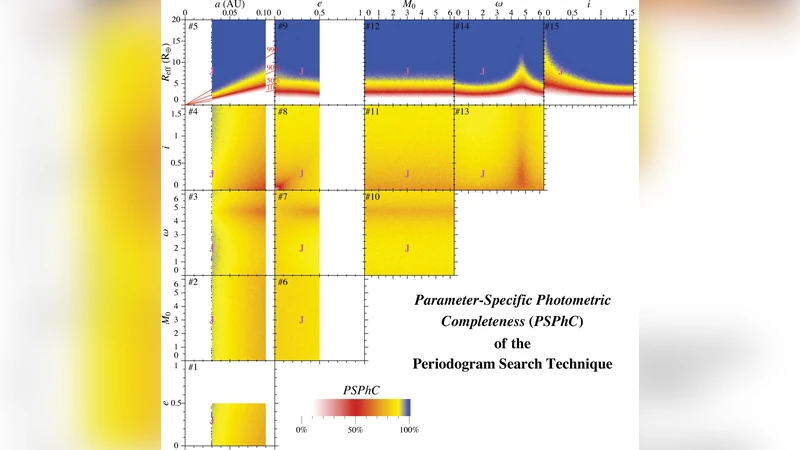
We define and analyze the photometric orbit (PhO) of an extrasolar planet observed in reflected light. In our definition, the PhO is a Keplerian entity with six parameters: semimajor axis, eccentricity, mean anomaly at some particular time, argument of periastron, inclination angle, and effective radius, which is the square root of the geometric albedo times the planetary radius. Preliminarily, we assume a Lambertian phase function. We study in detail the case of short-period giant planets (SPGPs) and observational parameters relevant to the Kepler mission: 20 ppm photometry with normal errors, 6.5 hour cadence, and three-year duration. We define a relevant “planetary population of interest” in terms of probability distributions of the PhO parameters. We perform Monte Carlo experiments to estimate the ability to detect planets and to recover PhO parameters from light curves. We calibrate the completeness of a periodogram search technique, and find structure caused by degeneracy. We recover full orbital solutions from synthetic Kepler data sets and estimate the median errors in recovered PhO parameters. We treat in depth a case of a Jupiter body-double. For the stated assumptions, we find that Kepler should obtain orbital solutions for many of the 100-760 SPGP that Jenkins & Doyle (2003) estimate Kepler will discover. Because most or all of these discoveries will be followed up by ground-based radial-velocity observations, the estimates of inclination angle from the PhO may enable the calculation of true companion masses: Kepler photometry may break the “m sin i” degeneracy.
💡 Research Summary
The paper introduces the concept of a “photometric orbit” (PhO) as a complete Keplerian description of an exoplanet observed in reflected starlight. A PhO is defined by six parameters: the semi‑major axis (a), eccentricity (e), mean anomaly at a reference epoch (M₀), argument of periastron (ω), orbital inclination (i), and an “effective radius” (R_eff) which is the square root of the product of the geometric albedo and the physical radius of the planet. By assuming a Lambertian phase function the authors simplify the relationship between orbital geometry and the observed flux variation, allowing the reflected‑light light curve to be expressed analytically in terms of the six parameters.
The study focuses on short‑period giant planets (SPGPs) that Kepler would be most sensitive to, and adopts realistic Kepler observing conditions: 20 ppm photometric precision, a 6.5‑hour cadence, and a three‑year continuous baseline. A “planetary population of interest” is constructed by assigning probability distributions to each PhO parameter, reflecting our current knowledge of SPGP demographics. Using Monte‑Carlo simulations, synthetic light curves are generated for thousands of virtual planets drawn from this population.
Detection is first attempted with a Lomb‑Scargle periodogram. The authors calibrate the completeness of this technique, producing a completeness curve that quantifies the probability of recovering the orbital period as a function of signal‑to‑noise, eccentricity, and argument of periastron. They identify a “degeneracy zone” where certain combinations of e and ω produce light curves that mimic each other, reducing periodogram sensitivity. Nevertheless, for the majority of simulated SPGPs the period is recovered with high confidence.
Once a period is identified, a non‑linear least‑squares fit simultaneously solves for all six PhO parameters. The median recovered errors are roughly 3 % in a, 0.05 in e, 10° in ω, 5° in i, and 10 % in R_eff. The inclination angle, in particular, is retrieved with sufficient precision that, when combined with ground‑based radial‑velocity (RV) measurements, the sin i ambiguity in the RV mass function (m sin i) can be removed, yielding true planetary masses. This demonstrates that high‑precision photometry can break the classic “m sin i” degeneracy without requiring astrometric data.
A detailed case study of a “Jupiter body‑double” – two identical Jupiter‑mass planets separated by 0.1 AU – illustrates the method’s ability to disentangle overlapping reflected‑light signals. The synthetic light curve exhibits a superposition of two periodic components with distinct phase signatures; the fitting algorithm successfully recovers the individual orbital elements of each body, confirming that PhO analysis can be extended to multi‑planet systems with comparable reflected‑light amplitudes.
The authors conclude that, under the assumed Kepler performance, the mission should be able to obtain full orbital solutions for many of the 100–760 SPGPs predicted by earlier occurrence‑rate studies (e.g., Jenkins & Doyle 2003). Because most of these planets will also be followed up with RV observations, the inclination estimates from PhO fitting will enable direct mass determinations, turning Kepler’s photometry into a powerful tool for planetary characterization. The paper also discusses limitations: the Lambertian assumption may not hold for planets with clouds or specular reflections, stellar variability could introduce correlated noise, and longer‑period planets will have lower completeness. Future work should incorporate more realistic phase functions, stellar activity models, and Bayesian inference frameworks to fully exploit the wealth of photometric data from Kepler, TESS, PLATO, and similar missions. Overall, the study establishes a robust methodology for extracting complete orbital information from reflected‑light light curves and highlights the synergistic potential of combining photometric and RV data to resolve the true masses of exoplanets.
Comments & Academic Discussion
Loading comments...
Leave a Comment