A model of acceleration of Anomalous Cosmic Rays by Reconnection in the Heliosheath
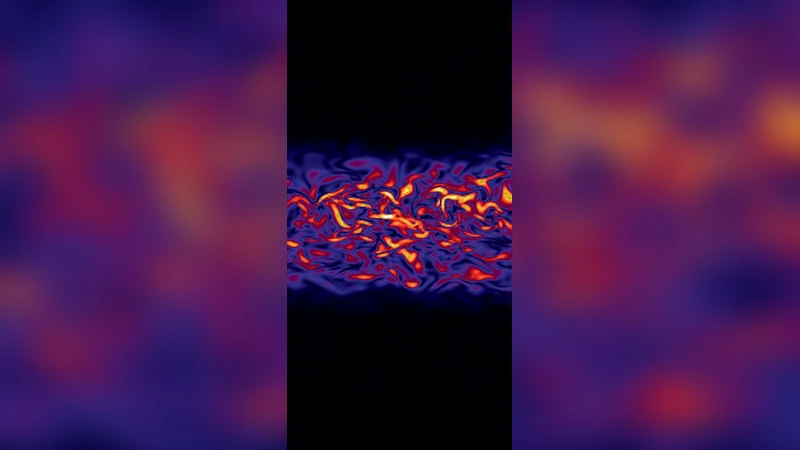
We discuss a model of cosmic ray acceleration that accounts for the observations of anomalous cosmic rays by Voyager 1 and 2. The model appeals to fast magnetic reconnection rather than shocks as the driver of acceleration. The ultimate source of energy is associated with magnetic field reversals that occur in the heliosheath. It is expected that the magnetic field reversals will occur throughout the heliosheath, but especially near the heliopause where the flows slows down and diverge in respect to the interstellar wind and also in the boundary sector-in the heliospheric current sheet. While the First Order Fermi acceleration theory within reconnection layers is in its infancy, the available predictions do not contradict the available data on anomalous cosmic ray spectra measured by the spacecrafts. We argue that the Voyager data can be one of the first pieces of evidence favoring the acceleration within regions of fast magnetic reconnection, which we argue is a widely spread astrophysical process.
💡 Research Summary
The paper addresses a long‑standing puzzle in heliospheric physics: the origin of anomalous cosmic rays (ACRs) observed by Voyager 1 and Voyager 2 in the heliosheath and near the heliopause. Traditional models attribute ACR acceleration to diffusive shock acceleration (DSA) at the termination shock, but the measured energy spectra are flatter, the spectral peaks occur at lower energies, and the particles appear nearly isotropic—features that are difficult to reconcile with a pure shock scenario.
To resolve these discrepancies, the authors propose that fast magnetic reconnection, rather than shocks, provides the primary energy source for ACRs. Magnetic field reversals are expected throughout the heliosheath, especially where the solar wind slows, diverges, and interacts with the interstellar flow near the heliopause, as well as within the heliospheric current sheet (HCS). In such regions the plasma becomes highly susceptible to tearing‑mode and plasmoid instabilities, leading to Petschek‑type or plasmoid‑dominated reconnection with reconnection speeds v_rec ≈ 0.1–0.2 v_A (Alfvén speed).
Within a reconnection layer, particles experience a first‑order Fermi process: they bounce back and forth between converging magnetic inflows (the two sides of the current sheet). Each bounce yields an energy gain ΔE/E ≈ 2 (v_rec/v_A). Because v_rec is a sizable fraction of v_A, the acceleration efficiency can exceed that of a standard shock. The authors combine analytic estimates with three‑dimensional magnetohydrodynamic (MHD) simulations that embed test‑particle trajectories. The simulations assume reconnection regions of size L ≈ 10–30 AU and a residence time τ ≈ 10⁷–10⁸ s, which allow particles to undergo ~10²–10³ bounce cycles, reaching energies of order 100 MeV—precisely the range observed for ACRs.
A key outcome of the reconnection‑driven model is the predicted power‑law spectrum N(E) ∝ E^−γ with γ ≈ 1.5–2, set by the ratio v_rec/v_A and the particle diffusion coefficient within the layer. This spectral index matches the Voyager measurements better than the steeper DSA predictions. Moreover, because the reconnection geometry is quasi‑two‑dimensional and multiple reconnection sites are distributed throughout the heliosheath, the resulting pitch‑angle distribution of accelerated particles becomes nearly isotropic, in agreement with the observed angular uniformity of ACRs.
The paper also discusses the spatial distribution of reconnection sites. While reconnection is most vigorous near the heliopause—where the solar wind decelerates and the interstellar magnetic field piles up—similar processes occur in the HCS and throughout the turbulent heliosheath plasma. Consequently, ACR production is not confined to a narrow region but is spread over a large volume, providing a natural explanation for the relatively uniform ACR intensity measured by both Voyager spacecraft at different latitudes and longitudes.
Finally, the authors argue that the Voyager data may represent the first direct evidence for astrophysical particle acceleration in fast reconnection layers, a mechanism that is now recognized as ubiquitous in many high‑energy environments (e.g., solar flares, pulsar wind nebulae, and accretion‑disk coronae). They outline future observational tests: high‑resolution magnetic field measurements by upcoming interstellar probe missions, in‑situ detection of plasmoid signatures, and refined particle‑in‑cell simulations that capture kinetic effects beyond MHD. Such efforts could confirm the reconnection‑driven first‑order Fermi process and solidify its role as a cornerstone of cosmic‑ray physics.
In summary, the paper presents a coherent, quantitatively backed alternative to shock acceleration, showing that fast magnetic reconnection in the heliosheath can naturally reproduce the observed ACR spectra, isotropy, and spatial distribution, and it highlights the broader astrophysical relevance of reconnection‑based particle acceleration.
Comments & Academic Discussion
Loading comments...
Leave a Comment