Dissecting Galaxy Formation: I. Comparison Between Pure Dark Matter and Baryonic Models
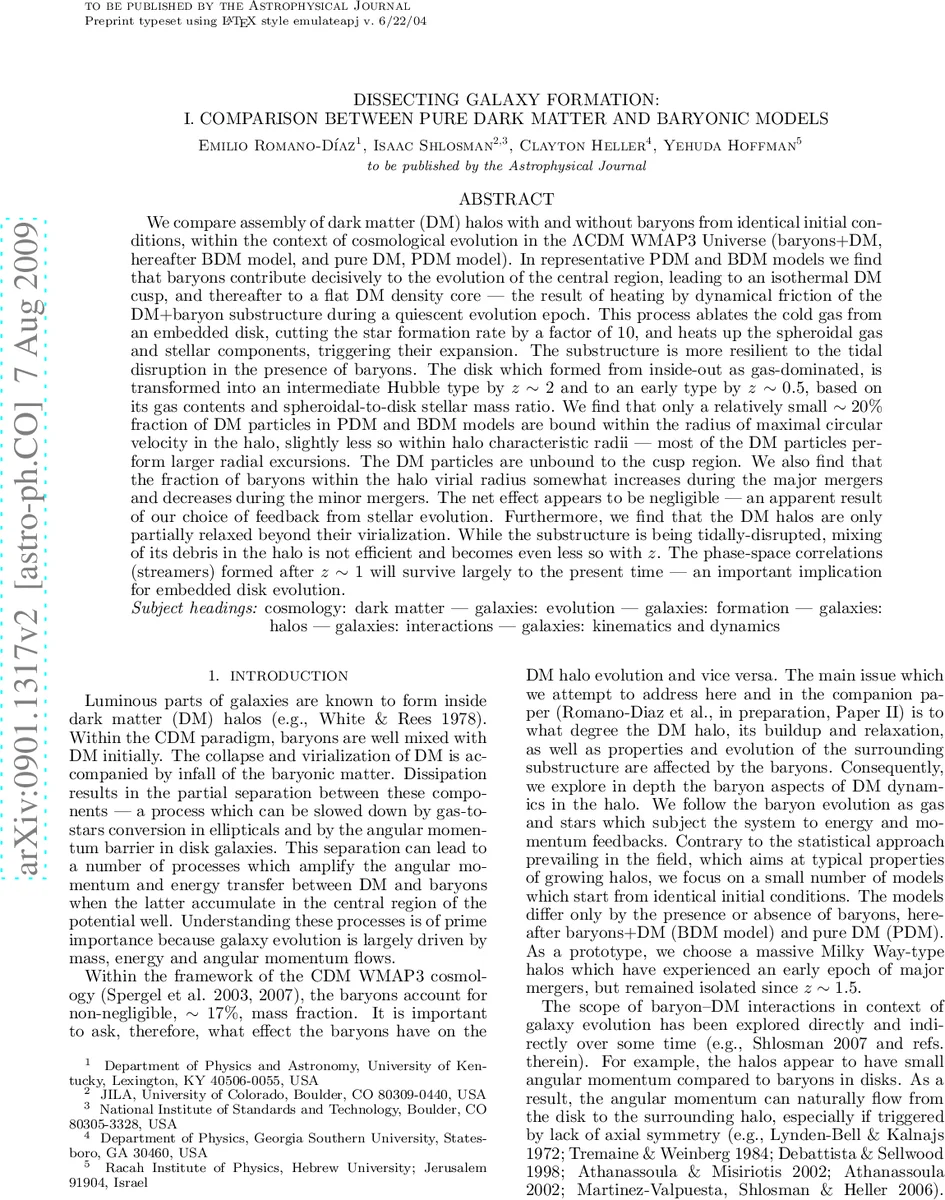
We compare assembly of DM halos with and without baryons, within the context of cosmological evolution in the LCDM WMAP3 Universe (baryons+DM, BDM model, and pure DM, PDM model). In representative PDM and BDM models we find that baryons contribute decisively to the evolution of the central region, leading to an isothermal DM cusp, and to a flat DM density core – the result of heating by dynamical friction of the substructure during a quiescent evolution epoch. This process ablates the cold gas from an embedded disk, cutting the star formation rate by ~10, and heats up the spheroidal gas and stellar components, triggering their expansion. The substructure is more resilient in the presence of baryons. The disk which formed from inside-out as gas dominated, is transformed into an intermediate Hubble type by z ~ 2 and to an early type by z ~ 0.5, based on its gas contents and spheroidal-to-disk stellar mass ratio. Only a relatively small ~20% fraction of DM particles in PDM and BDM models are bound within the radius of maximal circular velocity in the halo – most of the DM particles perform larger radial excursions. We also find that the fraction of baryons within the halo virial radius somewhat increases during the major mergers and decreases during the minor mergers. The net effect appears to be negligible. While the substructure is being tidally-disrupted, mixing of its debris in the halo is not efficient and becomes even less so with z. The streamers formed after z ~ 1 survive largely to the present time – an important implication for embedded disk evolution.
💡 Research Summary
This study presents a direct comparison between two cosmological simulations that share identical initial conditions but differ in the presence or absence of baryonic matter. Both simulations adopt the ΛCDM WMAP‑3 cosmology (Ω_m = 0.24, Ω_Λ = 0.76, h = 0.73, σ₈ = 0.76) and follow the evolution of a massive Milky Way‑type halo from redshift z = 120 to the present. The pure dark‑matter (PDM) run contains ≈2.2 × 10⁶ dark‑matter particles, while the baryon‑plus‑dark‑matter (BDM) run adds 4 × 10⁵ SPH particles, each with a mass of 2.78 × 10⁶ M_⊙. Gravitational forces are computed with the O(N) falcON tree algorithm (θ = 0.55) and a Plummer‑like softening length of 500 pc. Star formation follows a Schmidt‑Kennicutt prescription with feedback from Type II supernovae and OB stellar winds; the feedback parameters are ε_SF = 0.3, α_crit = 0.5, and α_ff = 1. No external UV background is applied.
Initial conditions are generated using the Constrained Realizations (CR) technique, imposing a 2.5σ overdensity of 10¹² h⁻¹ M_⊙ that collapses at z_c ≈ 1.3, embedded in a larger 5 × 10¹³ h⁻¹ M_⊙ region of average density. The total mass within the simulated sphere is ≈6.1 × 10¹² h⁻¹ M_⊙, leading to a final virial mass of ≈3.5 × 10¹² M_⊙ and a virial radius of ≈400 kpc in both runs. The major merger epoch ends around t ≈ 4.5 Gyr (z ≈ 1.5), after which the halo evolves quiescently.
Key findings are as follows:
-
Central density profile transformation – In the BDM run, rapid cooling of gas at early times produces an isothermal cusp (ρ ∝ r⁻²). After the major mergers, dynamical friction exerted by the surviving substructure (dark matter plus baryons) heats the central dark matter, flattening the cusp into a near‑constant‑density core. The pure‑dark‑matter halo retains a classic NFW‑like cusp (ρ ∝ r⁻¹) with only modest flattening due to subhalo disruption.
-
Substructure resilience and dynamical friction – Baryon‑laden subhalos possess higher binding energy and survive tidal stripping longer than their dark‑matter‑only counterparts. Their prolonged existence enhances dynamical friction, which both heats the central dark matter and drives the removal (ablation) of cold gas from the embedded disk. Consequently, the star‑formation rate drops by roughly an order of magnitude during the quiescent phase.
-
Disk evolution and morphological transition – The gas‑rich disk initially grows inside‑out, forming stars preferentially in the inner regions. As substructure‑induced heating removes gas, the disk’s gas fraction declines, and by z ≈ 2 the system resembles an intermediate‑type spiral. By z ≈ 0.5 the spheroidal stellar component dominates (spheroid‑to‑disk mass ratio > 1), yielding an early‑type morphology. The transition is driven by the combined effects of gas depletion, feedback‑driven heating, and the dynamical heating of the stellar disk.
-
Orbital distribution of dark‑matter particles – Only about 20 % of dark‑matter particles remain within the radius of maximal circular velocity (R_max) at any given time; the majority execute large radial excursions, indicating highly eccentric orbits. This fraction is similar in both runs, showing that the presence of baryons does not dramatically alter the global orbital mixing, although it does reduce the efficiency of phase‑space mixing for subhalo debris.
-
Baryon fraction evolution – The baryon‑to‑total mass ratio within the virial radius experiences modest increases during major mergers and slight decreases during minor mergers, but the net change is negligible (≈ ± 2 %). This stability reflects the adopted stellar feedback model, which prevents runaway baryon accumulation or loss.
-
Persistence of streamers – Subhalo tidal debris (streamers) formed after z ≈ 1 retain coherent phase‑space correlations to the present day, indicating inefficient mixing. These long‑lived streams can have observable consequences for the kinematics of the stellar halo and for the dynamical evolution of any embedded disk.
Overall, the inclusion of baryons fundamentally reshapes the inner dark‑matter structure, prolongs the survival of substructure, and drives a rapid morphological transformation of the galaxy from a gas‑rich disk to an early‑type system. The results provide a theoretical framework for several observed phenomena: flat‑core density profiles in low‑mass galaxies, the decline of star‑formation rates at intermediate redshifts, and the existence of long‑lived stellar streams in the Milky Way halo. The study underscores the necessity of high‑resolution, baryon‑inclusive simulations for a realistic picture of galaxy formation and evolution.
Comments & Academic Discussion
Loading comments...
Leave a Comment