We show that heterogeneous degree distributions in observed scale-free topologies of complex networks can emerge as a consequence of the exponential expansion of hidden hyperbolic space. Fermi-Dirac statistics provides a physical interpretation of hyperbolic distances as energies of links. The hidden space curvature affects the heterogeneity of the degree distribution, while clustering is a function of temperature. We embed the Internet into the hyperbolic plane, and find a remarkable congruency between the embedding and our hyperbolic model. Besides proving our model realistic, this embedding may be used for routing with only local information, which holds significant promise for improving the performance of Internet routing.
Deep Dive into Curvature and temperature of complex networks.
We show that heterogeneous degree distributions in observed scale-free topologies of complex networks can emerge as a consequence of the exponential expansion of hidden hyperbolic space. Fermi-Dirac statistics provides a physical interpretation of hyperbolic distances as energies of links. The hidden space curvature affects the heterogeneity of the degree distribution, while clustering is a function of temperature. We embed the Internet into the hyperbolic plane, and find a remarkable congruency between the embedding and our hyperbolic model. Besides proving our model realistic, this embedding may be used for routing with only local information, which holds significant promise for improving the performance of Internet routing.
Many complex networks possess heterogeneous degree distributions. This heterogeneity is often modeled by power laws, often truncated [1]. These networks also exhibit strong clustering, i.e., high concentration of triangular subgraphs. Our previous work [2] demonstrated that the clustering peculiarities of complex networks, and in particular their self-similarity, finds a natural geometric explanation in the existence of hidden metric spaces underlying the network and abstracting the intrinsic similarities between its nodes. Here we seek to provide a geometric interpretation of the first property-network heterogeneity. We show that heterogeneous, or scale-free, degree distributions in complex networks appear as a simple consequence of negative curvature of hidden spaces. That is, we argue that these spaces are hyperbolic.
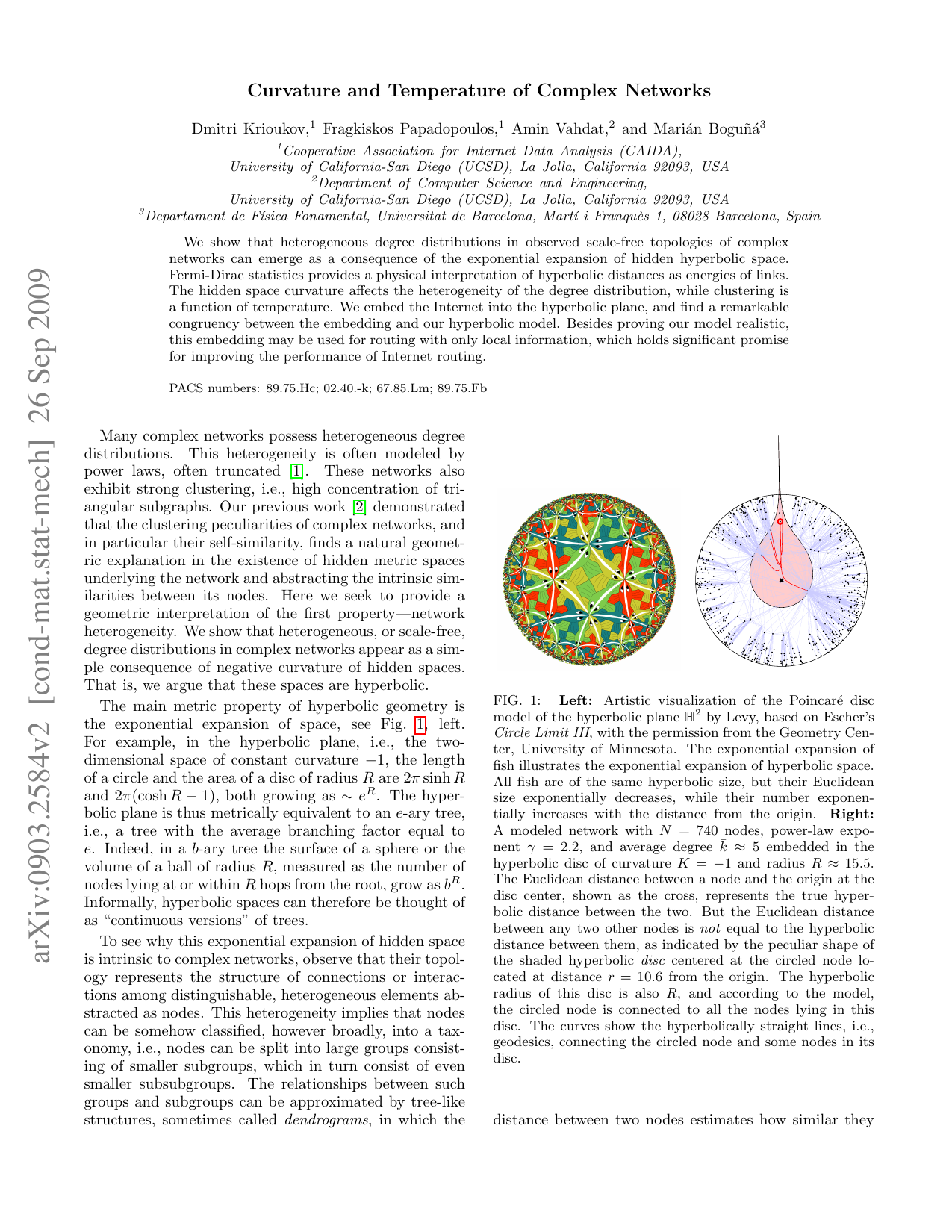
The main metric property of hyperbolic geometry is the exponential expansion of space, see Fig. 1,left. For example, in the hyperbolic plane, i.e., the twodimensional space of constant curvature -1, the length of a circle and the area of a disc of radius R are 2π sinh R and 2π(cosh R -1), both growing as ∼ e R . The hyperbolic plane is thus metrically equivalent to an e-ary tree, i.e., a tree with the average branching factor equal to e. Indeed, in a b-ary tree the surface of a sphere or the volume of a ball of radius R, measured as the number of nodes lying at or within R hops from the root, grow as b R . Informally, hyperbolic spaces can therefore be thought of as “continuous versions” of trees.
To see why this exponential expansion of hidden space is intrinsic to complex networks, observe that their topology represents the structure of connections or interactions among distinguishable, heterogeneous elements abstracted as nodes. This heterogeneity implies that nodes can be somehow classified, however broadly, into a taxonomy, i.e., nodes can be split into large groups consisting of smaller subgroups, which in turn consist of even smaller subsubgroups. The relationships between such groups and subgroups can be approximated by tree-like structures, sometimes called dendrograms, in which the All fish are of the same hyperbolic size, but their Euclidean size exponentially decreases, while their number exponentially increases with the distance from the origin. Right: A modeled network with N = 740 nodes, power-law exponent γ = 2.2, and average degree k ≈ 5 embedded in the hyperbolic disc of curvature K = -1 and radius R ≈ 15.5. The Euclidean distance between a node and the origin at the disc center, shown as the cross, represents the true hyperbolic distance between the two. But the Euclidean distance between any two other nodes is not equal to the hyperbolic distance between them, as indicated by the peculiar shape of the shaded hyperbolic disc centered at the circled node located at distance r = 10.6 from the origin. The hyperbolic radius of this disc is also R, and according to the model, the circled node is connected to all the nodes lying in this disc. The curves show the hyperbolically straight lines, i.e., geodesics, connecting the circled node and some nodes in its disc.
distance between two nodes estimates how similar they arXiv:0903.2584v2 [cond-mat.stat-mech] 26 Sep 2009 are [3]. Importantly, the node classification hierarchy need not be strictly a tree. Approximate “tree-ness,” which can be formally expressed solely in terms of the metric structure of a space [4], makes the space hyperbolic.
Let us see what network topologies emerge in the simplest possible settings involving hidden hyperbolic metric spaces. Let us form a network of N 1 nodes located in the hyperbolic plane H 2 . Since the number of nodes is finite, the area that nodes occupy is bounded. Let R 1 be the radius of a disc within which nodes are uniformly distributed. In hyperbolic geometry, this means that nodes are given an angular coordinate θ randomly distributed in [0, 2π], and a radial coordinate r following the density ρ(r) = sinh r/(cosh R-1) ≈ e r-R . Next, we have to specify the connection probability p(x) that two nodes at hyperbolic distance x are connected. We first consider the simplest case, the step function p(x) = Θ(R -x), and justify this choice later. This p(x) connects each pair of nodes if the hyperbolic distance between them is not larger than R.
The network is now formed, and we can compute the average degree k(r) of nodes at distance r from the disc center. These nodes are connected to all nodes in the intersection area of the two discs of the same radius R, one in which all nodes reside, and the other centered at distance r from the center of the first disc, see Fig. 1, right. Since the node distribution is uniform, k(r) is proportional to the area of this intersection, which decreases exponentially with r, k(r) ∼ e -r/2 . Therefore, the inverse function is logarithmic, r(k) ∼ -2 ln k, and the node degree distribution in the network is approximately a power law,
If we generalize the spac
…(Full text truncated)…
This content is AI-processed based on ArXiv data.