Curvature and temperature of complex networks
We show that heterogeneous degree distributions in observed scale-free topologies of complex networks can emerge as a consequence of the exponential expansion of hidden hyperbolic space. Fermi-Dirac statistics provides a physical interpretation of hy…
Authors: ** Dmitri Krioukov, Fragkiskos Papadopoulos, M. Boguñá
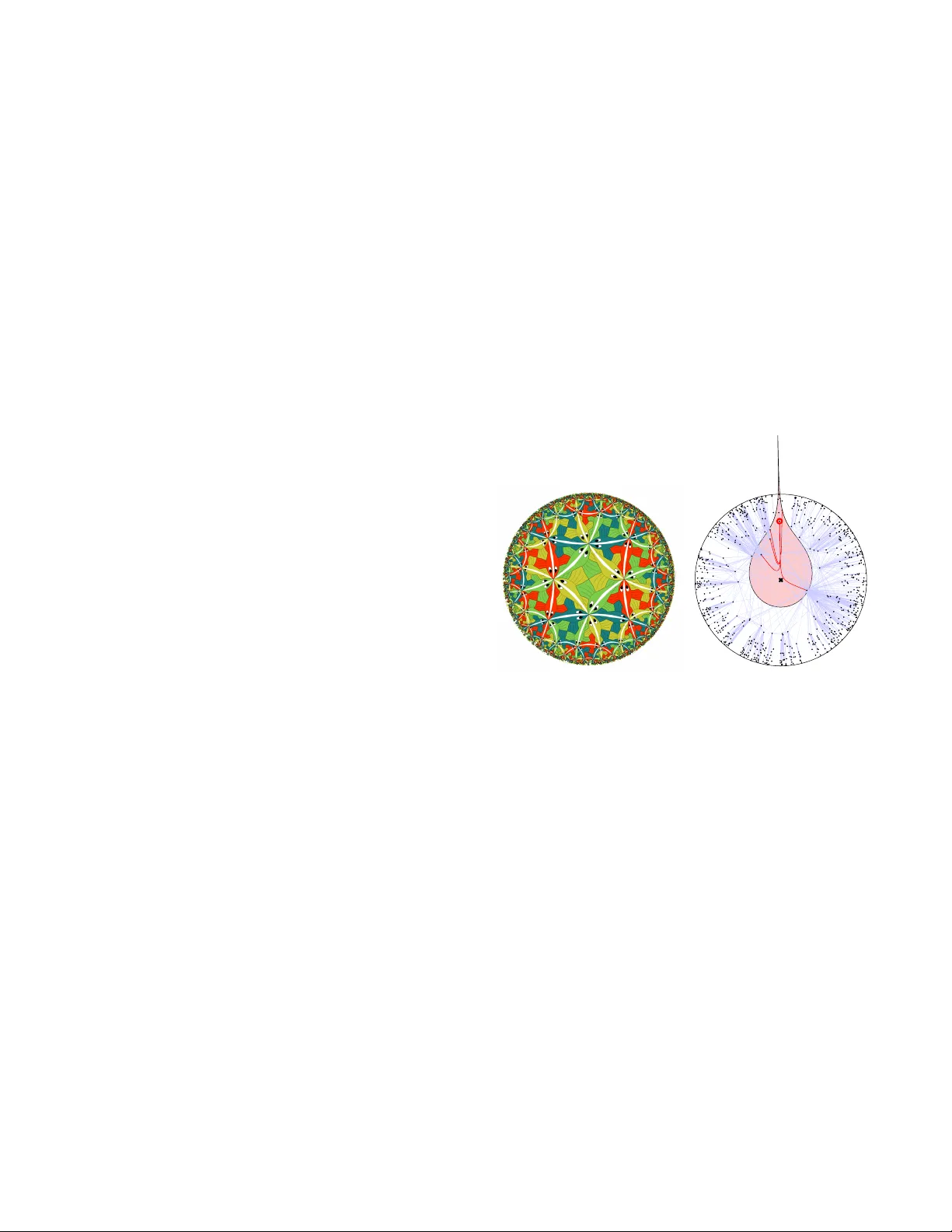
Curv ature and T emp erature of Complex Net w orks Dmitri Kriouk ov, 1 F ragkisk os P apadop oulos, 1 Amin V ahdat, 2 and Mari´ an Bogu ˜ n´ a 3 1 Co op er ative Asso ciation for Internet Data Analysis (CAID A), University of California-San Diego (UCSD), L a Jol la, California 92093, USA 2 Dep artment of Computer Scienc e and Engineering, University of California-San Diego (UCSD), L a Jol la, California 92093, USA 3 Dep artament de F ´ ısic a F onamental, Universitat de Bar c elona, Mart ´ ı i F r anqu ` es 1, 08028 Bar c elona, Sp ain W e show that heterogeneous degree distributions in observ ed scale-free top ologies of complex net works can emerge as a consequence of the exp onen tial expansion of hidden hyperb olic space. F ermi-Dirac statistics provides a physical interpretation of hyperb olic distances as energies of links. The hidden space curv ature affects the heterogeneity of the degree distribution, while clustering is a function of temp erature. W e embed the Internet into the hyperb olic plane, and find a remark able congruency b et ween the embedding and our hyperb olic mo del. Besides proving our mo del realistic, this em b edding ma y b e used for routing with only local inf ormation, whic h holds significant promise for improving the p erformance of Internet routing. P ACS n um b ers: 89.75.Hc; 02.40.-k; 67.85.Lm; 89.75.Fb Man y complex netw orks p ossess heterogeneous degree distributions. This heterogeneity is often mo deled by p o w er laws, often truncated [1]. These netw orks also exhibit strong clustering, i.e., high concentration of tri- angular subgraphs. Our previous w ork [2] demonstrated that the clustering p eculiarities of complex net w orks, and in particular their self-similarit y , finds a natural geomet- ric explanation in the existence of hidden metric spaces underlying the net work and abstracting the intrinsic sim- ilarities b et ween its no des. Here we seek to pro vide a geometric in terpretation of the first property—net w ork heterogeneit y . W e sho w that heterogeneous, or scale-free, degree distributions in complex net works app ear as a sim- ple consequence of negativ e curv ature of hidden spaces. That is, we argue that these spaces are hyperb olic. The main metric prop erty of hyperb olic geometry is the exp onen tial expansion of space, see Fig. 1, left. F or example, in the h yp erbolic plane, i.e., the tw o- dimensional space of constant curv ature − 1, the length of a circle and the area of a disc of radius R are 2 π sinh R and 2 π (cosh R − 1), b oth growing as ∼ e R . The hyper- b olic plane is thus metrically equiv alen t to an e -ary tree, i.e., a tree with the av erage branching factor equal to e . Indeed, in a b -ary tree the surface of a sphere or the v olume of a ball of radius R , measured as the num b er of no des lying at or within R hops from the root, gro w as b R . Informally , hyperb olic spaces can therefore b e though t of as “contin uous v ersions” of trees. T o see why this exp onential expansion of hidden space is in trinsic to complex net w orks, observ e that their topol- ogy represents the structure of connections or in terac- tions among distinguishable, heterogeneous elements ab- stracted as no des. This heterogeneity implies that no des can b e somehow classified, how ever broadly , into a tax- onom y , i.e., no des can be split in to large groups consist- ing of smaller subgroups, which in turn consist of even smaller subsubgroups. The relationships betw een suc h groups and subgroups can b e approximated by tree-lik e structures, sometimes called dendr o gr ams , in which the FIG. 1: Left: Artistic visualization of the Poincar ´ e disc mo del of the hyperb olic plane H 2 b y Levy , based on Escher’s Cir cle Limit III , with the p ermission from the Geometry Cen- ter, Universit y of Minnesota. The exp onential expansion of fish illustrates the exp onen tial expansion of hyperb olic space. All fish are of the same hyperb olic size, but their Euclidean size exp onentially decreases, while their num ber exp onen- tially increases with the distance from the origin. Right: A mo deled netw ork with N = 740 no des, p o w er-law exp o- nen t γ = 2 . 2, and a verage degree ¯ k ≈ 5 embedded in the h yp erb olic disc of curv ature K = − 1 and radius R ≈ 15 . 5. The Euclidean distance b etw een a no de and the origin at the disc center, shown as the cross, represents the true hyper- b olic distance betw een the tw o. But the Euclidean distance b et w een any t wo other nodes is not equal to the hyperb olic distance b etw een them, as indicated by the p eculiar shap e of the shaded hyperb olic disc centered at the circled no de lo- cated at distance r = 10 . 6 from the origin. The hyperb olic radius of this disc is also R , and according to the model, the circled no de is connected to all the no des lying in this disc. The curves sho w the hyperb olically straight lines, i.e., geo desics, connecting the circled no de and some no des in its disc. distance b etw een tw o no des estimates how similar they 2 are [3]. Importantly , the no de classification hierarch y need not be strictly a tree. Appro ximate “tree-ness,” whic h can b e formally expressed solely in terms of the metric structure of a space [4], mak es the space hyper- b olic. Let us see what netw ork top ologies emerge in the sim- plest possible settings in volving hidden h yp erb olic metric spaces. Let us form a netw ork of N 1 no des lo cated in the hyperb olic plane H 2 . Since the num b er of no des is finite, the area that nodes o ccup y is bounded. Let R 1 b e the radius of a disc within whic h no des are uniformly distributed. In hyperb olic geometry , this means that no des are given an angular coordinate θ randomly dis- tributed in [0 , 2 π ], and a radial co ordinate r following the densit y ρ ( r ) = sinh r / (cosh R − 1) ≈ e r − R . Next, w e ha v e to specify the connection probability p ( x ) that t w o no des at hyperb olic distance x are connected. W e first consider the simplest case, the step function p ( x ) = Θ( R − x ), and justify this choice later. This p ( x ) connects eac h pair of no des if the hyperb olic distance betw een them is not larger than R . The netw ork is now formed, and we can compute the a verage degree ¯ k ( r ) of no des at distance r from the disc cen ter. These nodes are connected to all nodes in the in tersection area of the tw o discs of the same radius R , one in which all no des reside, and the other cen tered at distance r from the center of the first disc, see Fig. 1, righ t. Since the no de distribution is uniform, ¯ k ( r ) is pro- p ortional to the area of this in tersection, which decreases exp onen tially with r , ¯ k ( r ) ∼ e − r/ 2 . Therefore, the in- v erse function is logarithmic, ¯ r ( k ) ∼ − 2 ln k , and the no de degree distribution in the netw ork is approximately a p ow er law, P ( k ) ≈ ρ [ ¯ r ( k )] | ¯ r 0 ( k ) | ∼ k − 3 . If we general- ize the space curv ature to K = − ζ 2 , ζ > 0, and the no de densit y to ρ ( r ) ≈ αe α ( r − R ) , where we can think of α > 0 as the logarithm of the av erage branching factor in the underlying hierarch y , then the av erage degree at radius r scales as ¯ k ( r ) ∼ e − ζ r / 2 if α/ζ > 1 / 2, or ¯ k ( r ) ∼ e − αr otherwise, so that the node degree distribution b ecomes P ( k ) ∼ k − γ with γ = ( 2 α/ζ + 1 if α/ζ > 1 / 2, 2 otherwise . (1) T o fix the av erage degree in the netw ork, we ha v e to c ho ose N = c e ζ 2 R , where c is a constant. The result in Eq. (1) is remark able as it shows that heterogeneous degree distributions ma y emerge as a simple consequence of the exp onen tial expansion of h yperb olic space. Ho wev er, our choice of the step-function connection probabilit y is not y et justified. T o justify it, and to show that scale-free netw orks hav e effective hyperb olic geome- tries underneath, w e recall the S 1 mo del introduced in [2]. In that mo del, net works are constructed as follo ws. First, distribute N nodes uniformly o v er the circle S 1 of ra- dius N / (2 π ), so that the no de density on the circle is fixed to 1. Second, assign to all no des an additional hidden v ariable κ representing their exp ected degrees. T o generate scale-free net w orks, the v ariable κ is pow er- la w distributed according to ρ ( κ ) = κ γ − 1 0 ( γ − 1) κ − γ , κ ∈ [ κ 0 , ∞ ), where κ 0 is the minim um expected degree. Finally , let κ and κ 0 b e the expected degrees of t w o nodes lo cated at distance d = N ∆ θ/ (2 π ) measured o v er the cir- cle (∆ θ is the angular distance b etw een the no des). W e connect each pair of nodes with probabilit y e p ( χ ), where χ ≡ d/ ( µκκ 0 ), and constant µ fixes the a verage degree in the netw ork. The key point is that the connection probability e p ( χ ) can b e any inte gr able function . As long as the distance o ver the circle is rescaled as χ ∼ d/ ( κκ 0 ), an y in tegrable e p ( χ ) guaran tees that the exp ected degree of no des with hidden v ariable κ is indeed κ , ¯ k ( κ ) = κ , so that γ , which is a model parameter, is indeed the exp onen t of the de- gree distribution in generated netw orks. W e now wan t to map the expected degree κ of each no de to a radial p osition r within a disk of radius R , suc h that after the mapping, the radial distribution of no des is ρ ( r ) ≈ αe α ( r − R ) , i.e., as in the h yp erb olic H 2 mo del in tro duced abov e. T o hav e this ρ ( r ), we must select the κ → r mapping according to κ = κ 0 e ζ 2 ( R − r ) , ζ 2 = α γ − 1 , N = c e ζ 2 R , c = πµκ 2 0 , (2) where ζ is fixed by the v alues of γ and target α . W e see that κ ( r ) and consequen tly ¯ k ( r ) scale with r as in the H 2 mo del, while the connection probability e p ( χ ) b ecomes e p e ζ 2 ( x − R ) , where the effectiv e distance x = r + r 0 + 2 ζ ln ∆ θ 2 (3) is appro ximately equal to the hyperb olic distance b e- t ween the t w o nodes in the disk. Indeed, the true h y- p erbolic distance x betw een tw o p oints with p olar co- ordinates ( r, θ ) and ( r 0 , θ 0 ) in the hyperb olic space H 2 of curv ature K = − ζ 2 is cosh ζ x = cosh ζ r cosh ζ r 0 − sinh ζ r sinh ζ r 0 cos ∆ θ , which for sufficien tly large ζ r , ζ r 0 , and ∆ θ > 2 √ e − 2 ζ r + e − 2 ζ r 0 is closely approximated by x = r + r 0 + 2 ζ ln sin ∆ θ 2 . (4) Since the effectiv e and true h yp erb olic distances in Eqs. (3,4) are appro ximately equal, the v alue of ζ in Eq. (2) is indeed the square root of curv ature of the h y- p erbolic disc, in agreement with Eq. (1) in the H 2 mo del. W e also notice that since the connection probabilit y e p ( χ ) in the S 1 mo del can b e an y integrable function, the con- nection probabilit y p ( x ) in the H 2 mo del can be any func- tion of the form p ( x ) = e p e ζ 2 ( x − R ) . Giv en this freedom of c hoice of the connection proba- bilit y , let us consider the family of functions p ( x ) = 1 1 + e ζ 2 T ( x − R ) (5) 3 parameterized b y T > 0. One motiv ation to fo cus on this family is that it generates exp onential random graphs in the statistical mechanics sense [5]. Eq. (5) is nothing but the grand canonical F ermi-Dirac distribution, and T is the system temperature. F rom the ph ysical persp ective, graph edges are non-in teracting fermions with energies equal to their hidden hyperb olic lengths, and R is the c hemical p oten tial defined by the condition that ¯ k N/ 2, the n umber of edges-fermions, is fixed on av erage. At T → 0 Eq. (5) conv erges to p ( x ) = Θ( R − x ), whic h a p osteriori justifies our choice of the step function connec- tion probability in the H 2 mo del. The dep endence on temp erature in the mo del is p ecu- liar. A t zero temperature, the netw ork is in the strongly degenerate ground state. As we heat it up, particles ex- plore higher-energy states, i.e., edges connect longer dis- tances, which affects clustering. At T → 0, clustering is maximized. It monotonically decreases with T , and at T → 1 w e hav e a phase transition with clustering go- ing to zero, and the netw ork losing its cold-state metric structure. In the cold regime with T < 1, the exp onen t of the degree distribution γ dep ends only on the ratio α/ζ via Eq. (1). Therefore, we can set α = 1 / 2 without loss of generality , so that γ = 1 /ζ + 1 is fully defined by cur- v ature K > − 1. In the hot regime with T > 1, clustering remains zero, the c hemical p otential is no longer given b y N = c e ζ 2 R but by N = c e ζ 2 T R , and γ also dep ends on temp erature, γ = T /ζ + 1. Therefore at T → ∞ the graph ensemble is identical to classical random graphs, as all fermions are uniformly distributed across all ener- gies, i.e., all pairs of nodes are connected with the same probabilit y indep enden t of the hidden distance betw een them, and the netw ork loses its cold-state hierarchical structure. Com bining the cold and hot regimes, γ = 1 /ζ + 1 if T < 1 and ζ < 1, T /ζ + 1 if T > 1 and ζ < T , 2 otherwise . (6) Finally , constan t c fixing the av erage degree in the net- w ork is c ≈ ( ¯ k sin πT 2 T (1 − ζ ) 2 ≈ κ 2 0 sin πT 2 ¯ kT if T < 1, ¯ k π 2 1 T T − 1 T 3 ( T − ζ ) 2 − − − − → T →∞ ¯ k if T > 1. (7) The H 2 mo del can th us generate classical random graphs and scale-free netw orks with an y a v erage degree, pow er- la w exp onen t γ > 2, and clustering. In Fig. 2, left, we see that the curv ature and temp erature of the Internet are approximately K = − 0 . 83 and T = 0 . 6 ± 0 . 1. Eq. (2) establishes a formal equiv alence betw een the S 1 and H 2 mo dels we introduced in [2] and here. The t wo mo dels generate similar netw ork top ologies thanks to the similarit y b etw een the effective and true h yp erb olic dis- tances in Eqs. (3,4). Ho wev er, if w e are to study other geometric properties of these net works, suc h as their na v- igabilit y [7], then it do es matter a lot what distances, spherical d native to S 1 or hyperb olic x native to H 2 , 10 0 10 2 10 4 10 -6 10 -4 10 -2 10 0 Skitter Model (T=0.47, K=-0.83) BGP Model (T=0.71, K=-0.83) 0 10 20 30 40 50 60 hyperbolic distance ( x ) 0 0.2 0.4 0.6 0.8 1 BGP Eq. (5) R=26 10 0 10 2 10 4 k 10 -2 10 0 P(k) c(k) p(x) k -2.1 FIG. 2: Netw orks in the H 2 mo del vs. the In ternet. Left: The degree distribution P ( k ) and degree-dep endent clustering co- efficien t ¯ c ( k ) are shown for the skitter ( ¯ k = 6 . 29, ¯ C = 0 . 46) and Border Gatewa y Proto col (BGP) ( ¯ k = 4 . 68, ¯ C = 0 . 29) views of the Internet from [6], and for mo deled netw orks with curv ature K = − 0 . 83 and tw o v alues of temperature T , 0 . 47 ( ¯ k = 6 . 03, ¯ C = 0 . 44) and 0 . 71 ( ¯ k = 4 . 85, ¯ C = 0 . 25). Righ t: The empirical connection probabilit y in the h yperb olically em b edded Internet, compared to Eq.(5). w e use to na vigate a netw ork. The latter distances x are dominated b y r + r 0 , min us some small θ -dependent corrections. This effect can b e observed in Fig. 1, righ t, where we sho w some hyperb olic geo desics b et ween nodes in a small mo deled netw ork. These geo desics follo w closely the radial directions b etw een the no des and the origin, i.e., they follow the same pattern as the shortest paths in the em b edded netw ork. Spherical distances d are at the other extreme, as their gradient lines lie in the orthogonal tangential directions. T o demonstrate ho w such differences in distance cal- culations affect the efficiency of transp ort pro cesses on net works, w e embed the real Internet top ology from [8] in to H 2 using maximum-lik eliho od tec hniques. Specif- ically , we first assign to no des random angular coordi- nates, while their radial co ordinates are fixed by Eq (2). W e then execute the Metropolis-Hastings algorithm [9] b y moving random no des to new lo cations with the same radial co ordinate but with a randomly c hosen new an- gular co ordinate. W e accept each mov e with probabilit y min(1 , L a / L b ), where L b and L a are the likelihoo ds, b e- fore and after the mov e, that the netw ork is pro duced by our H 2 mo del with parameters matching the In ternet in Fig. 2, left. F ormally , L = Q i
Original Paper
Loading high-quality paper...
Comments & Academic Discussion
Loading comments...
Leave a Comment