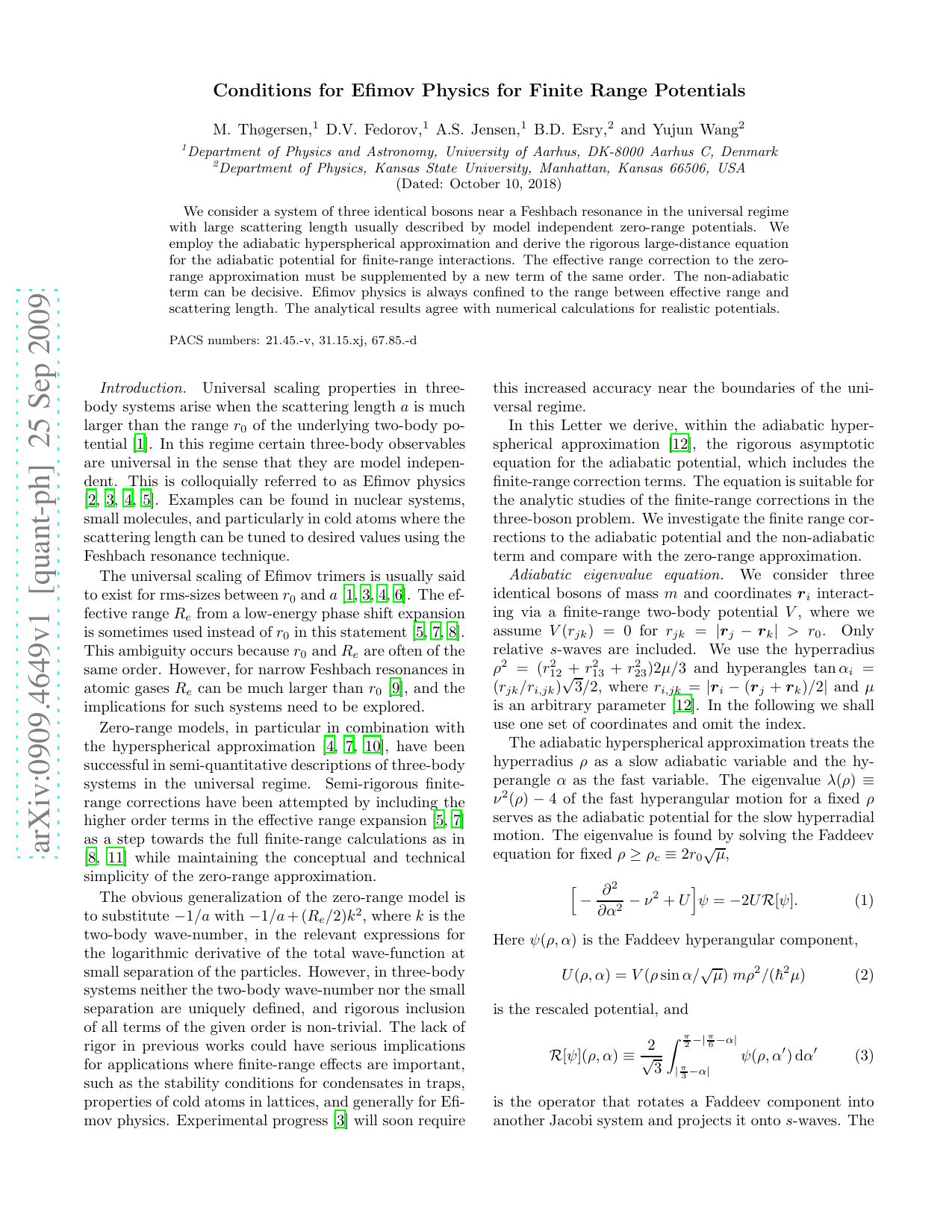
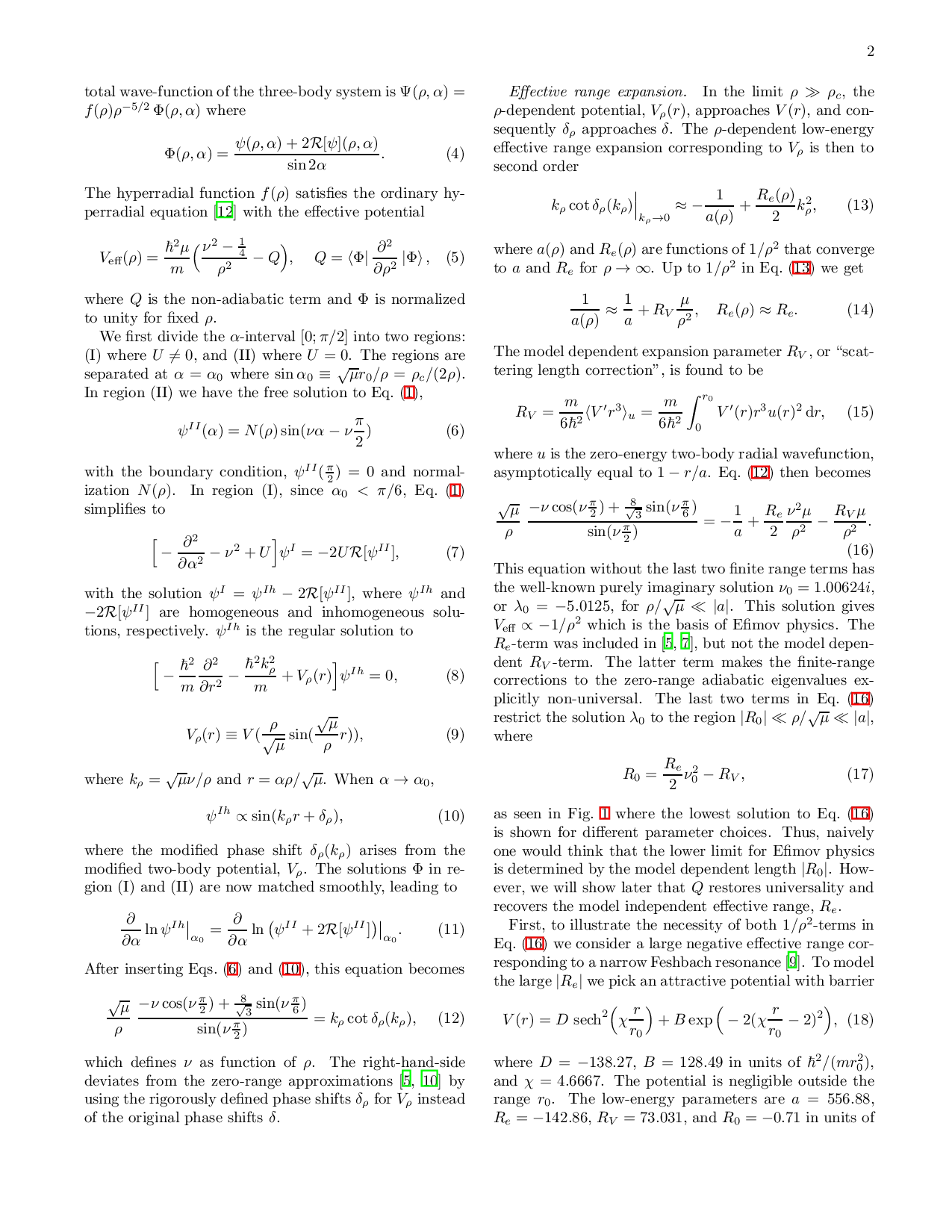
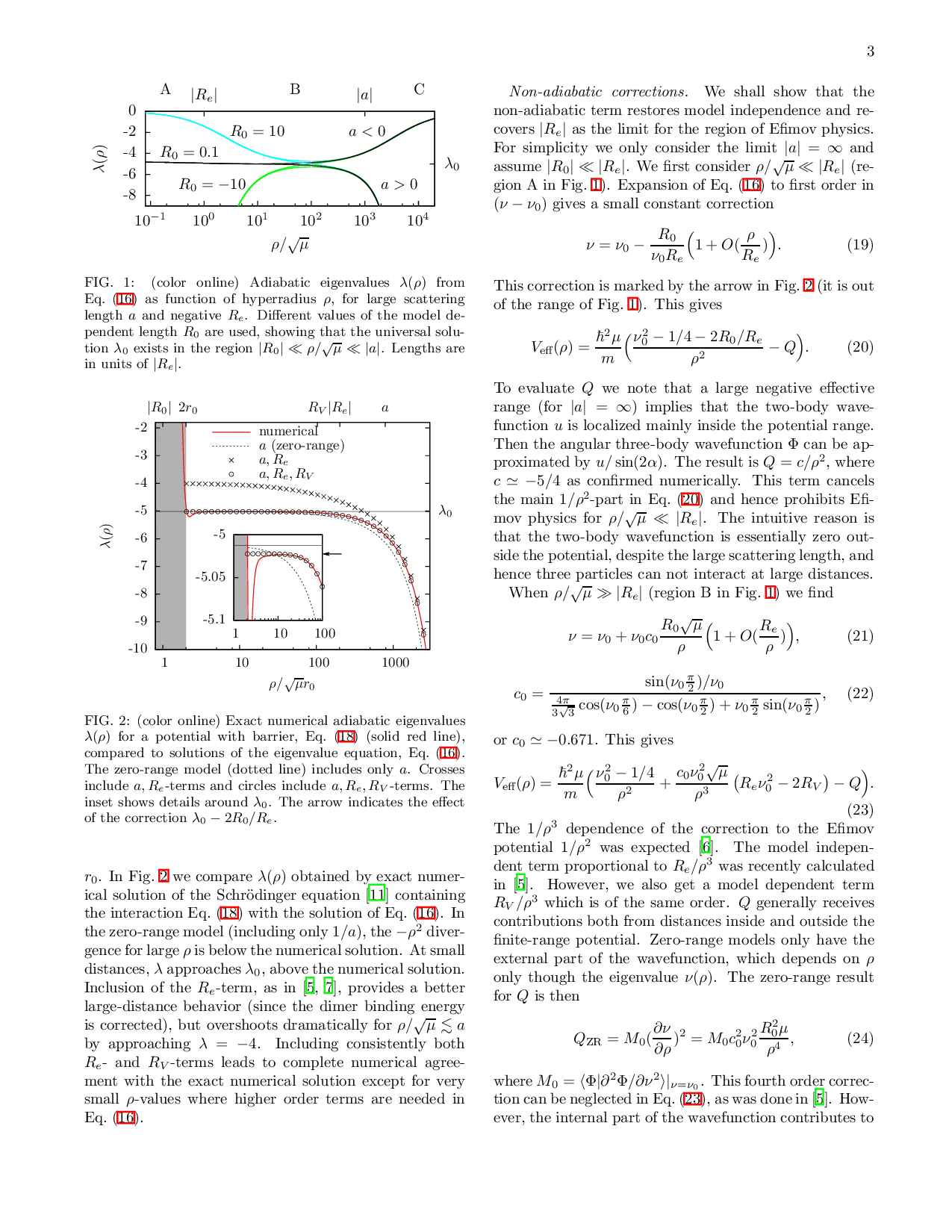
We consider a system of three identical bosons near a Feshbach resonance in the universal regime with large scattering length usually described by model independent zero-range potentials. We employ the adiabatic hyperspherical approximation and derive the rigorous large-distance equation for the adiabatic potential for finite-range interactions. The effective range correction to the zero-range approximation must be supplemented by a new term of the same order. The non-adiabatic term can be decisive. Efimov physics is always confined to the range between effective range and scattering length. The analytical results agree with numerical calculations for realistic potentials.
Deep Dive into Conditions for Efimov Physics for Finite Range Potentials.
We consider a system of three identical bosons near a Feshbach resonance in the universal regime with large scattering length usually described by model independent zero-range potentials. We employ the adiabatic hyperspherical approximation and derive the rigorous large-distance equation for the adiabatic potential for finite-range interactions. The effective range correction to the zero-range approximation must be supplemented by a new term of the same order. The non-adiabatic term can be decisive. Efimov physics is always confined to the range between effective range and scattering length. The analytical results agree with numerical calculations for realistic potentials.
Introduction. Universal scaling properties in threebody systems arise when the scattering length a is much larger than the range r 0 of the underlying two-body potential [1]. In this regime certain three-body observables are universal in the sense that they are model independent. This is colloquially referred to as Efimov physics [2,3,4,5]. Examples can be found in nuclear systems, small molecules, and particularly in cold atoms where the scattering length can be tuned to desired values using the Feshbach resonance technique.
The universal scaling of Efimov trimers is usually said to exist for rms-sizes between r 0 and a [1,3,4,6]. The effective range R e from a low-energy phase shift expansion is sometimes used instead of r 0 in this statement [5,7,8]. This ambiguity occurs because r 0 and R e are often of the same order. However, for narrow Feshbach resonances in atomic gases R e can be much larger than r 0 [9], and the implications for such systems need to be explored.
Zero-range models, in particular in combination with the hyperspherical approximation [4,7,10], have been successful in semi-quantitative descriptions of three-body systems in the universal regime. Semi-rigorous finiterange corrections have been attempted by including the higher order terms in the effective range expansion [5,7] as a step towards the full finite-range calculations as in [8,11] while maintaining the conceptual and technical simplicity of the zero-range approximation.
The obvious generalization of the zero-range model is to substitute -1/a with -1/a + (R e /2)k 2 , where k is the two-body wave-number, in the relevant expressions for the logarithmic derivative of the total wave-function at small separation of the particles. However, in three-body systems neither the two-body wave-number nor the small separation are uniquely defined, and rigorous inclusion of all terms of the given order is non-trivial. The lack of rigor in previous works could have serious implications for applications where finite-range effects are important, such as the stability conditions for condensates in traps, properties of cold atoms in lattices, and generally for Efimov physics. Experimental progress [3] will soon require this increased accuracy near the boundaries of the universal regime.
In this Letter we derive, within the adiabatic hyperspherical approximation [12], the rigorous asymptotic equation for the adiabatic potential, which includes the finite-range correction terms. The equation is suitable for the analytic studies of the finite-range corrections in the three-boson problem. We investigate the finite range corrections to the adiabatic potential and the non-adiabatic term and compare with the zero-range approximation.
Adiabatic eigenvalue equation. We consider three identical bosons of mass m and coordinates r i interacting via a finite-range two-body potential V , where we assume V (r jk ) = 0 for r jk = |r jr k | > r 0 . Only relative s-waves are included. We use the hyperradius ρ 2 = (r 2 12 + r 2 13 + r 2 23 )2µ/3 and hyperangles tan α i = (r jk /r i,jk ) √ 3/2, where r i,jk = |r i -(r j + r k )/2| and µ is an arbitrary parameter [12]. In the following we shall use one set of coordinates and omit the index.
The adiabatic hyperspherical approximation treats the hyperradius ρ as a slow adiabatic variable and the hyperangle α as the fast variable. The eigenvalue λ(ρ) ≡ ν 2 (ρ) -4 of the fast hyperangular motion for a fixed ρ serves as the adiabatic potential for the slow hyperradial motion. The eigenvalue is found by solving the Faddeev equation for fixed
Here ψ(ρ, α) is the Faddeev hyperangular component,
is the rescaled potential, and
is the operator that rotates a Faddeev component into another Jacobi system and projects it onto s-waves. The total wave-function of the three-body system is Ψ
The hyperradial function f (ρ) satisfies the ordinary hyperradial equation [12] with the effective potential
where Q is the non-adiabatic term and Φ is normalized to unity for fixed ρ.
We first divide the α-interval [0; π/2] into two regions: (I) where U = 0, and (II) where U = 0. The regions are separated at α = α 0 where sin α 0 ≡ √ µr 0 /ρ = ρ c /(2ρ). In region (II) we have the free solution to Eq. ( 1),
with the boundary condition, ψ II ( π 2 ) = 0 and normalization N (ρ). In region (I), since α 0 < π/6, Eq. ( 1) simplifies to
with the solution
where ψ Ih and -2R[ψ II ] are homogeneous and inhomogeneous solutions, respectively. ψ Ih is the regular solution to
where
where the modified phase shift δ ρ (k ρ ) arises from the modified two-body potential, V ρ . The solutions Φ in region (I) and (II) are now matched smoothly, leading to
After inserting Eqs. ( 6) and (10), this equation becomes
which defines ν as function of ρ. The right-hand-side deviates from the zero-range approximations [5,10] by using the rigorously defined phase shifts δ ρ for V ρ instead of the original phase shifts δ.
Effective range expansion. In the li
…(Full text truncated)…
This content is AI-processed based on ArXiv data.