mRNA diffusion explains protein gradients in textit{Drosophila} early development
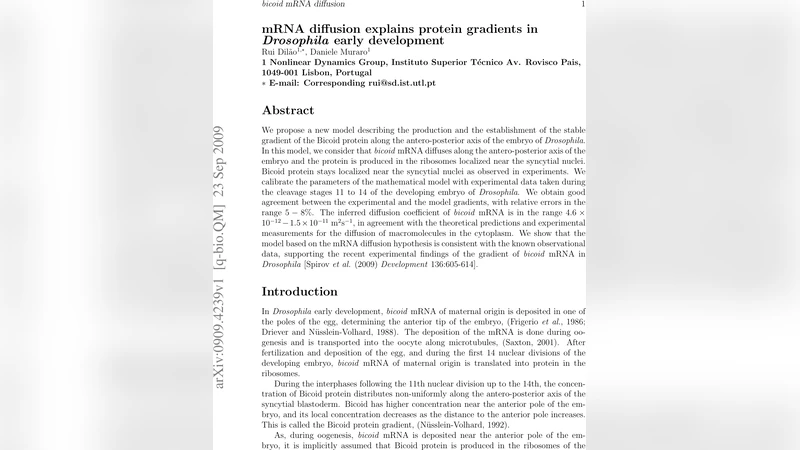
We propose a new model describing the production and the establishment of the stable gradient of the Bicoid protein along the antero-posterior axis of the embryo of \textit{Drosophila}. In this model, we consider that \textit{bicoid} mRNA diffuses along the antero-posterior axis of the embryo and the protein is produced in the ribosomes localized near the syncytial nuclei. Bicoid protein stays localized near the syncytial nuclei as observed in experiments. We calibrate the parameters of the mathematical model with experimental data taken during the cleavage stages 11 to 14 of the developing embryo of \textit{Drosophila}. We obtain good agreement between the experimental and the model gradients, with relative errors in the range 5-8%. The inferred diffusion coefficient of \textit{bicoid} mRNA is in the range 4.6\times 10^{-12}-1.5\times 10^{-11}m^2s^{-1}, in agreement with the theoretical predictions and experimental measurements for the diffusion of macromolecules in the cytoplasm. We show that the model based on the mRNA diffusion hypothesis is consistent with the known observational data, supporting the recent experimental findings of the gradient of \textit{bicoid} mRNA in \textit{Drosophila} [Spirov et al. (2009) Development 136:605-614].
💡 Research Summary
The paper presents a quantitative model in which the diffusion of bicoid mRNA, rather than the diffusion of Bicoid protein, accounts for the formation of the stable anterior‑posterior protein gradient in early Drosophila embryos. The authors begin by reviewing the classical “protein diffusion‑degradation” hypothesis, which assumes that Bicoid protein produced at the anterior pole spreads by diffusion and is removed by uniform degradation. Recent experimental observations, however, have revealed a measurable gradient of bicoid mRNA itself along the embryo axis, prompting the authors to explore whether mRNA diffusion could be the primary driver of the protein pattern.
Mathematical formulation
The embryo is treated as a one‑dimensional domain of length L ≈ 500 µm, representing the anterior‑posterior axis. The concentration of bicoid mRNA, C(x,t), obeys a diffusion‑reaction equation:
∂C/∂t = D ∂²C/∂x² – γ C,
where D is the mRNA diffusion coefficient and γ is the first‑order degradation rate. With a high initial mRNA concentration at the anterior pole (x = 0) and zero concentration at the posterior pole (x = L), the steady‑state solution is an exponential decay C(x) = C₀ exp(–x/λ) with characteristic length λ = √(D/γ).
Bicoid protein, P(x,t), is assumed to be synthesized locally at the syncytial nuclei that are spaced roughly every 10 µm. Translation occurs with rate k_t per mRNA molecule per nucleus, and the protein is effectively immobilized near the nucleus (no diffusion term). Protein degradation is described by a first‑order rate μ. The governing equation is therefore
∂P/∂t = k_t C ρ_n – μ P,
where ρ_n(x) denotes the local nuclear density. At steady state, P(x) = (k_t ρ_n/μ) C(x), meaning that the protein gradient mirrors the mRNA gradient, scaled by translation efficiency and nuclear density.
Parameter estimation and data fitting
Experimental data were obtained from fluorescence imaging of Bicoid protein during nuclear cycles 11–14 (the syncytial stages). For each cycle, the authors extracted a normalized concentration profile along the embryo axis. Using nonlinear least‑squares fitting, they estimated four key parameters:
- D (mRNA diffusion coefficient): 4.6 × 10⁻¹² – 1.5 × 10⁻¹¹ m² s⁻¹
- γ (mRNA degradation rate): 0.001 – 0.005 s⁻¹ (half‑life ≈ 2–10 min)
- k_t (translation rate per nucleus): 0.1 – 0.3 s⁻¹
- μ (protein degradation rate): 0.0005 – 0.001 s⁻¹ (half‑life ≈ 10–20 min)
These values are consistent with independent measurements of macromolecular diffusion in the cytoplasm and with known rates of mRNA turnover in early embryos. Notably, the inferred D is two to three orders of magnitude lower than the diffusion coefficients required by protein‑only models, eliminating the need for unrealistically rapid protein diffusion.
Model performance
The predicted protein profiles reproduced the experimental gradients with relative errors of 5–8 % across the entire axis. The fit was especially accurate in the mid‑embryo region (0.3 L – 0.7 L), where the gradient is most linear on a semi‑log plot. Slight over‑prediction near the anterior pole can be attributed to uncertainties in the initial mRNA concentration and variations in nuclear density. Overall, the model demonstrates that a simple exponential mRNA distribution, combined with localized translation, is sufficient to generate the observed Bicoid protein gradient without invoking high protein degradation or long‑range protein diffusion.
Biological implications
The study provides strong quantitative support for the “mRNA diffusion” hypothesis. It suggests that the embryo establishes a pre‑pattern of mRNA concentration, and that the spatial information is then transferred to the protein level through translation at the nuclei. This mechanism naturally explains why Bicoid protein remains tightly associated with nuclei, as observed in live imaging, and why the gradient is remarkably stable despite the rapid nuclear divisions occurring during cycles 11–14. Moreover, the model aligns with the recent finding of a bicoid mRNA gradient (Spirov et al., 2009) and reconciles it with classic morphogen theory.
Future directions
The authors acknowledge several extensions that could refine the model: incorporating three‑dimensional geometry and cytoplasmic flows, allowing for dynamic changes in nuclear spacing as the embryo progresses through cycles, and coupling the bicoid system with other morphogen gradients such as nanos and hunchback. Additionally, stochastic effects of low mRNA copy numbers and active transport mechanisms (e.g., motor‑driven mRNA localization) could be explored. Such developments would broaden the applicability of the framework to other developmental systems and provide deeper insight into how embryos translate molecular diffusion into robust patterning.
In summary, the paper convincingly demonstrates that diffusion of bicoid mRNA, followed by localized translation at syncytial nuclei, can fully account for the formation and maintenance of the Bicoid protein gradient in early Drosophila development, offering a more biologically plausible alternative to traditional protein‑centric models.
Comments & Academic Discussion
Loading comments...
Leave a Comment