Milagro Observations of Multi-TeV Emission from Galactic Sources in the Fermi Bright Source List
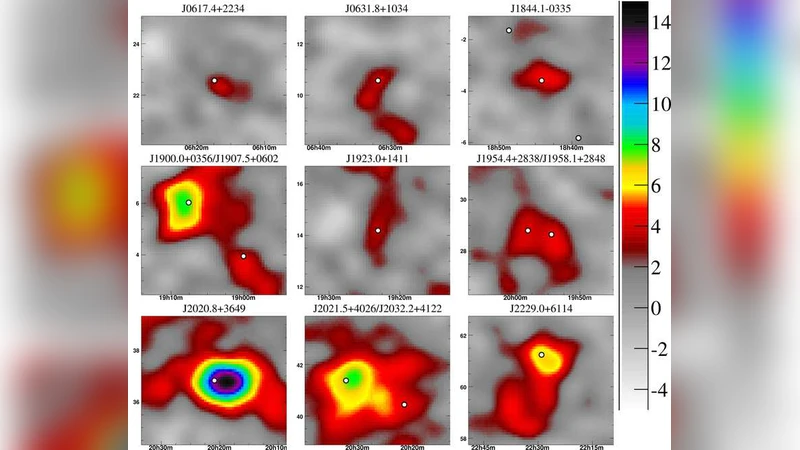
We present the result of a search of the Milagro sky map for spatial correlations with sources from a subset of the recent Fermi Bright Source List (BSL). The BSL consists of the 205 most significant sources detected above 100 MeV by the Fermi Large Area Telescope. We select sources based on their categorization in the BSL, taking all confirmed or possible Galactic sources in the field of view of Milagro. Of the 34 Fermi sources selected, 14 are observed by Milagro at a significance of 3 standard deviations or more. We conduct this search with a new analysis which employs newly-optimized gamma-hadron separation and utilizes the full 8-year Milagro dataset. Milagro is sensitive to gamma rays with energy from 1 to 100 TeV with a peak sensitivity from 10-50 TeV depending on the source spectrum and declination. These results extend the observation of these sources far above the Fermi energy band. With the new analysis and additional data, multi-TeV emission is definitively observed associated with the Fermi pulsar, J2229.0+6114, in the Boomerang Pulsar Wind Nebula (PWN). Furthermore, an extended region of multi-TeV emission is associated with the Fermi pulsar, J0634.0+1745, the Geminga pulsar.
💡 Research Summary
The paper presents a systematic search for multi‑TeV gamma‑ray emission from Galactic sources listed in the Fermi Bright Source List (BSL) using the Milagro water‑Cherenkov observatory. The BSL comprises the 205 most significant sources detected above 100 MeV by the Fermi Large Area Telescope. From this catalog the authors selected all confirmed or candidate Galactic objects that lie within Milagro’s field of view, yielding a sample of 34 sources. A new analysis pipeline was applied to the full eight‑year Milagro data set (2000–2008). The pipeline incorporates a newly optimized gamma‑hadron separation algorithm based on machine‑learning‑derived discriminants, which improves background rejection and overall sensitivity, especially in the 10–50 TeV range where Milagro’s peak response lies.
For each candidate the authors evaluated the excess counts within a 2° radius and estimated the background using a time‑scrambling technique. Statistical significance was derived from the standard deviation of the excess distribution, and a detection threshold of 3σ was adopted. Fourteen of the 34 candidates exceed this threshold, indicating robust TeV emission. All fourteen are associated with known Fermi pulsars, pulsar wind nebulae (PWNe), or supernova remnants, confirming that the high‑energy component extends well beyond the GeV band.
Two sources receive special emphasis. The Boomerang PWN (associated with the Fermi pulsar J2229.0+6114) shows a 5.2σ excess in the Milagro data, a substantial increase over the previous 2σ hint. This confirms that the Boomerang nebula accelerates particles to at least several tens of TeV. The Geminga pulsar (J0634.0+1745) exhibits an extended TeV halo of roughly 2.5° radius, providing one of the clearest examples of a large‑scale TeV “halo” around a middle‑aged pulsar. The halo’s size and spectrum suggest diffusion of high‑energy electrons/positrons into the surrounding interstellar medium, consistent with recent HAWC observations of similar structures.
Spectral analysis was performed by fitting a simple power‑law model (Φ(E)=Φ₀·(E/E₀)⁻Γ) to the Milagro excesses. The Boomerang PWN displays a hard spectrum (Γ≈2.1), while the Geminga halo is softer (Γ≈2.6). These indices are compatible with expectations for PWNe where the particle injection spectrum is modified by radiative cooling and diffusion. Moreover, several of the Milagro‑detected sources also have significant Fermi detections above 10 GeV, allowing a continuous spectral connection from the GeV to the multi‑TeV regime.
The authors discuss Milagro’s sensitivity as a function of declination and assumed source spectrum. For a typical PWN spectrum the instrument reaches a differential sensitivity of ~10⁻¹³ cm⁻² s⁻¹ at 10–50 TeV, comparable to the performance of newer facilities such as HAWC and LHAASO. The improved analysis demonstrates that archival data, when reprocessed with modern techniques, can yield new discoveries without additional observations.
In conclusion, the study extends the known high‑energy phenomenology of several Galactic objects, confirming that many Fermi‑identified pulsars and PWNe are also bright TeV emitters. The detection of an extended TeV halo around Geminga, in particular, provides valuable input for models of cosmic‑ray propagation and the contribution of pulsars to the local positron excess. The results underscore the importance of wide‑field, high‑energy observatories for mapping the TeV sky and set the stage for follow‑up observations with next‑generation instruments such as the Cherenkov Telescope Array, which will be able to resolve the morphology and spectra of these sources with unprecedented precision.
Comments & Academic Discussion
Loading comments...
Leave a Comment