Maximum Entropy Estimation for Survey sampling
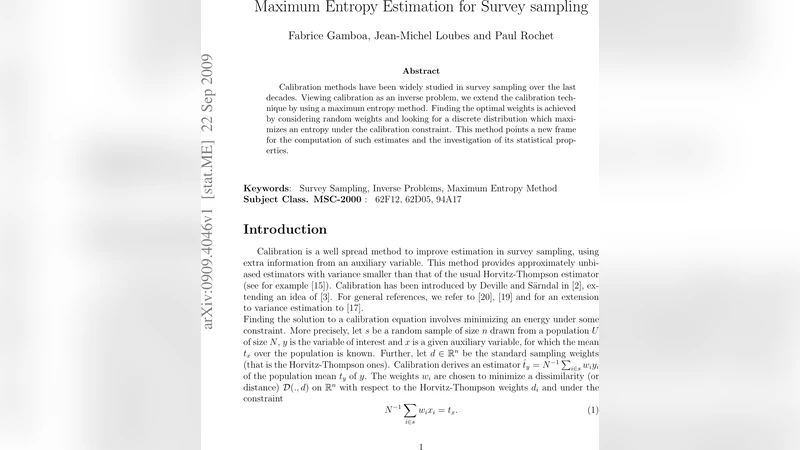
Calibration methods have been widely studied in survey sampling over the last decades. Viewing calibration as an inverse problem, we extend the calibration technique by using a maximum entropy method. Finding the optimal weights is achieved by considering random weights and looking for a discrete distribution which maximizes an entropy under the calibration constraint. This method points a new frame for the computation of such estimates and the investigation of its statistical properties.
💡 Research Summary
The paper revisits the well‑established calibration technique used in survey sampling and proposes a novel framework based on the principle of maximum entropy. Traditional calibration methods treat the problem as a constrained optimization where a set of auxiliary variables is forced to match known population totals by adjusting the sampling weights. These methods typically minimize a chosen loss function (e.g., least squares, chi‑square, or r‑calibration) subject to linear constraints. While effective, they suffer from two major drawbacks: the choice of loss function is often ad‑hoc, and the feasible set of weights may contain many solutions, leaving the practitioner without a principled rule for selecting the “best’’ weights.
The authors recast calibration as an inverse problem: the sampling weights are regarded as random variables with an unknown discrete distribution. The calibration constraints are expressed as expectations under this distribution, i.e., the expected weighted sum of the auxiliary variables must equal the known population totals. Within the class of all discrete distributions that satisfy the constraints, the authors select the one that maximizes Shannon entropy (or a suitable generalization). This maximization embodies the information‑theoretic principle of choosing the least informative distribution consistent with the available information.
Mathematically, the problem is formulated with Lagrange multipliers λ. The entropy‑maximizing distribution belongs to the exponential family and takes the form
\
Comments & Academic Discussion
Loading comments...
Leave a Comment