Multiple positive steady states in subnetworks defined by stoichiometric generators
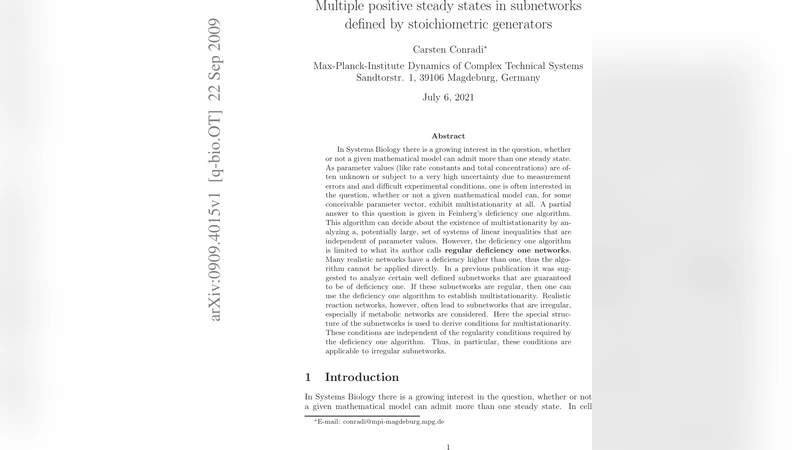
In Systems Biology there is a growing interest in the question, whether or not a given mathematical model can admit more than one steady state. As parameter values are often unknown or subject to a very high uncertainty, one is often interested in the question, whether or not a given mathematical model can, for some conceivable parameter vector, exhibit multistationarity at all. A partial answer to this question is given in Feinberg’s deficiency one algorithm. This algorithm can decide about multistationarity by analyzing systems of linear inequalities that are independent of parameter values. However, the deficiency one algorithm is limited to what its author calls regular deficiency one networks. Many realistic networks have a deficiency higher than one, thus the algorithm cannot be applied directly. In a previous publication it was suggested to analyze certain well defined subnetworks that are guaranteed to be of deficiency one. Realistic reaction networks, however, often lead to subnetworks that are irregular, especially if metabolic networks are considered. Here the special structure of the subnetworks is used to derive conditions for multistationarity. These conditions are independent of the regularity conditions required by the deficiency one algorithm. Thus, in particular, these conditions are applicable to irregular subnetworks.
💡 Research Summary
The paper addresses the fundamental question in systems biology of whether a given biochemical reaction network can exhibit multistationarity – the existence of multiple positive steady states – for some choice of kinetic parameters. Traditional tools, most notably Feinberg’s deficiency‑one algorithm, can answer this question by solving a set of linear inequalities that are independent of the actual parameter values. However, the algorithm is restricted to “regular deficiency‑one” networks, i.e., networks whose deficiency equals one and that satisfy several structural regularity conditions (every complex participates in at least one reaction, the complex graph is weakly reversible, etc.). Realistic metabolic and signaling networks often have higher deficiency and violate these regularity constraints, rendering the classical algorithm inapplicable.
To overcome this limitation, the authors propose a systematic reduction of a high‑deficiency network to a collection of subnetworks that are guaranteed to have deficiency one. The reduction is based on the concept of stoichiometric generators – a minimal set of vectors that span the null‑space of the stoichiometric matrix. By selecting appropriate linear combinations of these generators, one can isolate a subnetwork consisting of a subset of reactions and species whose stoichiometric matrix has exactly one deficiency. Crucially, the resulting subnetworks may be irregular; they need not satisfy the regularity assumptions required by the original deficiency‑one theory.
The core contribution is a new set of linear inequality conditions that determine multistationarity for these irregular, deficiency‑one subnetworks. Assuming mass‑action kinetics, the authors derive inequalities that involve only the signs and relative magnitudes of the reaction rate constants. These inequalities are derived from the structure of the null‑space basis and from the directionality of the reaction fluxes within the subnetwork. If the inequality system admits a positive solution, the subnetwork is guaranteed to possess at least two distinct positive steady states for some choice of kinetic parameters. Importantly, the conditions are completely independent of the regularity constraints of Feinberg’s algorithm; they rely solely on the deficiency‑one property and the stoichiometric structure.
The paper provides a rigorous mathematical proof that the regularity assumptions are unnecessary for the validity of the inequality test. Two key ideas enable this extension: (1) the deficiency‑one property alone ensures that the steady‑state equations reduce to a one‑dimensional affine subspace, and (2) by explicitly accounting for flux orientation, the derived inequalities remain valid even when the complex graph is not weakly reversible or when some complexes are isolated.
To demonstrate practical relevance, the authors apply their method to several biologically motivated models, including a glycolytic pathway and a tricarboxylic acid (TCA) cycle fragment. For each case they (i) compute the stoichiometric matrix, (ii) identify stoichiometric generators, (iii) construct a deficiency‑one subnetwork, and (iv) solve the associated linear inequality system. In all examples a feasible solution is found, confirming that the original high‑deficiency networks can indeed exhibit multistationarity despite failing the regularity tests of the classical algorithm. Numerical simulations of the full kinetic models corroborate the analytical predictions by displaying multiple stable steady states.
The authors also discuss limitations and future directions. The current framework assumes mass‑action kinetics; extending the approach to Michaelis–Menten, Hill, or other rate laws will require additional analysis. Moreover, the selection of generators and the construction of subnetworks are presently performed manually; developing automated algorithms for optimal subnetwork extraction is an open computational challenge. Finally, integrating this subnetwork‑based multistationarity test into larger model‑building pipelines could provide a powerful diagnostic tool for modelers dealing with highly uncertain parameter spaces.
In summary, the paper expands the applicability of deficiency‑based multistationarity analysis beyond regular deficiency‑one networks. By exploiting the special structure of stoichiometric generators, it derives parameter‑independent linear inequality criteria that are valid for irregular subnetworks. This work offers both a theoretical advance in chemical reaction network theory and a practical method for assessing the capacity for multiple steady states in complex biochemical systems.
Comments & Academic Discussion
Loading comments...
Leave a Comment