The stabilization theorem for proper groupoids
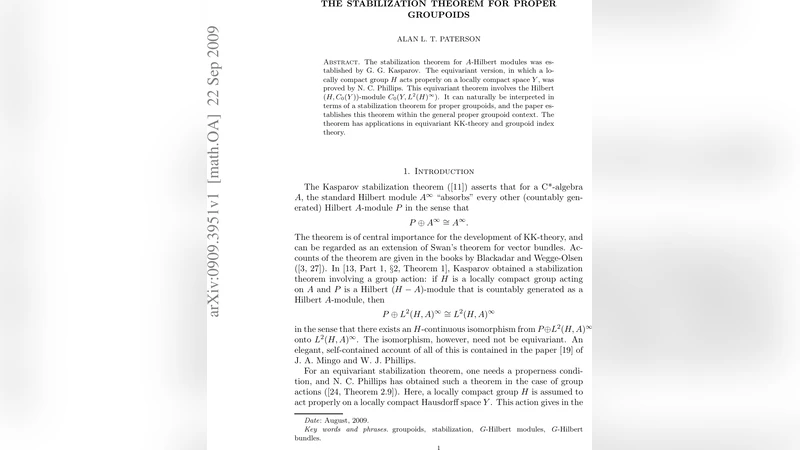
The stabilization theorem for $A$-Hilbert modules was established by G. G. Kasparov. The equivariant version, in which a locally compact group $H$ acts properly on a locally compact space $Y$, was proved by N. C. Phillips. This equivariant theorem involves the Hilbert $(H,C_{0}(Y))$-module $C_{0}(Y,L^{2}(H)^{\infty})$. It can naturally be interpreted in terms of a stabilization theorem for proper groupoids, and the paper establishes this theorem within the general proper groupoid context. The theorem has applications in equivariant KK-theory and groupoid index theory.
💡 Research Summary
The paper establishes a stabilization theorem for Hilbert modules over the C‑algebra of a proper groupoid, thereby extending Kasparov’s original stabilization result for $A$‑Hilbert modules and Phillips’s equivariant version for proper actions of a locally compact group $H$ on a space $Y$. The authors begin by recalling the classical setting: Kasparov proved that for any countably generated Hilbert $A$‑module $E$, the direct sum $E\oplus A\otimes\ell^{2}$ is isomorphic to $A\otimes\ell^{2}$, and Phillips showed that when a group $H$ acts properly on $Y$, the standard equivariant module $C_{0}(Y,L^{2}(H)^{\infty})$ plays the same role.
The central contribution is to replace the pair $(H,Y)$ by a general proper groupoid $G\rightrightarrows G^{(0)}$ equipped with a Haar system ${\lambda^{x}}{x\in G^{(0)}}$. The authors define the canonical $G$‑Hilbert $C{0}(G^{(0)})$‑module $L^{2}(G)$ as the completion of $C_{c}(G)$ with respect to the $C_{0}(G^{(0)})$‑valued inner product \
Comments & Academic Discussion
Loading comments...
Leave a Comment