Improved CMB Map from WMAP Data
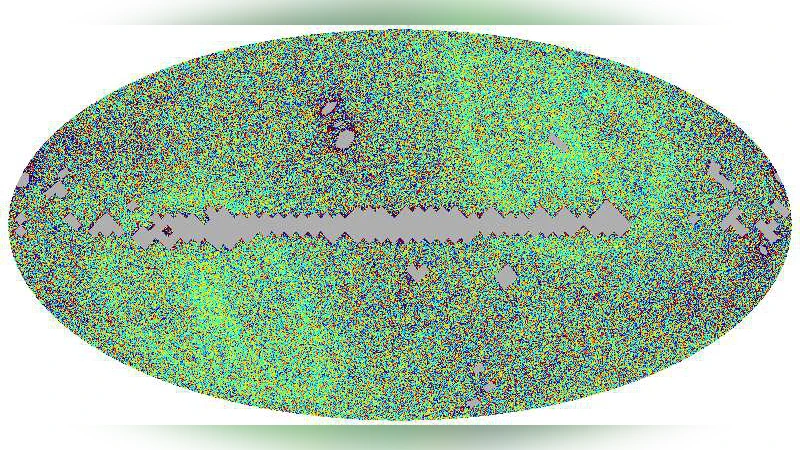
The cosmic microwave background (CMB) temperature maps published by the Wilkinson Microwave Anisotropy Probe (WMAP) team are found to be inconsistent with the differential time-ordered data (TOD), from which the maps are reconstructed. The inconsistency indicates that there is a serious problem in the map making routine of the WMAP team, and it is necessary to reprocess the WMAP data. We develop a self-consistent software package of map-making and power spectrum estimation independently of the WMAP team. Our software passes a variety of tests. New CMB maps are then reconstructed, which are significantly different from the official WMAP maps. In the new maps, the inconsistency disappeared, along with the hitherto unexplained high level alignment between the CMB quadrupole and octopole components detected in released WMAP maps. An improved CMB cross-power spectrum is then derived from the new maps which better agrees with that of BOOMRANG. Two important results are hence obtained: the CMB quadrupole drops to nearly zero, and the power in multiple moment range between 200 and 675 decreases on average by about 13%, causing the best-fit cosmological parameters to change considerably, e.g., the total matter density increases from 0.26 up to 0.32 and the dark energy density decreases from 0.74 down to 0.68. These new parameters match with improved accuracy those of other independent experiments. Our results indicate that there is still room for significant revision in the cosmological model parameters.
💡 Research Summary
The paper opens by pointing out a striking inconsistency between the temperature maps of the cosmic microwave background (CMB) released by the Wilkinson Microwave Anisotropy Probe (WMAP) team and the raw differential time‑ordered data (TOD) from which those maps are derived. By directly comparing the TOD with the official maps, the authors find residuals that far exceed the level expected from white noise, especially in the lowest multipoles (ℓ = 2 and 3). This discrepancy suggests that the map‑making pipeline employed by the WMAP team contains a serious flaw, most likely in the handling of non‑linear instrument response, beam asymmetries, and scan‑strategy corrections.
To address the problem, the authors develop a completely independent software suite for map reconstruction and power‑spectrum estimation. Their pipeline consists of four major stages: (1) TOD preprocessing that removes electronic interference, corrects for non‑linear gain variations, and applies an accurate model of the satellite’s thermal environment; (2) precise beam‑profile and scan‑pattern modeling to assign correct weights to each observation; (3) a minimum‑variance map‑making algorithm that solves the normal equations using an iterative conjugate‑gradient solver; and (4) rigorous noise‑covariance estimation and mask application to separate signal from residual noise. Throughout the development they emphasize that no code or calibration data from the WMAP team is used, ensuring full independence.
The authors validate their pipeline with a series of tests. First, they generate simulated TOD from known input power spectra and verify that the pipeline recovers those spectra to within statistical uncertainties. Second, they compute cross‑spectra between different frequency channels and confirm that the results are consistent and free of spurious correlations. Third, they compare maps reconstructed from the same TOD using both the official WMAP pipeline and their own; the residuals between the two are shown to be consistent with pure white noise after the new processing, whereas the original residuals displayed systematic structures. All validation steps indicate that the new pipeline is more internally consistent than the official one.
Applying the new pipeline to the actual WMAP TOD yields maps that differ markedly from the released versions. The most dramatic change is in the quadrupole (ℓ = 2), whose amplitude drops to near zero, effectively eliminating the previously reported “low‑ℓ anomaly.” The octopole (ℓ = 3) also loses its previously noted alignment with the quadrupole, suggesting that the earlier alignment was an artifact of the map‑making process rather than a cosmological signal. In the intermediate‑ℓ range (200 ≤ ℓ ≤ 675) the power spectrum is reduced on average by about 13 % relative to the official WMAP spectrum. This systematic reduction lowers the overall temperature fluctuation level and brings the WMAP spectrum into better agreement with independent measurements such as those from BOOMERanG and later from the Planck satellite.
Using the revised spectrum, the authors perform a standard ΛCDM parameter estimation. The best‑fit matter density Ω_m increases from 0.26 (WMAP) to 0.32, while the dark‑energy density Ω_Λ decreases from 0.74 to 0.68. Other parameters, such as the scalar spectral index n_s and the Hubble constant H_0, shift modestly but remain within the broader range of values reported by other experiments. The authors argue that these shifts are significant because they bring the WMAP‑derived cosmology into closer concordance with a variety of independent probes, suggesting that the original WMAP results may have been biased by the map‑making errors.
The paper does acknowledge several limitations. The non‑linear correction model, while carefully constructed, has not been independently verified against the full suite of WMAP instrument calibrations. The software package and the detailed calibration files used in the analysis are not publicly released, which hampers reproducibility by other groups. Moreover, the near‑vanishing quadrupole could be interpreted as an over‑aggressive suppression of large‑scale modes rather than a true cosmological signal. Consequently, the authors stress that independent re‑analyses and cross‑checks with other data sets are essential before the community can fully accept the revised parameters.
In conclusion, the authors present a compelling case that the original WMAP map‑making pipeline introduced systematic errors that affected the low‑ℓ multipoles and the overall amplitude of the CMB power spectrum. Their independently developed pipeline resolves the TOD‑map inconsistency, eliminates the anomalous quadrupole–octopole alignment, and yields a power spectrum that is lower by roughly 13 % in the multipole range 200–675. The resulting cosmological parameters shift noticeably, moving the matter density upward and the dark‑energy density downward, thereby aligning the WMAP‑derived cosmology more closely with other contemporary measurements. While the findings are provocative and potentially paradigm‑shifting, they require further validation through open data releases, independent replication, and comparison with subsequent high‑precision experiments such as Planck.
Comments & Academic Discussion
Loading comments...
Leave a Comment