Some equivariant constructions in noncommutative algebraic geometry
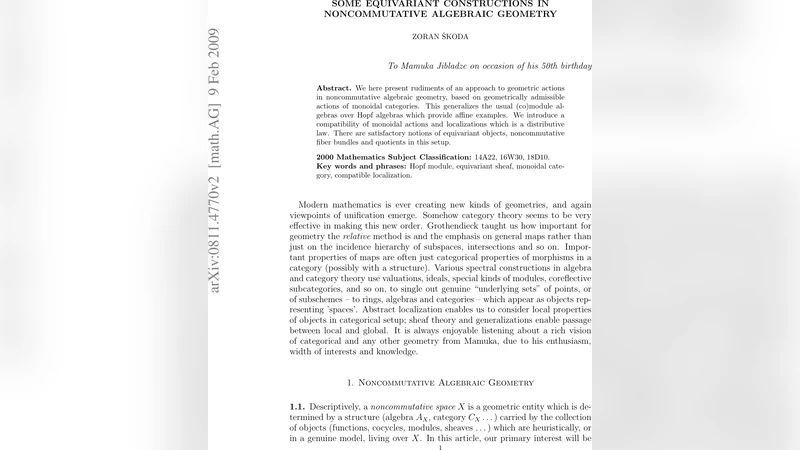
We here present rudiments of an approach to geometric actions in noncommutative algebraic geometry, based on geometrically admissible actions of monoidal categories. This generalizes the usual (co)module algebras over Hopf algebras which provide affine examples. We introduce a compatibility of monoidal actions and localizations which is a distributive law. There are satisfactory notions of equivariant objects, noncommutative fiber bundles and quotients in this setup.
💡 Research Summary
The paper develops a categorical framework for equivariant constructions in non‑commutative algebraic geometry that goes far beyond the classical Hopf‑algebra setting. The authors begin by observing that (co)module algebras over a Hopf algebra H provide only a narrow class of examples of equivariant non‑commutative spaces. To obtain a more flexible theory they replace the Hopf algebra by an arbitrary monoidal category 𝒞 and study “geometrically admissible” actions of 𝒞 on non‑commutative algebras or, equivalently, on the associated non‑commutative schemes.
A central technical contribution is the introduction of a compatibility condition between a 𝒞‑action and the process of localization. For a given object X equipped with a 𝒞‑action, one can form an Ore‑type localization L(X). The authors require a natural transformation η: 𝒞⊗L ⇒ L⊗𝒞 satisfying the usual Beck distributive‑law coherence diagrams. This distributive law guarantees that the action can be “lifted’’ to the localized object, so that equivariance survives passage to open sub‑schemes in the non‑commutative sense.
With this machinery in place, the paper defines equivariant objects as 𝒞‑modules (or 𝒞‑comodules) in the category of non‑commutative algebras that are stable under localization. The authors verify that tensor products, internal Homs, and other standard constructions respect both the 𝒞‑action and the localization, thereby providing a robust internal calculus for equivariant geometry.
The next major development is the notion of a non‑commutative fiber bundle. Given a base non‑commutative space B and a total space E equipped with a free and surjective 𝒞‑action, the pair (E→B) is called a 𝒞‑bundle. Fibers are identified with the orbits of the action, and the bundle satisfies a non‑commutative analogue of the usual local triviality condition thanks to the admissibility of the action. Concrete examples include quantum principal bundles arising from coactions of quantum groups and their localizations.
Finally, the authors construct quotients (or non‑commutative stacks) by forming the coequalizer of the action map and the projection map, again using the distributive law to ensure that the quotient inherits a well‑behaved localization structure. In the special case where 𝒞=Rep(H) for a Hopf algebra H, the quotient coincides with the classical ring of coinvariants, showing that the new theory truly extends the familiar Hopf‑algebra picture.
The paper concludes with several illustrative examples: (i) the recovery of ordinary Hopf‑module algebra theory, (ii) actions of the representation categories of quantum groups U_q(g), and (iii) higher‑categorical actions coming from 2‑algebras. These examples demonstrate that the framework accommodates a wide variety of symmetry types, ranging from ordinary groups to quantum groups and even higher categorical symmetries.
Overall, the work provides a systematic, category‑theoretic approach to equivariant non‑commutative geometry. By isolating the essential distributive law between monoidal actions and localizations, it offers a unifying language for equivariant objects, non‑commutative fiber bundles, and quotients, and opens the door to further developments such as non‑commutative stack cohomology, classification of equivariant modules, and applications to quantum field theories with non‑commutative symmetry.
Comments & Academic Discussion
Loading comments...
Leave a Comment