Three-dimensional conceptual model for service-oriented simulation
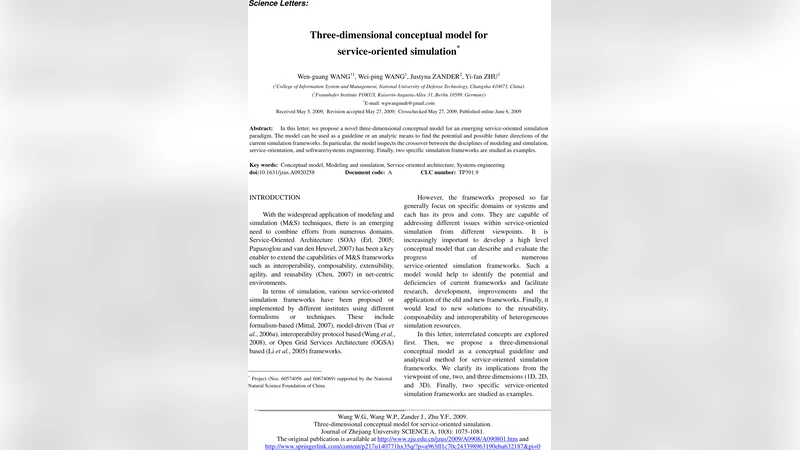
In this letter, we propose a novel three-dimensional conceptual model for an emerging service-oriented simulation paradigm. The model can be used as a guideline or an analytic means to find the potential and possible future directions of the current simulation frameworks. In particular, the model inspects the crossover between the disciplines of modeling and simulation, service-orientation, and software/systems engineering. Finally, two specific simulation frameworks are studied as examples.
💡 Research Summary
The paper introduces a three‑dimensional conceptual model designed to structure and evaluate the emerging service‑oriented simulation (SOS) paradigm. The authors begin by outlining the limitations of traditional simulation frameworks—namely, limited reusability, scalability constraints, and cumbersome engineering processes—and argue that a service‑oriented approach can address these issues.
The model consists of three orthogonal axes. The first axis, Modeling & Simulation (M&S), encompasses modeling languages, simulation algorithms, verification and validation (V&V) procedures, and result‑analysis tools, thereby ensuring scientific accuracy and reliability. The second axis, Service‑Orientation, treats each simulation capability as an independent service, exposing standardized interfaces (e.g., REST, gRPC) and leveraging service registries for dynamic discovery and composition. Key concerns on this axis include service contracts, Service Level Agreements (SLAs), and composition patterns. The third axis, Software/Systems Engineering, covers requirements management, architectural design, quality assurance, continuous integration/continuous deployment (CI/CD), and operational monitoring, providing lifecycle governance that keeps services and models coherent.
Crucially, the three dimensions are not isolated; they interact bidirectionally. For instance, a model’s fidelity on the M&S axis must align with the interface schema defined on the Service‑Orientation axis, and this alignment is verified through the testing and quality metrics prescribed on the Engineering axis. To visualize these interactions, the authors map existing simulation frameworks onto a three‑dimensional coordinate space, representing each framework as a point or plane. This visual mapping reveals strengths, weaknesses, and gaps, guiding future research directions.
Two representative frameworks are examined as case studies. The first is a traditional High‑Level Architecture (HLA)‑based simulation framework, which excels on the M&S axis with rich standards for model representation and time management but suffers on the Service‑Orientation axis due to static federation structures and limited dynamic service composition. The second is a cloud‑native, microservice‑based simulation platform that shines on the Service‑Orientation axis by offering high reusability, automatic scaling, and flexible deployment, yet it lacks mature, standardized V&V processes on the M&S axis, raising concerns about model trustworthiness. Both frameworks implement CI/CD pipelines, but they differ in test coverage depth and monitoring sophistication, reflecting divergent maturity levels on the Engineering axis.
From this comparative analysis, the authors derive several insights. First, integrating service orientation requires careful alignment with existing M&S standards; explicit meta‑data definitions and service contracts are essential to avoid incompatibilities. Second, robust engineering practices—automated quality assurance, continuous monitoring, and feedback loops—are vital to maintain consistency between services and underlying models. Third, the three‑dimensional model itself serves as a design guideline, helping architects balance trade‑offs across the three axes when creating new SOS solutions. Finally, the paper highlights future research avenues: standardizing meta‑data for model‑service interoperability, developing runtime environments that support dynamic service composition, and leveraging AI‑driven automated model verification.
In conclusion, the proposed three‑dimensional conceptual model offers a systematic lens for both scholars and practitioners to assess the current state of service‑oriented simulation, identify gaps, and chart a coherent roadmap for advancing the field.
Comments & Academic Discussion
Loading comments...
Leave a Comment