Direct search for exact solutions to the nonlinear Schroedinger equation
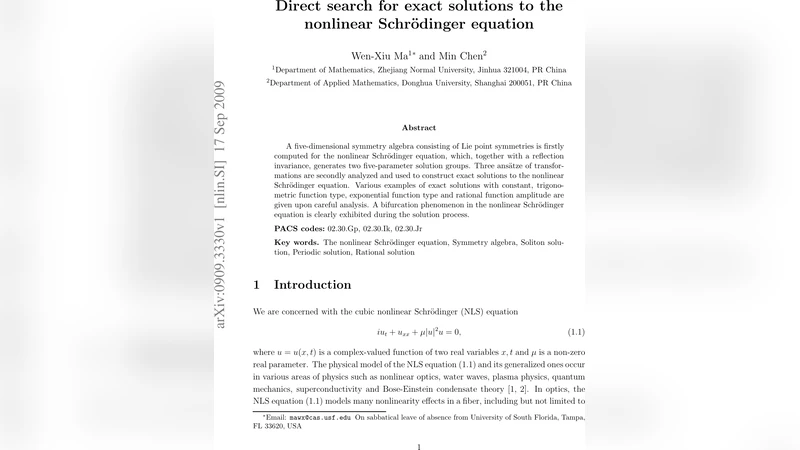
A five-dimensional symmetry algebra consisting of Lie point symmetries is firstly computed for the nonlinear Schroedinger equation, which, together with a reflection invariance, generates two five-parameter solution groups. Three ansaetze of transformations are secondly analyzed and used to construct exact solutions to the nonlinear Schroedinger equation. Various examples of exact solutions with constant, trigonometric function type, exponential function type and rational function amplitude are given upon careful analysis. A bifurcation phenomenon in the nonlinear Schroedinger equation is clearly exhibited during the solution process.
💡 Research Summary
The paper presents a systematic method for constructing exact solutions of the one‑dimensional nonlinear Schrödinger equation (NLSE)
( i\psi_t + \psi_{xx} + 2|\psi|^2\psi = 0 ).
First, the authors perform a Lie point‑symmetry analysis and obtain a five‑dimensional symmetry algebra. The generators correspond to time translation, space translation, phase rotation, scaling (which simultaneously rescales time, space and the field amplitude), and a complex‑conjugation type transformation. These operators close under commutation and leave the NLSE invariant. In addition, a discrete reflection symmetry ((x\to -x,;\psi\to\psi^*)) is identified. By combining the continuous Lie group with the reflection, two distinct five‑parameter solution groups are formed. Each group provides a set of transformation formulas that map any known solution into a new one, with five independent parameters controlling shifts, phase, scaling, and sign changes.
Next, three ansätze are introduced to reduce the PDE to ordinary differential equations (ODEs) or algebraic relations. The first ansatz separates amplitude and phase, (\psi=R(x,t)\exp
Comments & Academic Discussion
Loading comments...
Leave a Comment