Non-equilibrium thermodynamics of gene expression and transcriptional regulation
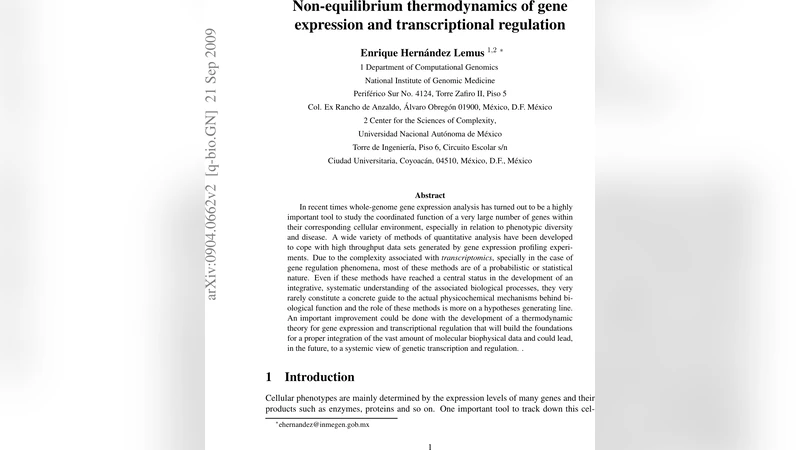
In recent times whole-genome gene expression analysis has turned out to be a highly important tool to study the coordinated function of a very large number of genes within their corresponding cellular environment, especially in relation to phenotypic diversity and disease. A wide variety of methods of quantitative analysis have been developed to cope with high throughput data sets generated by gene expression profiling experiments. Due to the complexity associated with transcriptomics, specially in the case of gene regulation phenomena, most of these methods are of a probabilistic or statistical nature. Even if these methods have reached a central status in the development of an integrative, systematic understanding of the associated biological processes, they very rarely constitute a concrete guide to the actual physicochemical mechanisms behind biological function and the role of these methods is more on a hypotheses generating line. An important improvement could be done with the development of a thermodynamic theory for gene expression and transcriptional regulation that will build the foundations for a proper integration of the vast amount of molecular biophysical data and could lead, in the future, to a systemic view of genetic transcription and regulation.
💡 Research Summary
The paper proposes a novel theoretical framework that treats gene expression and transcriptional regulation as non‑equilibrium thermodynamic processes. It begins by highlighting the rapid growth of high‑throughput transcriptomics, which now allows simultaneous measurement of thousands of genes, but points out that most analytical tools are probabilistic or statistical in nature. While such methods excel at pattern recognition and hypothesis generation, they rarely provide insight into the underlying physicochemical mechanisms that drive transcription. The authors argue that a rigorous thermodynamic description is essential for integrating the wealth of biophysical data now available and for moving toward a systemic, quantitative understanding of genetic regulation.
To this end, the authors construct a mathematical model grounded in the principles of non‑equilibrium thermodynamics. Binding of transcription factors (TFs) to promoter DNA is treated as a reversible chemical reaction (TF + DNA ⇌ TF·DNA) characterized by an association rate k_on, a dissociation rate k_off, and an equilibrium dissociation constant K_d that can be measured experimentally by surface plasmon resonance or isothermal titration calorimetry. The initiation of transcription is modeled as an energy‑driven step that consumes high‑energy nucleotides (ATP, GTP), introducing a free‑energy change ΔG_transcription that drives the system away from equilibrium. The subsequent steps—RNA polymerase elongation, mRNA processing, and degradation—are represented as a cascade of irreversible reactions, each associated with its own rate constant and entropy production term. By writing master equations for the probability distribution of each molecular species, the authors derive expressions for the net entropy production σ and the energy flux Φ that maintain the system in a steady‑state non‑equilibrium condition.
A key strength of the framework is its direct link to measurable physical quantities. The model can be parametrized using experimentally determined binding free energies, transcription initiation rates obtained from real‑time PCR or nascent‑RNA sequencing, and mRNA half‑life measurements. Once calibrated, the model predicts not only steady‑state expression levels but also the thermodynamic cost (in terms of ATP consumption and entropy production) associated with maintaining those levels. This enables a quantitative comparison of different regulatory architectures—such as activator‑driven versus repressor‑driven networks—on a common energetic footing.
The authors apply the theory to several biological scenarios. In stress‑response pathways, rapid activation of TFs lowers ΔG_transcription, leading to a transient surge in entropy production that matches observed spikes in metabolic activity. In cancer cells, chronic dysregulation of repressors results in persistently high non‑equilibrium fluxes, reflecting the elevated energetic demands of uncontrolled proliferation. The framework also offers practical guidance for synthetic biology: by specifying a desired expression output, one can back‑calculate the required binding affinity and energy input, thereby informing promoter design and TF engineering.
In the discussion, the paper emphasizes that non‑equilibrium thermodynamics provides a mechanistic bridge between molecular biophysics and systems‑level gene regulation, complementing statistical learning approaches rather than replacing them. It outlines future directions, including extending the model to multi‑gene networks with feedback loops, incorporating cellular micro‑environmental variables (pH, ion concentrations), and developing experimental protocols to directly measure entropy production in living cells (e.g., using calorimetry or fluorescence‑based reporters).
Overall, the work argues that a thermodynamically grounded description of transcription can transform our understanding of how cells allocate energy to control gene expression, offering a unified language for interpreting diverse high‑throughput data sets and for designing energy‑efficient synthetic regulatory circuits.
Comments & Academic Discussion
Loading comments...
Leave a Comment