Detecting codimension one manifold factors with topographical techniques
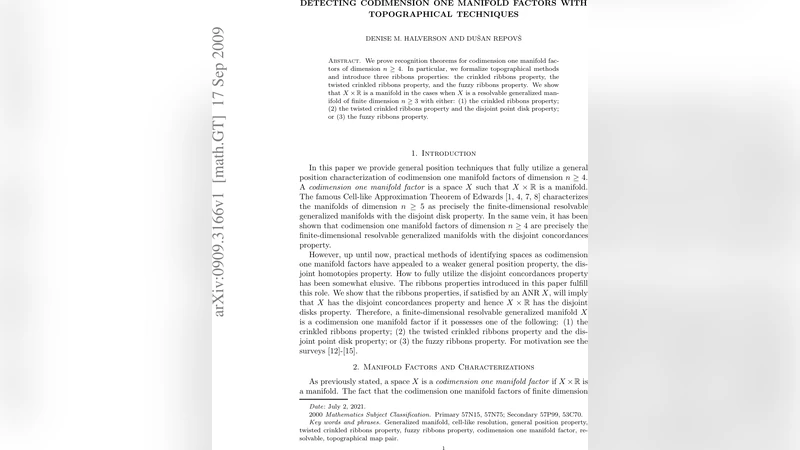
We prove recognition theorems for codimension one manifold factors of dimension $n \geq 4$. In particular, we formalize topographical methods and introduce three ribbons properties: the crinkled ribbons property, the twisted crinkled ribbons property, and the fuzzy ribbons property. We show that $X \times \mathbb{R}$ is a manifold in the cases when $X$ is a resolvable generalized manifold of finite dimension $n \geq 3$ with either: (1) the crinkled ribbons property; (2) the twisted crinkled ribbons property and the disjoint point disk property; or (3) the fuzzy ribbons property.
💡 Research Summary
The paper addresses the long‑standing problem of recognizing when a space $X$ is a codimension‑one manifold factor, i.e., when the product $X\times\mathbb R$ is a genuine $(n+1)$‑dimensional manifold. Building on earlier work that used disjointness properties such as the Disjoint Disk Property (DDP) and the Disjoint Point‑Disk Property (DPDP), the authors develop a systematic “topographical” framework that replaces isolated disk embeddings with families of thin, ribbon‑like 2‑disks. Within this framework three new ribbon conditions are introduced: the Crinkled Ribbons Property (CRP), the Twisted Crinkled Ribbons Property (TCRP), and the Fuzzy Ribbons Property (FRP).
CRP requires that any two embedded disks can be thickened into narrow ribbons that can be positioned without intersecting each other; this is sufficient when $n\ge4$. TCRP relaxes the geometry by allowing a controlled twist of the ribbons; when combined with DPDP it yields a recognition theorem for resolvable generalized manifolds of dimension $n\ge3$. FRP is the most flexible condition: it tolerates a bounded amount of “fuzziness’’ along the ribbon boundaries, thereby encompassing both CRP and TCRP as special cases.
The main theorems state that if a resolvable generalized manifold $X$ of finite dimension $n\ge3$ satisfies any one of these ribbon properties (with the additional DPDP hypothesis in the TCRP case), then $X\times\mathbb R$ is an $(n+1)$‑manifold. The proofs proceed by constructing explicit local charts in $X\times\mathbb R$ via a sequence of ribbon expansions, untwisting, and smoothing operations, showing that the resulting neighborhoods are homeomorphic to Euclidean space. The authors also verify that several classical examples—cellular manifolds, ANR manifolds, and certain non‑manifold resolutions—indeed satisfy the appropriate ribbon condition, thereby extending the class of known codimension‑one factors.
Beyond the technical results, the paper highlights the broader impact of these ribbon techniques: they provide a unified language for handling high‑dimensional embedding problems, suggest new avenues for weakening separation hypotheses, and open the possibility of applying similar ideas to lower dimensions ($n=2,3$) where exotic phenomena occur. Future work is proposed to explore further generalizations of the ribbon conditions and to investigate their interaction with other topological invariants such as shape theory and controlled topology.
Comments & Academic Discussion
Loading comments...
Leave a Comment