Idempotent monads and $star$-functors
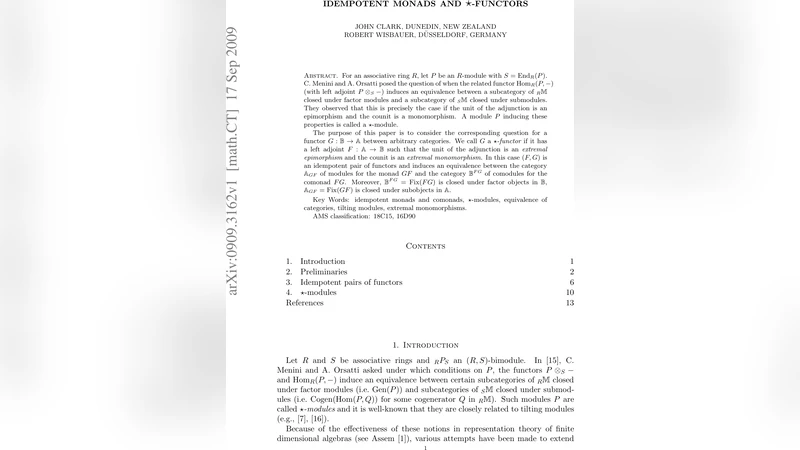
For an associative ring $R$, let $P$ be an $R$-module with $S=\End_R(P)$. C.\ Menini and A. Orsatti posed the question of when the related functor $\Hom_R(P,-)$ (with left adjoint $P\ot_S-$) induces an equivalence between a subcategory of $R\M$ closed under factor modules and a subcategory of $S\M$ closed under submodules. They observed that this is precisely the case if the unit of the adjunction is an epimorphism and the counit is a monomorphism. A module $P$ inducing these properties is called a $\star$-module. The purpose of this paper is to consider the corresponding question for a functor $G:\B\to \A$ between arbitrary categories. We call $G$ a {\em $\star$-functor} if it has a left adjoint $F:\A\to \B$ such that the unit of the adjunction is an {\em extremal epimorphism} and the counit is an {\em extremal monomorphism}. In this case $(F,G)$ is an idempotent pair of functors and induces an equivalence between the category $\A{GF}$ of modules for the monad $GF$ and the category $\B^{FG}$ of comodules for the comonad $FG$. Moreover, $\B^{FG}=\Fix(FG)$ is closed under factor objects in $\B$, $\A{GF}=\Fix(GF)$ is closed under subobjects in $\A$.
💡 Research Summary
The paper revisits the classical notion of a ★‑module introduced by Menini and Orsatti and lifts it to a completely categorical setting. For a ring R and an R‑module P with endomorphism ring S = End_R(P), the adjoint pair (P ⊗_S –, Hom_R(P,–)) satisfies that the unit η : Id → GF is an epimorphism and the counit ε : FG → Id is a monomorphism precisely when P is a ★‑module. In that case the functor Hom_R(P,–) induces an equivalence between a subcategory of left R‑modules closed under factor modules and a subcategory of left S‑modules closed under submodules.
The authors abstract this situation to arbitrary categories 𝔄 and 𝔅 equipped with an adjunction F ⊣ G (F : 𝔄 → 𝔅, G : 𝔅 → 𝔄). They introduce the concepts of extremal epimorphism and extremal monomorphism: a morphism e is an extremal epi if it is epi and whenever e = m ∘ f with m a monomorphism, then m must be an isomorphism; dually, a morphism m is an extremal mono if it is mono and any factorisation m = g ∘ e with e an epi forces e to be an iso. A functor G is called a ★‑functor when the unit η of the adjunction is an extremal epi and the counit ε is an extremal mono.
The central theorem proves that a ★‑functor automatically yields an idempotent adjoint pair: the monad T = GF and the comonad C = FG are idempotent (T² ≅ T, C² ≅ C). Consequently, the categories of T‑modules (Fix(T)) and C‑comodules (Fix(C)) are equivalent, with F and G restricting to mutually inverse equivalences between them. Moreover, Fix(C) is closed under quotients (factor objects) in 𝔅, while Fix(T) is closed under subobjects in 𝔄. The proof proceeds by exploiting the extremal nature of η and ε to show that any T‑algebra structure is uniquely determined by a subobject of its underlying object, and similarly any C‑coalgebra structure is uniquely determined by a quotient.
After establishing the abstract theory, the paper demonstrates that the classical ★‑module situation is a special case: taking 𝔄 = _RMod, 𝔅 = _SMod, F = P ⊗_S –, G = Hom_R(P,–) reproduces the original conditions. Additional examples are provided to illustrate the breadth of the concept: (i) the arrow category Arr(𝒞) with domain and codomain functors, (ii) the free‑forgetful adjunction for comonadic categories, and (iii) certain duality functors in topos theory. In each case the unit and counit satisfy the extremal conditions, leading to subcategories closed under the appropriate sub‑ or quotient‑operations.
The authors conclude by emphasizing that ★‑functors give a clean categorical criterion for when a monad/comonad pair induces an equivalence between “fixed‑point” subcategories, generalising the module‑theoretic picture. They suggest future work on characterising the existence of ★‑functors in concrete algebraic or topological contexts, and on extending the framework to higher‑category or ∞‑categorical settings, where analogous extremality conditions might control homotopical idempotence.
Comments & Academic Discussion
Loading comments...
Leave a Comment