Moving Lemma for additive Chow groups and applications
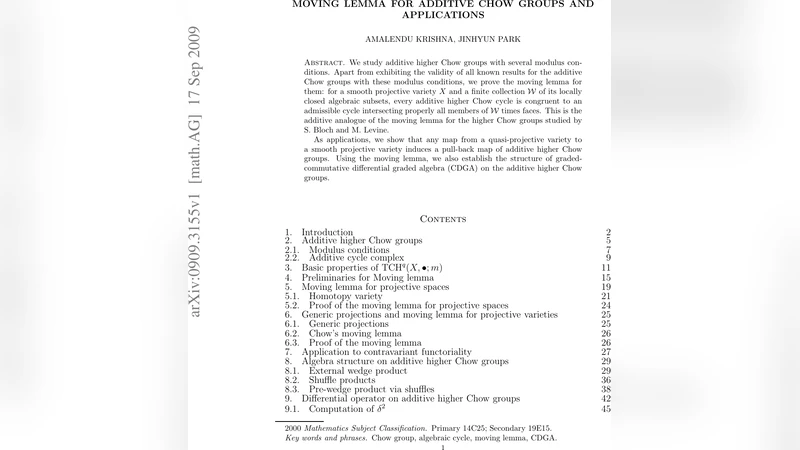
We prove moving lemma for additive higher Chow groups of smooth projective varieties. As applications, we prove the very general contravariance property of additive higher Chow groups. Using the moving lemma, we establish the structure of graded-commutative differential graded algebra (CDGA) on these groups.
💡 Research Summary
The paper establishes a comprehensive framework for additive higher Chow groups, extending the classical theory of higher Chow groups by incorporating an additive parameter that endows the groups with differential‑like structure. The authors begin by recalling the definition of the additive cycle complex (Z^{}_{\mathrm{add}}(X,r)) for a smooth projective variety (X) over a field (k), where the parameter (t) lives in the affine line (\mathbb{A}^{1}). The associated homology groups (CH^{}_{\mathrm{add}}(X,r)) inherit a grading by the usual codimension and an extra “additive” grading given by the power of (t).
The central technical achievement is a moving lemma for these groups (Theorem 2.1). The lemma asserts that any additive cycle can be moved, via a combination of a generic linear automorphism of the ambient projective space and a translation in the additive parameter, to a cycle that meets all prescribed closed subsets of (X) properly. The proof proceeds in two stages. First, a generic translation in the (t)‑direction is used to achieve transversality with respect to the additive divisor ({t=0}). Second, a generic linear change of coordinates on (X) (realised by an element of (GL_{N}(k)) after embedding (X) into (\mathbb{P}^{N})) forces proper intersection with any finite collection of subvarieties. The argument relies on standard flattening techniques, generic smoothness, and the classical moving lemma for ordinary higher Chow groups, but it is carefully adapted to respect the extra additive structure.
Armed with the moving lemma, the authors prove a very general contravariance property (Theorem 3.5). For any regular morphism (f\colon Y\to X) between smooth projective varieties, there exists a well‑defined pull‑back homomorphism \
Comments & Academic Discussion
Loading comments...
Leave a Comment